Author H.G. Potter is an illustrator and classicist. He was elevated to the priesthood in 2009.
H.G. Potter has written and published five books set in the epic milieu of Whitehawk. His latest work is a collection of short stories. Even these he writes in a certain epic style which he claims to draw from the shared memory of civilization.
The author had early occupation teaching Greek Drama and Mythology at WSU and local colleges. The first fiction work he completed was The DeepTracker's Guide, which was followed by The Fall of Nystol and Sage of the Eldark, all derived from an original 1988 manuscript
At the age of 33, H. G. Potter responded to the call to the priesthood. He studied the old Latin Mass and finished his studies at a National Seminary of in Boston and was ordained in 2009.
We sat down with Fr. Potter to explain his thoughts on seemingly divergent things: wizardry and Catholicism.
CM: Why did you start writing these novels? What was the inspiration for your stories?
Father Potter: Originally I wrote the manuscript in 1988 to describe an imaginary world. The writing was mysterious, but I was unable to complete it, refine it, or even at that time understand where it was headed.
Later, in subsequent years, the "Harry Potter" books were becoming famous. Happily, I returned to the developing my writing skills.
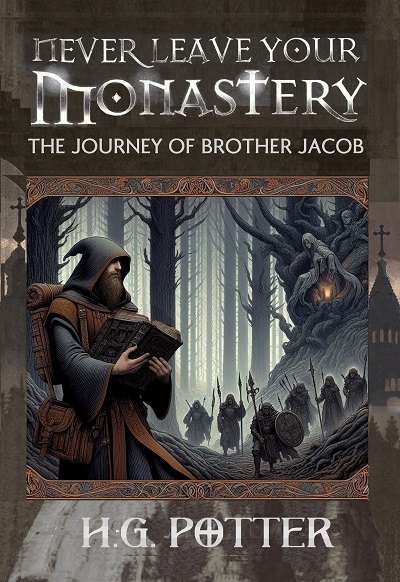
I went back to my manuscript and started to re-furbish the work, writing stories from a traditional ecclesiatical perspective, preserving what was already written and making it work as a real story. it was a worthy endeavor when pausing from the long years of study in Seminary. The seminary experiences also informed my thought. It was especially helpful for Never Leave Your Monastery.
CM: Can you describe the overall feel of the stories (without a spoiler)?
Fr. HP: The themes of the works are the familiar medieval and ancient kind that you might find in many classic works. Epic can serve as a kind of compendium of wisdom and thought, a vessel for culture. My work is meant to convey some of the Christian and pre-Christian foundations of imagination, of mythology and of philosophy. One of the most important themes is Faith vs. Magic.
The stories take place on a lost continent of Earth, lands which had been colonized by the Ancient Egyptians, Greeks, Romans and Medievals.
CM: Is there any symbolism or special meanings in the names or places?
Fr. HP: Certainly there is a kind of verbal symbolism. Certain cities on the lost continent correspond to certain civilizations. Regulum, for example, is where the Romans settled, Hermopolis is similar to Alexandria, Vesulum is for Jerusalem. There is a mountain of God, like Sion, called Arginuzial upon which Christ rules as king; it is a pilgrimage site for the Christian kingdoms. He is called "The Furth High King." Characters also represent biblical or historic figures, or even are prophetic.
As far as fantasy writing, I depart from J.R.R. Tolkien in my approach and probably have more in common with C.s. Lewis, who wrote in a medieval technique of allegory. So I do not say that these are "fantasy" (save for genre placement), but rather "Medieval Imagination"
There is no overt religion in Tolkien because he wants to maintain the story-mode of folktale and "once upon a time" His work points to the perenniel truths of human destiny. That's good, but we also need to believe in the efficacy of sign and ritual, that the numinous enters our reality and our history, life is not just reality vs fantasy, but the two collide in imagination-epic. Just as is found in Homer, Vergil, and Dante. Originally 19th century readers thought that Troy was but a figment of poetic imagination. Now we know it actually existed.
My works also are inspired by Howard's works, stories in which there is religion, and religious cults, which making it feel more like the real ancient world. To exclude Christ and his church from my imagination I could do, I could not design an imaginary continent that did not at leastvknow of the Church. That is unhealthy fantasy. This storytelling includes the Church as a reality counterpoised to the occult and institutionalized magic. So there is not just allusions to God and issues surrounding God, but the characters actually explicitly talk about these things —about faith or the consequences of disbelief, the miraculous and the mysterious.
In the Realms of Whitehawk, the "Ammouric Rite" of the Catholic Church and its governing arm of the Soothfold is something for the wizards to reckon with, but it is also the Medieval Church with all its secular authority and interior corruptions of clerics and monks.
CM: You mentioned that your book the Fall of Nystol is meant for readers that are obsessed with fantasy worlds. Is it bad to sort-of "live" in fantasy worlds?
Fr. HP: Certainly, it's not so healthy to mentally sojourn too long in a fantasy world. Nevertheless some people may not know how to cope with their present reality, especially if they have no potent spirituality to counterpoise and give strength. Reality, especially God's creation, has so much to offer. Therefore the best fantasy imitates reality. Some fantasy, if it contradicts reality and supplies evil contemplations, is truly dangerous. You can see this in Howard's work. Conan the hero has only natural virtues, but not faith, hope and charity. The stories do sometimes seem to teach that might makes right. Howard was acutely anti-religious and atheistic in tone, eventhough Conan his hero did have a personal religion, Crom as his deity. Nevertheless I loved Howard's honest expression of the pre-christian world, but not the morality. So his work is appreciated. Howard was truthful to history, and his writing is quite good. I have designed a hero to parallel Howard's Conan, not physically, but who is Christian, and a monk, who is weak in many ways, but wants to be virtuous and not self-serving.
Fantasy may become a time-out zone for those who have been wounded or experience a kind of melancholy or angst. My writing features what is morally good and virtuous for us to encounter in story and excludes unhealthy lessons or images, or at least exposes them. Its also a way of talking about the world we are presently living in, which certainly, and very powerfully, a world of Sword and Sorcery. You can see also the disenchantment with modernism and post-modernism driving youth not only to imaginary constructs for a kind of false emotionalism, but even to the addictive virtual reality of computer game worlds in which pseudo-relationships and violence are the supreme enjoyments. This is diabolical.
CM: How can readers escape from an unhealthy obsession with a fantasy world?
Fr. HP: Well, since fantasy is a kind of escape in itself, the answer is not further escape, but integrating fantasy into reality. For young people, this means first and foremost to accept who they are and how God made them and to have an appropriate self-love. It is impossible to love others without this.
Inordinate self-love leads to sin, but so does self-loathing. This is one of the reasons I wrote the book Never Leave Your Monastery. It is a vehicle for acceptance of self, and I think I share this in common with Tolkien.
CM: How do you balance the fantasy world with the Catholic faith?
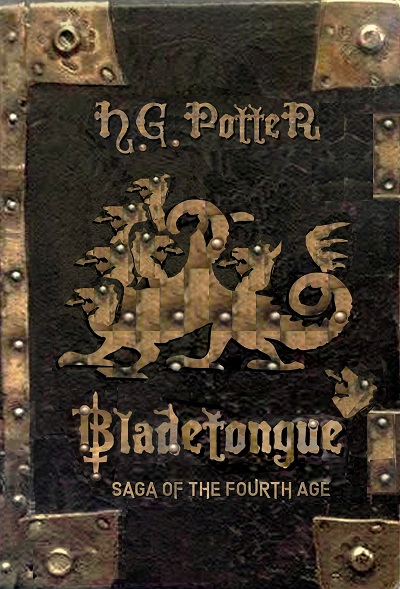
Fr. HP: There is no need to balance it, for the ancient hero story is ultimately a call to conversion, which my epic "Bladetongue" demonstrates. Part of the tension that exists in this writing has to do with bringing the reader to a kind of realization that fantasy is derived from reality, not divorced from it like gnoticism. In fact the gnostics are the villians in my stories.
The story-telling is a form of edification and education back into reality. What we seek is actually all around us, even within, and certainly spiritual. What we seek is already written and simply is the luminous Christian life.
CM: Isn't sorcery condemned by Scripture as a sin against the First Commandment? Do you portray magic and the like in the book as sinful?
Fr. HP: Certainly, real sorcery is condemned and rightly so. It is the summoning of fallen spirits. However, this is not stopping many young people from dabbling in it.
Wizardry in these stories is portrayed how it was understood in the Medieval period: not evil in and of itself, since it is merely manipulating matter. That's just technology really, like we have today. The very computer you are reading this on would be considered magic. The magic becomes evil when sinful men utilize it for their own ends — warlock and witchcraft — and so merit the wrath of God and devouring flames.
The story includes an early form of magic — what the Church called "natural magic" — in which certain rules had to be obeyed in order not to anger God, or even transgress the old pagan piety. Even the ancient Romans of the Republic, who were pagans, condemned not magic, but witchcraft with the death penalty.
In these stories, in Nystol, the city of wizards, there is the Soothfold, a council of clerics who make certain that ethical laws are observed when magic was used. However, certain evil-minded practitioners with unsound philosophical ideas were tolerated. They became Sorcerers, summoning evil spirits, and therefore earned divine retribution for the entire city.
The seed for the idea was drawn from a scene in St. Luke's Book of Acts where it says that many gathered together after hearing the preaching and they cast down their many magic scrolls, repenting, and set them afire.
Nystol did not follow suite.
So Along with all the magic scrolls were all the books of the entire continent in their libraries endangered, and all were burned; not on account of christian men, but rather barbarians. That story goes back to the 1988 original. A great age of darkness commences for the continent in which the Christian kingdoms had to pay the price for sin, making war with the dark Lord of the North, the Dire of Melancholy. Eventually, the kingdoms begin recovery, but soon, by the mystery of iniquity that St. Paul mentions, the Antichrist comes to power and threatens to restore Nystol! Most of the kingdoms apostatize and submit to his power, save one, the Kingdom of Ael Lot under their new Christian queen — but that's all for a later book.
CM: What types of moral messages do you show in your stories?
Fr. HP: I hope this: repentance, humility, the cross, preparation for the Apocalypse and God's wrath upon the wicked. The city of wizards, Nystol, self-destructs, not on account of magic, but rather pride and religious indifference. The barbarians who destroy the city are the scourge of God. Of course, this is all very medieval morality-themes. We worship the same God today, by the way.
CM: You've written four books and two epic poems. Which is your favorite and why?
Fr. HP: Although its not easy reading, Never Leave Your Monastery is the most Christian in its culture. I love it because I think God put more in it than I did!
CM: What is your next project?
Fr. HP: I must write the sequel and final book to Never Leave Your Monastery, in which the monk-hero returns to the monastery and restores true spirituality to the order of monks in Homeric fashion (like Homer's Odyssey), inspiring repentance, punishing the wicked and bringing about submission to the Furth High King. I imagine it will be several years before it's done.
Accomplishments: a1992-WSU received the 4 year degree of Masters of Arts in Classics; ancient Greek and Latin languages.
2009 Saint John XXIII Masters of Divinity
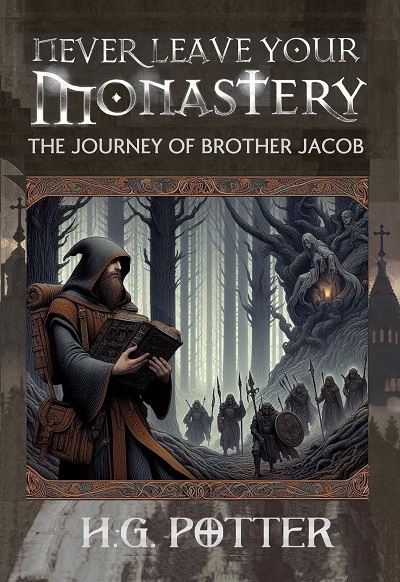
AGAINST THE ARCHONS With the Valraphs, Brother Jacob goes on a dangerous journey across the lost continent in order to confront The Dire of Melancholia. Guided by a Lizardman Sahkah, he finds himself at one time in a vast underground cult complex, at another time in the secret labyrinths of the Arc du Baffay, grand fortress of DIRE.... Amazon.com,
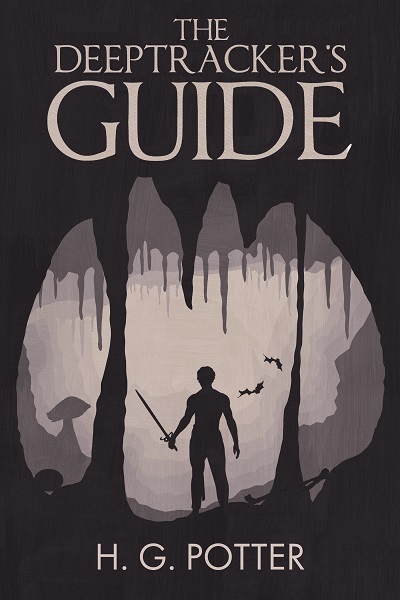
A 900 year old gnome catalogues the many perils and creatures encountered in the hollow earth in his quest for lost knowledge. Enchiridion de Rebus Subterraneis treats on the various environments of the intermudane caverns and subterraneous worlds, providing eyewitness testimony, ancient manuscripts, Church-like admonitions, and rebuke against unbelievers.
Incl...
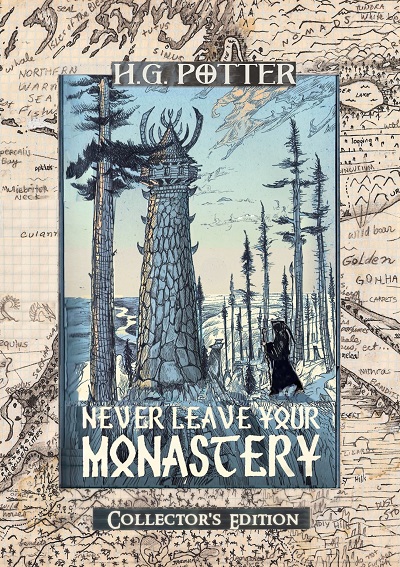
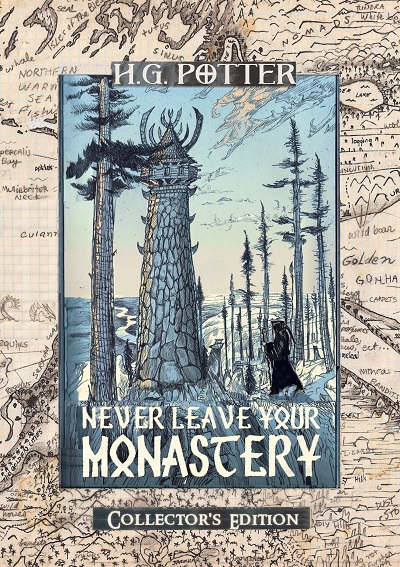
Books 1 & 2 of Never Leave Your Monastery, both in one volume. This Collector's Edition features the ORIGINAL ART of the Author, over 25 hand-drawn illustrations.
Although available elsewhere; the author urges you to order the Lulu.com printing which is considerably higher quality printing.THIS DOUBLE VOLUME WITH DRAWINGS OF THE AUTHOR is best printed available ... LULU
The ancient kings of Whitehawk were all too aware of the temptation of magic. They could feel its threat, a presence in their courts, a serpent slithering at their feet, even entering into their beds.
To deal with the problem they formed a pact against all magic. They agreed to send all wizards into exile, across the desert wastes and the vast expanse of...
Price:
$3.99
(eBook) Kindle (eBook),
<span style=
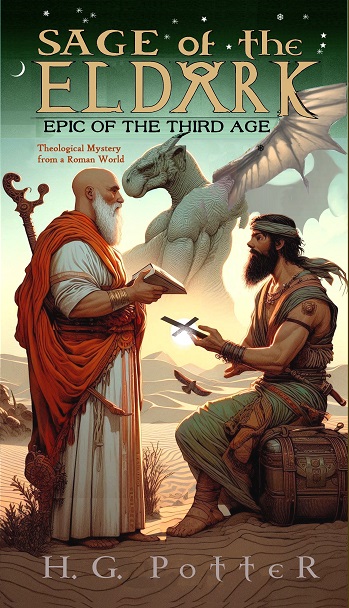
A cerebral dark Mystery of the Third Age..The serenity of a Roman statesman is interrupted by a wild-haired wanderer. The zealot seeks refuge from the powerful demon pursuing him, and not only that, but tries to recruit his host to patriotic self sacrifice in the name of restoring the free Republic.Yet there is a price....
Price:
$4.99
(eBook) Intermundane Journeys
A crusade against an ancient evil.
A brotherhood bound by oath.
A victory that will cost everything.
This chivalric epic, lost for centuries, now in the refurbished language of Malory. A crew of disenfranchised veterans strike upon sea for a dragon horde, but the many-headed one attempts to corrupt their souls first. ...
Price:
$8.99
(eBook) Kindle (eBook),
Amazon(Read first 150 pages here!)
Short Stories ( View all 8 stories ) The Diamond Mines of Yezez by H.G. Potter
The DeepTracker's Guide includes a Bestiary of Underworld denizens. The entries often feature archaic short stories to illustrate the creature's behavior.<... Opening of Homer's Odyssey by H.G. Potter (translated from the original Greek)... The Wizard who could not Die by H.G. Potter
Blessed with victory against the tyrannical dwarf emperor, the alliance of monarchies is at last free. But ... After Atlantis: Sage of the Eldark by H.G. Potter (1988-2021) Roman-Era Fantasy Intriguing and Engaging
This horror-mystery will keep you guessing. An unexpected guest arrives in the desert hermitage. He has traveled the worlds and speaks of man... The Lost Library of Hyrzu by H.G. Potter Incidents that occured during an Archeologic Expedition to the Oriental Colony of Authapis, a city that sits in the shadow the Butterfly Volcano and whose ancient streets had been once preserved in as... The Nomads of Sardu by H.G. Potter Abbot travels forbidden lands to obtain a forbidden book.... The Dice of Golgotha by H.G. Potter
(2010)Dialogue with a Stranger: Two wanted treasure-hunters are hiding at an apartment in the town of Wh...
Poetry ( View all 7 poems ) Zen Guitar Summer by H.G. Potter This poem which I wrote circa 1988, is fragmentary, having been somehow torn. It is believed that certain poets, O'Leary brothers in Chicago, may know of a complete version, although it may not be de... The Vortex Poem by H.G. Potter This also was from circa 1989... Stormscald by H.G. Potter circa 1989 while day-dreaming near Lake St. Claire at Windmill Pointe Park.... of The Spartan by H.G. Potter 1989 The poet at that time wished to convey a soldier's atmosphere and so did not moderate his language.... Dream of the Centaur by H.G. Potter A short account of the traveler Hepthe with ancient poem. excerpt from "The fall of Nystol and other Tales"... The Martyrdom by H.G. Potter
The Katabasid of Nilus by H.G. Potter This translation styled roughly after Oruscan Hexameter...(I recommend reading it with the music by clicking the link at the bottom of this page).
...