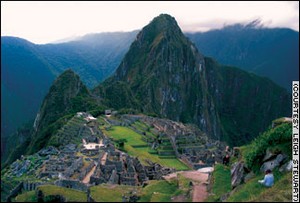
ESSAY MACHU PICCHU
Tourists from all around the world -- many ready for some serious high altitude hiking -- flock to the mysterious ruins of Machu Picchu. Hidden nearly 8,000 feet above sea level in the Andes Mountains of Peru, the ancient Inca city remained lost to modern civilization until 1911. Although its purpose and place in the Inca culture remain a mystery, the accomplishments of its builders and the beauty of its surrounding make Machu Picchu one of South America's top archeological and tourist destinations.
Arriving by train from Cusco
Adventurers begin their journey in the Incan capital city of Cusco, (more than a 24-hour drive or about an hour flight from Lima), where they board a train for the 4-hour trip through the Andes to Aguas Calientes. The final ascent to the top of the 500-meter cliff,
where Machu Picchu overlooks the Urubamba River canyon, can be completed by a 30-minute bus ride. More adventurous travelers can forgo the bus and hike up the Inca trail to the citadel.
Inca trail
Those who choose to hike the mountain follow the trail established by the original Inca inhabitants of the Sacred Valley below Machu Picchu. The trail -- made entirely of fitted stone rocks -- served as a trade and communication link between Incan strongholds. With
most of the original stones gone, today's trail is a dirt path with intermittent steps and stone areas. The trip up the mountain can take from one to five days. For the longer treks, hikers disembark at kilometer 88 in the town of Qorihuayrachina. One-day hikers depart at
kilometer 104 at the Incan ruin of Chalcabamba.
The mystery of Machu Picchu
Once at the summit, a day pass to the city allows visitors to explore the ruins on their own or with a tour guide. The entire site, which covers about five square miles and is more than 500 years old, contains homes, irrigation channels and farming terraces. The Incas' unusual building technique of precisely joining stone blocks without cement or mortar has
impressed scholars since Hiram Bingham, an archaeologist from Yale University who discovered the ruins in 1911. The Incas also used complex mathematics to study astronomy and lay out the site, though the city's place in Inca society and the fate of its inhabitants remains a mystery.
Huinay Huayna
Taking walking trips from the city site -- no matter how visitors reach the peak -- is a popular way to explore more about Incan culture. The well-preserved ruins at Huinay Huayna, left, -- approximately a 4-hour hike from Machu Picchu -- provide an example of the farming terraces the Incas used to cultivate crops.
The Sun Gate
Hikers without the time or energy for a 4-hour trek have many options for shorter trips. A popular 1-hour hike takes adventurers along the well-preserved road from Machu Picchu to Intipunku, the Sun Gate. The gate originally served as the entrance to the city from the Inca trail.
Huayna Picchu
Another option is a hike up to Huayna Picchu, the skyward peak behind the ruins. This challenging trek takes an average of one and a half hours. But the view is worth the walk. The peak of Huayna Picchu has a postcard-perfect view, shown left, of the entire lost city nestled beneath the towering Andes.
Copyright © A. L. Stewart


