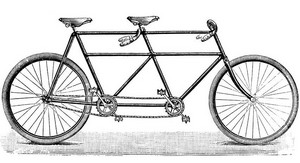
Imagine: President Woodrow Wilson goes for a tandem ride around the Palace of Versailles with a young British economist. Could our world have been different?
Versailles Palace Monday March 31st 1919
“Monsieur President, sir, would you like to go for a ride with one of our girls?” The question being asked of Monsieur Woodrow Wilson did sound a little incongruous and, as he looked over at our little group, his face suggested he thought so too. But Marc, one of the Park Managers, hadn’t meant anything untoward or immoral; it was a simple enquiry to see if the President of America would like a ride around the Park on one of us tandems piloted by Clotilde or Irčne; we’d been doing trips for the conference delegates for some weeks since they’d all arrived in Paris. The wide open spaces and the fresh air of the beautifully manicured Palace Park had come as a welcome relief for some of the representatives from overseas who’d spent many long hours in meetings and deliberations over the Peace Treaty they were there to finalise; I also think that some of them also liked the idea of sitting on the back of a tandem being supervised by a pretty young French girl. One of the Italian ministers, who’d clearly taken the invitation to mean something else, had received a sharp rebuke from Clotilde for refusing to keep his hands on the handlebars.
I had seen Monsieur Wilson pacing up and down at the back of the Palace a few times over the past weeks – he was usually in deep conversation with his closest adviser, Monsieur Edward House – but today he was alone and seemingly a little melancholy. On seeing the two girls stood prettily alongside us tandems, his stiff, slightly gloomy, demeanour changed quite markedly; a handsome man with the square features, he cracked a pleasant smile that revealed a charming, if not even playful, person; an informality that would be somewhat out of place at the negotiating table .
“Well I don’t think I would mind if I did! – I have seen these contraptions back home in the United States, but I have never ridden on one.” I could see quite quickly that he had singled out Irčne for his pilot; she was the more placid of the two girls with the slightly larger and fuller figure; a stoutish frame much closer, I was later informed, to that of his young wife, Emily. Clotilde, on the contrary, was angular and bony with her elbows as sharp as her tongue – as the Italian delegate had discovered. Her face frequently bore a slight sneer; Monsieur Wilson reading people well.
Madame Emily Wilson was one of the few wives of the foreign dignitaries that had come with their spouses to the talks, and it became well-known that she was taking the opportunity to spend her days shopping in the upmarket Parisian stores that still managed to sell their high quality goods – despite that the war was barely over and the streets still filled with de-mobbed soldiers begging for change. If not shopping, she would be playing her favourite game at the nine-hole Golf de l’Ermitage course on the outskirts of the City. It may have been the first time that a serving American President had ever been to Europe but, despite the importance of the task confronted by her husband and the other leaders to negotiate a settlement after an interminable four years of war, she wasn’t going to miss the chance to enjoy herself.
“Would you like a cigarette before the ride Monsieur Wilson?” Marc held out a languid hand with an open silver cigarette holder for the President. Wilson’s jaw hardened slightly as he looked dismissively at the offering.
“No thank you sir – I think my Father did enough smoking in his life for the both of us.”
“Sir, Mr President?” Just as Monsieur Wilson was about to climb on the seat behind Irčne, another, younger and bespectacled man, hurried towards us from the direction of the Palace. “Sir, do you have a moment?” I sensed a large sigh and a touch of annoyance from Monsieur Wilson; it seemed that just as he’d discovered a few moment’s escape from the incessant negotiations indoors, his attention was being demanded of again.
“Yes, but only a moment – what do you want?” He was quite firm and short towards the earnest young man who, I think, immediately realised that his target wasn’t happy with the prospect of more talking, so quickly changed tack.
“Sir, why don’t I join you on the other bicycle? I take it you are taking a spin around the Park? We could talk as we ride together.” Despite his dexterous change of direction, the man’s English accent and straight words suggested he wasn’t a politician; but he was definitely charming. Monsieur Wilson seemed to calm a little.
“That would be fun, sir – sorry, what was your name again?”
“Keynes, sir, John Keynes.”
“Yes, of course that is who you are, my apologies – your Prime Minister, Mr Lloyd George speaks very highly of you. So are you ready for this? Quickly, let’s get going before someone else comes.” There was a slightly impish thrill to Monsieur Wilson’s tone as if he was pleased to getting away from it all, even if only for a few minutes joyride to chat with the bright young economist from Great Britain.
It was clear from the start that Monsieur Wilson wasn’t as fit as Keynes, and his partnership with Irčne was always going to be a little cumbersome, but our two teams rode together through the near-deserted formal gardens of the Parterre de Latone and onto the Allee Royal. The crisp chill of the March air was softened by the low sun that shone as brightly as it could, as the brilliantly coloured tulips, narcissi and hyacinths that bordered our ride contrasted with the grey and unbroken surface of Grand Canal lying just ahead of us in the centre of the Park; the early morning frost had lifted and the paths were smooth and safe under our silky pneumatic tyres. Nobody spoke for the first few minutes as they accustomed themselves to their machines and the peculiar proximity of their partners. I felt that Monsieur Wilson was quite comfortable in his seat but, looking at Monsieur Keynes, I sensed an unease as he sat as far back as the saddle would allow; I didn’t believe he was used to the presence of women. Irčne and Clotilde ensured that the two bikes rode alongside each other closely and exchanged knowing glances and furtive smiles; who’d have thought that they would have been riding tandems through le parc du Chateau Versailles with the President of the United States aboard; that most powerful man, who, after sending his soldiers to bring to an end the dreadful war, had sailed triumphantly from America to assist with the peace.
“So, young man, what was it you wanted to ask?” Monsieur Wilson was clearly beginning to relax into the ride and was calming down a little from whatever had upset him earlier.
“Well, sir, I just wanted to talk, if I may, about Germany?” Monsieur Wilson thought for a moment.
“Well, that is why we’re all here after all.”
“Sir, if I may… I just wanted to say that I think that it is important that your proposals are presented a little more forcefully to my Prime Minister and the French Prime Minister, Monsieur Clemenceau. I have been trying to suggest that Mr Lloyd George relaxes our stance on the German reparations – but it seems that he has changed his view since we left London – he keeps pressing for larger and larger sums. It is my belief, sir that elements of your own 14 point plan will genuinely make for a better economic future for Europe.”
“In what way?”
“Well, it seems to me that what Mr Lloyd George and Monsieur Clemenceau are proposing is the most outrageous act of cruelty by the victors over a defeated nation that has ever been seen in civilised society. It is a Carthaginian Peace. Everyone in London and Paris wants Germany to pay for the war, but the amounts they are talking about will skin her alive year after year in perpetuity. My hypothesis is that the only way to build a proper peace is for us to re-build Germany into a better society with a sound financial footing. We, the victorious nations should be doing so much more than simply exacting revenge.” Monsieur Wilson paused for a moment before replying.
“You may be right and whilst I am in agreement with you, Mr Lloyd George, seemingly, is simply doing what his electorate wants and Clemenceau just wants revenge for the Franco-Prussian war that cost the French people so dearly half a century ago?”
“I know that sir. But I believe that I am with a Government that is working for ends that I think are criminal.”
“Those are strong words. Are you sure Mr Keynes?”
“Yes, completely. And you, sir, are in the best position to broker the situation for everyone – the United States is the biggest creditor and you have helped to close out the war. If you were to right-off America’s loans to Germany then it would at least show intent. We shouldn’t be crushing Germany – there will be repercussions you know; vengeance doesn’t limp!”
We rode on in silence for a while with just the sound of the spokes whirring through the air and the girls’ crisp linen culottes flapping with the speed. At the end of the Allee Royale, Irčne waved to Clotilde to get her attention.
“Nous irons a gauche et vous allez a droite?” Clotilde nodded with a smile as we parted and circled the huge oval pond in opposite directions. Called Bassin d’Apollon, the low walled pool features the huge bronze centrepiece depicting the Greek god Apollo rising from the sea in a four-horse chariot.
As we passed each other at the top of the pond, Monsieur Keynes called out to the President.
“It’s in your hands sir – the future of Europe is in your hands – the seed of revolution is repression!”
After circling the pond once more we headed north up the Allee Saint Antoine to the junction with the Avenue de Trianon. There we stopped with our breathless guests and walked along the grassy border with its crocussed carpets.
“But John, I do agree with you – I have been discussing with your Prime Minister and Clemenceau about the size of the payments that they want – and I too believe that we should be strengthening democracy by self-determination of the peoples of Europe – not trying to teach them a lesson.”
“Germany is no longer a people and a state; it has become a mere trade concern being placed by its creditors into the hands of the receiver.” The two of them were walking slightly ahead of Irčne and Clotilde, but we could still hear them as their voices rose with the strength of their convictions.
“…John, you need to know that I could never get the Senate to agree to writing down the debt. Look, I understand entirely your belief but no one knows what will happen tomorrow. I came to Paris with a plan to realise a vision, to realise an ideal – to re-discover liberty among men. But the complications of the people of Europe are far worse than I ever imagined. There is no will to live together and help each other.”
At that moment they were interrupted by the sound of hoarse coughing; Irčne was leant over my handlebars and convulsing painfully.
“What is wrong Irčne?” asked Clotilde without moving towards to her colleague. Irčne shook her head. She suddenly looked very pale. Monsieur Wilson came over to us and, with a genuinely paternal touch, placed his hand on her forehead as she looked dolefully up at him.
“You are very hot – chaud? – you have a fever! Come, we must take you back. With his arm around the fast fading Irčne, he walked her gently back to the rear of the Palace as Monsieur Keynes and Clotilde followd behind with us tandems. At the Palace Irčne was helped indoors by a clearly embarrassed Marc. The two of us were left leant against the wall close to the two men as Clotilde followed her stricken friend inside.
“She didn’t look well at all – it was a genuine fever – and it came on so quickly with the cold air and the exertions of the ride.” There was a palpable bleakness in Monsieur Wilson’s voice.
Irčne died as the clock struck eight that evening. The flu epidemic that had decimated the soldiers in the war-torn trenches to the north during the previous summer had, by then, spread to the civilian population and had claimed another victim. The Spanish flu, as it was known, appeared to attack the young and healthy more so than the old and the weak; the immediacy of chills, fever and fatigue took them down within just hours. We heard later that Monsieur Wilson too, was struck down, within a day; probably breathing in Irčne’s infected air. He survived, but the enforced time away from his work at the Conference, however, ensured that Monsieur Clemenceau (or ‘Pere la Victoire’ as he was nicknamed by the French Press) got his way and he ‘skinned’ the German people; the British, too, squeezed the German lemon until the little pips squeaked.
Clemenceau was old at the time of the Peace Conference of 1919, so didn’t live to see the vengeance wrought by the people he had made to pay for the tragedies of the Somme, of Verdun, of Passchendaele. Monsieur Keynes resigned his post shortly after his meeting with the President when his pleadings were ignored by his Prime Minister. The future might have been so very different if we’d not taken that ride in the Park.
I love historical fiction. At first I thought the "us" was a mistake, but shortly I learned that you were writing from the viewpoint of the bicycles. I'm not sure that tandem bicycles were really a new device in 1919, but I'll let that pass, because the rest of the story is very historically accurate.
By the same token, at the time of the conference, I thought that Wilson was already very ill and that his wife had taken over most of the presidential duties for him. And then, at the end you clearly indicated that it was the Spanish flu that he contracted at the conference that led to his illness and his eventual death.
Wilson was, indeed, a great statesman but great statesmen don't seem to get very much credit. Especially the American people, after "winning" World Wars I and II, prefer to give honor to warlike people who are very good at threats and punishment. John Keynes was, certainly, a great economist. Leaders would certainly benefit from taking the advice of economists who know what they're talking about. Unfortunately, leaders worldwide seem to be about feathering their own nests and catering to the rich getting richer instead of listening to economists and giving everyone a piece of the world economy.
People would be well educated is this political election in the United States by reading your story. The lesson teaches is truly extraordinary.
Dublin 1941. A brutal murder. Mistaken identity. And barman Eamon Foley is running for his life.
Nine months later Foley is in a crowded pub, and his brother-in-law is shot dead.
Ireland 1947. Seven weeks of relentless snow. Guard Eamon Foley is searching for a missing child.
At Toby Appleyard’s farm, he discovers the kitchen littered with dead cats. And the skeletal remains of a woman. Upstairs, Toby is dead in his bed.
Available Now! Rated 5 ***** by readers and listeners.
Sweet Revenge is a powerful and romantic saga of th mid 1800's, recalling pirates and those trying to rid the seas of such vermin. Shawn, a debonair captain, gets caught up in


 Versailles Palace Monday March 31st 1919