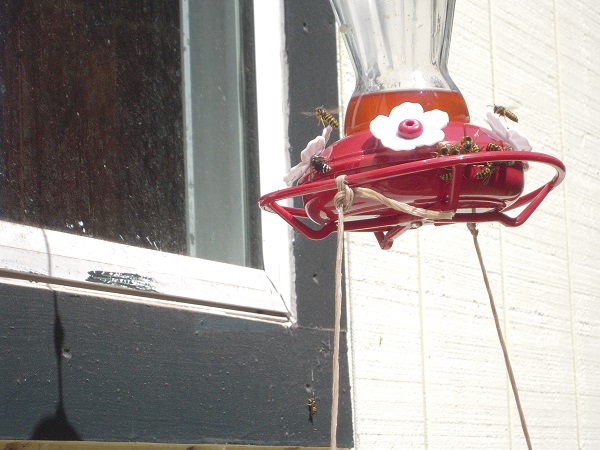
When honey bees raided the authors hummingbird feeder, she knew she had to write about it, but not from her POV, but that of the bees! Read on to see why these bees may have been so intent on getting all that nectar. Enjoy the photo of the real feeded located in the author''s back yard in Houghton County, Michigan''s Upper Peninsula.
The Giant Flower
By Deborah K. Frontiera
Scout Bee #2100 buzzed into the hive bursting with excitement. She danced in circles indicating the direction of the sun’s rays and distance to her incredible find. Translated from the language of bees, it went something like this.
“You’ll never believe the Giant Flower absolutely filled with never-ending sweetness I found! I’ve never tasted nectar so sweet. Or so much of it. Not far from here hanging from the house of the two-legged giants.”
“Calm down #2100,” said Lead Worker.
#2100 stopped her dance and rested—something difficult for a hive scout, or any worker bee, to do.
Lead Worker then questioned her further. “Now, please describe this supposed ‘Giant Flower’.”
“It’s large, very large, and reflects the sunlight in places, but is opaque in others. It’s red with yellow blossom openings. I headed for a blossom first, and found them not living, but the scent of nectar was SO strong. I tried to sip from the hole, but my proboscis could not reach the sweetness. It’s hanging in front of the shiny smooth place we can’t get through.”
“So how do you really know what is there?”
“It was sticky beneath my feet! Then I discovered a narrow crack between the top and bottom half of the huge red part and the bottom of it, just enough to slip my sucking tongue in. Oh, I can’t tell you how sweet it is!”
Lead Worker buzzed, still skeptical, but also thinking. Finally, she said, “Come over here, #3421! Go with #2100 and check this out. Report back immediately.”
The two bees left their hive in a hollow of a dead tree in the forest. A few weeks before, a bear had raided the hive and stolen over half their supply of food and eaten many larval and pupating bees along with the honey. Those remaining had worked so hard to repair the damage and build more honeycomb deeper in the hollow, where hopefully, the bear could not reach it again. The Queen had immediately laid eggs to replace the lost young. Now the new larva would soon pupate and then emerge as young workers. The Queen’s immediate assistants were concerned that if they didn’t have more scouts and gatherers to work extra hard to replace their food supply, the hive might not be able to survive the next winter.
Scout #2100 slowed down a bit flying around balsam tree to check her position in the angle of a patch of sunlight coming through the branches. She turned to make sure #3421 was still following as she changed direction slightly. Ah, there it was, perhaps twenty feet from the tree line. #3421 could smell the sweetness and grew as excited as #2100 had been when she entered the hive.
“Here,” #2100 buzzed to her companion. “If you turn upside down by this crack, you can get your proboscis in better.” She demonstrated the technique she had done herself not long before.
#3421 copied the position and took a long suck. “WOW! You weren’t telling a tale! We must lead the others here.”
A few minutes later, a large group of bees followed the #2100 and #3421 to the remarkable find. Back and forth the gatherer bees zoomed. To the Giant Flower, suck up a load, buzz back to the hive, deposit the sweetness into an empty cell (which the Queen would soon fill with a new egg, and nurse bees would cover with a layer of wax) and back to the Giant Flower. They worked at a feverish pace until the sunlight left the Giant Flower in shadow and almost until it was too dark to find, vowing to return the next morning for more.
For the next few days, many gatherers spent the entire day sucking nectar from the Giant Flower. On the fourth day, #3421 noticed something troubling, which she reported to her Queen. “When we first went to the Giant Flower, I could see red liquid on the inside, which we were sucking out at the bottom of the of the flower, about 2/3 up the see-through part of the thing. Now I see it is about half as much. I think we will eventually empty it. Great as the amount is, it will run out.”
The Queen was silent for a moment and then called for the Lead Worker. “#3421, please tell Lead Worker what you just told me.”
So, #3421 repeated her observation. “How many days more do think there will be of gathering there?” Lead Worker asked.
#3421 was silent for a moment, then replied, “Well, based on the rate of collecting we’ve been doing, I’d say not more than four or five days.”
Lead Worker and Queen stopped buzzing to think.
Finally, Queen stated, “Starting tomorrow, send only a third as many workers to the Giant Flower to continue collecting there. Send all the scouts out to search for more sources of nectar. While the Giant Flower has definitely saved us from our losses to the bear, we can’t depend on only one source of nectar.”
#3421 and Lead Worker nodded and flew off to carry out Queen’s instructions.
The following week, the bear attacked the hive again, but because the bees had built the new comb farther inside the tree, the bear could not reach it. The bear tried to rip the edges of the hive entrance to reach farther in. Though the tree was dead, the wood was not so rotten that the bear could rip the wood away easily to reach farther into the hole. The bees gave the bear’s nose such a stinging that the bear retreated growling in complaint. To be certain it would not return, #2100 and two other scouts followed the bear. It licked its nose, still growling and then settled for easier food in a patch of wild blueberries.
“You should say thank you,” buzzed one of the scouts. “We pollinated those white blossoms in the spring to make those berries for you.”
The bear paid no attention to her.
“You have to remember,” said one of the other scouts, “bears do not understand our language. It’s useless to try to reason with them.”
“I know, but one can always try.” #2100 was an eternal optimist.
The bees at the Giant Flower could no longer reach the nectar with their proboscises and had about decided to leave when a friendly harvester ant climbed up the string from which the Giant Flower hung. She had labored long to climb up the wall to where the string was tied, up the string, across from where the string was hooked to the eve of the Giant Two-Legged Creatures’ dwelling, and down to the Giant Flower. The bees, being insect cousins to ants, understood the ant’s telepathic message asking if she could share their bounty.
One bee told her their dilemma. The ant looked at the hole in the middle of one of the fake blossoms. Yes, she thought she could crawl in and check out the situation. She pushed her body through the hole and landed with a sploop in the pool of nectar remaining at the bottom. “Oh, oh, oh, there’s so much here,” the ant’s telepathy told them. “I can see the crack you used and, no, you won’t be able to reach it. BUT I can’t swim! I can’t get out! I shall drown in this nectar.”
The bees buzzed around in frustration as the ant struggled to reach the edge, which was too slippery to climb up. There was nothing they could do to help. The ant’s telepathy grew weaker and then stopped.
“What a shame,” one of the bees said. “But what a way to go!”
“Perhaps we should stop buzzing for a while in respect for her heroic actions,” said another.
“Here comes another ant,” buzzed a third. “We should warn her not to crawl in there.”
The bees buzzed around the second ant, gently so she wouldn’t think they wished her harm. The ant stopped, listened, thanked the bees, and turned to go back up the string, across the top, down again, then down the wall to the ground. Then it headed for an ant hill not far away. The bees assumed they would report it all to their Queen.
Not long after, scout #2100 happened to fly to the opposite side of the Giant Two-Legged Creatures’ dwelling and spotted another Giant Flower! She flew over to investigate. While not as large as the one they had already harvested, it was shaped in a way that did not allow any way for a bee to get at the nectar. Hummingbirds, rivals with the bees, landed, sucked away at it, and gave #2100 a mean look. She retreated. But she returned to check out the situation briefly every day. A Two-Legged female took down the Giant Flower one day and brought it back filled to the top with nectar. #2100 sighed and wondered why she didn’t fill up the other one again.
Life went on in the beehive. Late summer and then fall flowers bloomed, and the bees gathered more nectar. They still checked the Giant Flower from time to time, but the Two-Legged did not refill their flower. Did she mean for that nectar to be only for Hummingbirds? That seemed so wrong. Bees needed nectar, too. The days grew shorter, the mornings colder. The maples turned bright red and the birches yellow. Queen declared it was time for her to stop laying more eggs for that season. She directed her workers to continue gathering their winter food supply until there were no more flowers.
The day came when #2100 saw a Two-Legged take down both Giant Flowers but she didn’t bring them back out. She took in their outside chairs and her mate pulled their boat out of the lake. When #2100 reported seeing that, she heard a long sigh from the whole hive. Queen said their work for that year was done, decreed the usual rationing of stored honey, and told her workers to rest for the cold season to come. But #2100 made up her mind she would watch and hope that the Giant Flower would be refilled in the spring.






 This story was first published in the 2023 U.P. Reader, published by the Upper Peninsula Publishers and Authors Association. Enjoy it now for free.
Our hummingbird feeder here in Houston Texas of the same design became infested with fire ants that climbed the tree and down the wire to get to it and the sweet nectar.
Ron