The Time of Our Lives
By Deborah K. Frontiera
(Note: This piece is autobiographical, but the names have been changed.)
Time had been weaving a tapestry of Planet Earth for a few billion years. Once Homo Sapiens evolved, it grew exponentially. Vertical warp threads crossed horizontal weft strings; one interaction affecting another. Colors blended, designs and figures combined, creating scenes and characters Time had not planned, but there they were. Human choices caused repercussions, important and unimportant, life giving and life taking—the past affected the present, which influenced future scenes in the tapestry. In one insignificant area at the beginning of 1960s BCE, as people measured it, Time’s eye was drawn to a budding artist and her youngest sister.
Denise peeked into the living room. Lynore had laid out newspaper on the carpeting which meant she was going to paint, and Denise loved to watch.
“Can I watch you?” she asked.
Lynore sighed. “Only if you are absolutely quiet! Remember last time?”
Denise did—she had asked a question; Lynore stopped working and glared at Denise until she left the room.
“I’ll be quiet. I promise.” She sat down cross-legged.
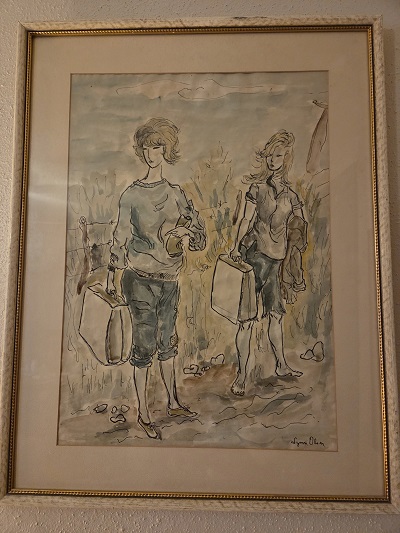
Lynore picked up a pencil and began to sketch. The line from the tip of the pencil seemed alive as it swooped, rose from the paper, landed in another place. The forms of two girls holding suitcases emerged. Lynore picked up a different pencil, darkened some of the lines, added details—a roadside at the girls’ feet and a meadow behind them.
Denise almost said, “That looks like you and your friend Karen,” but clamped her hand over her mouth just in time.
While she watched, Denise thought about the fact that Lynore would graduate from high school in June. Next fall she would go away to college, leaving nobody to protect Denise from her brother, Pete, and two other older sisters, Kate and Beth, who often teased her into temper tantrums and then laughed at her anger. What would she do without Lynore? She glanced out the window at the blowing blizzard—the reason there was no school today, giving Lynore the chance to paint in the first place.
Lynore spread pasty watercolors on her palate, choose a brush and begin to fill in color: the tan road, pale green meadow grass, hazy blue sky and clouds, blond poofy hair, gray worn suitcases. It all looked so easy. Why can’t I do that? My stick-people look silly. Why can’t I create something on a blank piece of paper? Lynore has her art. Pete plays guitar and has a band. Kate gets all As. Beth will start art classes with Lynore’s teacher soon. I’m no good at anything. I’m already nine and I can’t even ride a bike!
A few weeks later, Lynore’s painting, The Hitchhikers, was matted, framed, and presented to the girls’ grandparents. Grandpa wrote a check to Lynore—for her college fund—and they took the painting home with them.
*
Time continued to watch Earth’s events, and one day glanced back at that small spot to see what was happening with the sisters. Lynore had completed a bachelor's degree in art, was married and had a son. Pete was in the Air Force, a radio repairman serving in Vietnam. Kate and Beth had also married. Grandma and Gramps had retired to Arizona.
Denise, now seventeen, sat at a desk looking out the window to where the two-lane highway made a sharp right and climbed the hill out of her town’s valley. Patches of bare ground were finally showing; winter would end soon. Denise had conquered riding a bicycle in the spring after she watched her sister paint that picture and had learned to play the piano.
She was on the girls’ gymnastics team as accompanist. Denise couldn’t even do a cartwheel, but she knew every move of the floor exercise routine, where it went with the music, and each girl’s speed, adjusting her tempo so every teammate ended on the final note played. Girls whose teams relied on recordings were docked points when they finished ahead or behind the music.
But back to this week’s essay topic. I don’t care what the topic is this week. I want to write something DIFFERENT! They had been studying kinetic and potential energy in physics. Life was like that. You started as a baby, all potential, and then, like a rock rolling down a hill, became kinetic and did things. Eventually, you ran out of potential, used up kinetic, slowed down, and passed away. Some people had long gradual hills; they lived longer. Others had steep hills, went fast for a while but crashed at the bottom. Words flew onto the paper, a metaphor for life. Yes, it was off topic, but maybe her teacher would comment about the ideas. Denise rewrote it carefully in ink in her best penmanship and turned it in.
Her teacher always handed back essays folded, so nobody could see someone else’s grade. With great hope and some trepidation, Denise opened hers. C+ OFF TOPIC. And all her spelling errors circled in RED. Hands shaking and biting back tears, she stuffed the essay into her folder.
*
Time watched Saigon fall, witnessed President Nixon resign his office in disgrace, and life settled into the 70s. Denise married and had a daughter. She and her husband lived only forty miles from Lynore and her husband. Denise traveled there to visit when she didn’t have college classes. They talked over cups of tea while Lynore’s seven-year-old son minded Denise’s crawling baby.
“How are your classes going?” Lynore asked.
“Really well! It will take me another year to finish, but I’ll have a BA in English along with my teaching credentials. I managed to fit in a creative poetry-writing class. We are going to choose two of our best for a class anthology.”
“That’s great!”
Denise dared to ask, “Do you remember that day I watched you paint The Hitchhikers?”
“Yes.”
“Were those two girls supposed to be you and Karen trying to get out of our hometown?”
Lynore’s silence revealed the truth before she replied, “No, it was just two girls hitchhiking. More tea?”
A year later, Denise graduated Magna Cum Laude; she and her husband moved to another state, where she would work to support him and their daughter while her husband completed a BS in mathematics and student teaching. Long-distance calls were expensive, and neither Lynore nor Denise had much time to write letters.
*
Time watched others for a while until Jimmy Carter was elected President. Denise and her husband now lived in western Kansas where he was an oil field “mud” engineer, making enough that Denise could be a stay-at-home mom. Two more daughters arrived in quick succession.
Denise’s father stopped on his way to Arizona to settle his mother’s estate after her death. He shook his head as they talked. “Toward the end I’d tell her about you kids and she’d say, ‘You sound like my son Clint,’ to which I said, ‘Mother, I am your son Clint.’ Then she’d drift away wherever those with Alzheimer’s go in their minds. I’ll stop by again on my way home.”
Denise gave her father a long hug.
On his way back, Clint said, “I have something I think you’ll like from Grandma’s house. It’s a painting Lynore did back when she was in high school. I think the colors would look nice in your bedroom.”
He opened the trunk. Denise watched her father unwrap the painting and found herself staring at The Hitchhikers!
Hand to her mouth, Denise said, “Oh, Dad, you don’t know how much this means to me! I watched Lynore paint that.”
“You did?”
Denise nodded and lifted the painting lovingly from its bed in the blanket. Then she told him about that day with her sister.
*
Life was good. Denise’s husband received a raise; the couple put a swimming pool in their backyard. Denise taught summer swimming lessons there, especially to kids who couldn’t seem to learn at the usual places.
One day while pulling a dry T-shirt on over her swimsuit, a parent asked Denise, “How do you do it with these fearful kids?”
Denise replied, “I had trouble learning to swim and hated to put my head under, so I know how they feel and can help them through that.”
“With all you know, you should write a book!”
Maybe I should, Denise thought.
Daughter number four came along during that time, but Denise listed topics, outlined, drafted in a notebook, typed on her college typewriter, corrected, looked up spellings, typed some pages three, four times, correcting errors.
Then the economy took a downturn, and Denise’s husband was laid off. Four kids, no money coming in. Both took whatever work they could find, refinanced their mortgage, ran through all their savings. Teaching jobs were scarce in western Kansas; the family moved to Houston, Texas, at the same time a small press accepted Denise’s manuscript on teaching fearful kids to swim.
Two parents working, three of four kids in school, day care to pay for the fourth, her husband coaching various sports to make ends meet, zero time to market that book, few royalties. The book went out of print.
*
Time still watched. Earth seemed to be in constant turmoil. Protesters took over the US Embassy in Tehran, CNN broadcast the Iran-Iraq war, and Mount St. Helen’s erupted. Someone tried to assassinate President Reagan; a nuclear plant at Chernobyl caused devastation than Time had not seen since Hiroshima. The space shuttle Challenger fell out of the sky. The Berlin wall came down, but Time worried about the ozone layer and the fact that humans continued to warm things up. Hurricane Andrew smashed a lot of people and buildings in Florida. What was Homo Sapiens trying to do? Wipe themselves out?
Denise wrote poems about teaching, students, and principals. After seeing live crawdads tossed into boiling water at a party with some of her husband’s fellow coaches, Denise wrote a humorous essay about giant alien crawdads. They scooped up vehicles during Houston’s rush hour and pried human meat out of their metal shells. It was published in the Houston Post’s Sunday magazine. She thought about framing the check but cashed it to buy notebooks and ink for the printer they had bought for a new PC.
Denise and her husband sat watching TV, laughing at a popular comedian making jokes about saving the planet, and how, now that Earth had plastic, it could shake off these humans “like a case of bad fleas.” Denise’s mind took off.
What if people became extinct? What if God decided to try again with another species? What might evolve to take our place as top dogs on the planet? The dinosaurs had their day; so did the giant mammals. Hmmmmmmm … cockroaches! And ants! They’ve been around since before the dinosaurs, survived every mass extinction. How might they evolve?
The idea would not go away. In brief moments of spare time, she went through many years of National Geographic magazines in her bookshelf, pulled every issue that had anything about extinct species or archeology, imagined scenes of her post-people world, jotted in a notebook.
She called Lynore. They talked often about creativity now that unlimited long-distance was available. “I don’t know what to do with this crazy idea I have,” she said, and described this “planet of the ants” to her sister.
“I don’t know either, but do something with it and keep me posted,” Lynore encouraged.
She talked to Beth, who was in New York City after a divorce, working on a Master of Fine Arts degree while holding down a day job. “It sounds like a novel to me,” Beth said.
“I don’t know how to write a novel.”
“Sure, you do! You’ve written lots of stuff. Just start writing, and rewrite over and over until it’s right.”
“When I get some done, can I send it to you?”
“Sure.”
Denise gave herself two hours every Tuesday evening and two more hours every Sunday afternoon and drafted in a college-ruled notebook—every other line so there was room to rewrite. When no one else was on the family computer, she’d enter as much as she could into her future book file on a floppy disk. When she had about thirty pages, she printed and mailed them to Beth.
Beth called the Saturday after reading it. “The idea is good, but on page nine, what were you thinking? …” on and on Beth droned. Denise bit her lip; her voice quavered when she replied to questions. But then, “Now, sweet little sister, don’t be discouraged by all that I’ve said. Put it away for at least three weeks. Don’t even touch it. Then take it out and read it again and see what you think.”
Denise took that suggestion, and when she read her work, she thought, Gaaa … this really is bad! and started over. A new clean notebook went everywhere with her. Scribble, scribble while she waited for one daughter to come out from swim team practice, or for another to finish with marching band, or while the third and fourth were at religion class on Wednesday nights, scribbling under the light of a streetlamp.
*
While Denise scribbled in her notebook, Time watched world events with a combination of shock, dismay, and hope. On the hopeful side: the breakup of the Soviet Union, the reunification of Germany, and the end of Apartheid in South Africa. But the negatives outweighed the positives: the Persian Gulf War, genocides in Rwanda and Bosnia, riots after the beating of Rodney King, a bombing in Oklahoma City, mass shootings in schools. Time shook her head and wondered how much longer Earth could last.
These same events rolled around in Denise’s mind that decade. She watched all four daughters graduate from high school, and pondered what kind of lives lay ahead for them. The turbulent events on Earth also helped Denise refine her future world. While none of her insects symbolized any particular human, several inspired symbolic characters in what had grown into a trilogy.
Agents and editors that she met at writing conferences liked the idea but rejected the manuscript. She rewrote and rewrote, telling herself, “Let’s see which happens first—I get a publishing contract or save up enough from tutoring to do it myself.” Her sisters continued to encourage her, along with new friends in writing groups. Her confidence waxed and waned with the cycles of submission and rejection.
By 2000, she had saved enough to work with a “subsidy publisher.” It was an experiment to see how marketing on her own would go. When the first box of printed copies arrived, she told Lynore, “I feel like I’ve given birth to another baby! But this one took eight years, not nine months.”
“Nothing good comes easily,” Lynore replied. “I’ve been at this for over three decades, but I don’t have courage like yours to get out there and sell at art and craft shows. I hope you realize that you are painting with words.”
*
“We should stop talking about getting our own place up here and just do it,” Denise’s husband said a few days into a summer vacation at her hometown in Michigan’s Upper Peninsula. Within a few days, a realtor helped them find a “fixer-upper” they could afford. It was at the edge of a small lake where the shore area was “common access” for everyone on three one-lane dirt “roads,” only three miles from the Lake Superior shore where Denise had spent many happy beach days as a child.
“Well, nobody can build on that fifty-foot stretch in front of you, and it’s a beautiful lot. You’ve got a well head here, and a good septic mound in the back …” Denise’s dad ticked off the advantages and the fact that the old mobile home was worth next to nothing, did some math in his head, and suggested a low-ball price. “Then see what they counter.”
Their offer was accepted if they would take it “as is.” Done! Since both were teachers, Denise and her husband would have eight to ten weeks every summer to take their time with improvement projects after getting it livable. The long-range plan was to retire there.
Spending whole summers in her home area got Denise thinking about the region’s rich history, and the fact that while there was plenty of adult nonfiction about the area, there was not much for young people. She decided to begin research to write a piece of historical fiction for middle grades featuring a key turning point in the area’s history.
“Back again, Denise?” commented the archivist at a local college.
“Yes, I need to dig more into what life was like for a young person in the early 20th century.”
“I have just the thing! Back in the 1970s, the college sent students out to interview the elderly around here. Using cassette recorders, they captured a lot of individual and family histories which were then transcribed into print. I’ll get the index for you.”
What a treasure trove! Denise, wearing white gloves supplied by the archivist and using a pencil, spent that summer pouring through first-hand accounts and taking notes. She bought more books to take back to Texas with her to read over the winter, as she had done the two previous summers. Finally, she had enough information to begin drafting.
*
During the beginning of the 21st Century, Time’s attention had been drawn away from Denise’s life to watch the continuing war in Iraq which the USA began following the terrorist attacks of September 11, 2001. Mass murders continued across the US at schools and other locations. Humanity seemed to take one step forward and then two steps back. The US was not the only nation being attacked by terrorists or finding their borders flooded with refugees. Time sighed and then looked at something more hopeful.
Denise finished and published the historical fiction work with a grant from a local philanthropist and a loan from her father. It won an award, and several area school districts bought class sets for regional history units. Her other books were doing well enough to pay for themselves. Denise retired from her public-school teaching job to have time for author visits to schools and write. She also took a part-time job with a nonprofit group in Houston as a “writer in residence” at selected Houston schools.
She called Lynore after a session with low-economic, minority third graders. “Lynore, you won’t believe this! I’ve had such a hard time getting the kids to see that the first paragraph they write is not their best. Today, I decided to take The Hitchhikers into the classroom. I had the kids come up and look closely where a few sketch lines still show near the girls’ feet.”
“What?” Lynore’s voice was something between a question and an exclamation.
“I told them that what they wrote last week was only a sketch. And now they needed to add more detail and description, like the ink lines and the color in the painting! You sketch, I draft; you add ink and color, I add detail and improve scenes; you perfect and I proofread.”
“Hmmm, I wouldn’t have thought to use that comparison with kids.”
“Anyway, they got it! I put questions on their papers from last week, suggesting places they could add more. And they DID! Sure, they are only third graders, but each improved their work. I’m going to ask a few if I can copy their stories to send to you. Would you like that?”
Lynore chuckled. “Sure, I’ll look forward to it.”
Denise brought up a touchy subject, which Lynore downplayed whenever someone asked. “How are you doing fighting COPD?”
A long sigh before the reply, “I’ve got oxygen at home now, long tubes to get around the house, so I can go upstairs at night and down to the basement to my studio, and a two-hour portable O2 canister that I can carry, so I can leave the house for that much time. I’m good.”
*
Halfway through a tour of U.P. Michigan libraries during the summer of the 100th anniversary of the piece of history that Denise had written about so successfully, talking to audiences, and signing books, she pulled onto the shoulder of the two-lane highway because her nephew’s number popped up on her cell phone screen.
“Aunt Denise, Mom’s in the hospital … she’s not going to make it home.”
“Do you want me to come down there? I can cancel the rest of this tour. I’m close to the bridge; it wouldn’t be a long drive.”
“No, there’s nothing you could do right now. I’ll keep you posted.”
“Okay, but as soon as I finish the tour, I’ll head down there.” Denise wiped her eyes and blew her nose before pulling back onto the highway.
Time thought a minute—ah, yes, “down there” meant to Michigan’s Lower Peninsula, and “the bridge” referred to that remarkable piece of human engineering spanning the Straights of Mackinac.
Somehow, Denise functioned during the last two library talks. Her nephew’s next call came as she sat in a restaurant. Lynore had passed that afternoon.
Denise headed home to repack. In each small town, she pulled into a parking lot to check her phone and answer messages. Oh, those irritating “dead zones” between towns with cell towers spread across the wide stretches in the Upper Peninsula! Anger and blue funk alternated as she blinked back tears to focus on the road.
Bawling in her husband’s arms, repacking, driving the same roads, across the bridge, heading south … Her husband had given her a long hug as she pulled out of the driveway. He could not go with her. Friends would drop him at the airport to fly back to Houston and begin another school year.
Once, years back, Denise admitted to Lynore that, as a child, she had been afraid to go into the bedroom Lynore and Kate shared.
“What did I do to make you so afraid?” Lynore had asked.
“I don’t know,” Denise admitted. “I just remember thinking lightning would strike me dead if I put a toe into your room.” They laughed together.
Now Denise stood before Lynore’s vanity, feeling like a trespasser or a thief, opening drawers and tiny boxes to find the right broach and earrings to take to the funeral home because her nephew couldn’t make himself do it. Barely nine months had passed since he and his mother had buried his dad. Denise kept biting her lip. How could she risk tears dropping on that beautiful maple, staining it? She finally chose jewelry that had once belonged to their grandmother.
Then she searched through files and photo albums in Lynore’s immaculate, organized basement studio. A baby picture, a Sunday School class group, a teen in a prom dress, a high school graduation photo, a wedding portrait, Lynore and a child who was now a man, and one with grandbabies who were now teens. Trips to the local airport, picking up her sisters and brother. Keeping busy eased the pain.
Hugs, laughter at memorable times, helped them stay upbeat even when crushed. Denise stared at the walls of her sister’s house, covered with her art, and hundreds of neatly organized, unframed works, sheets of acid-free paper between them, a lifetime of work, carefully arranged in the basement. Had Lynore spent the last nine months since her husband’s death getting ready for her own to make it easier on her son and the rest of the family? Beth would stay after the funeral photographing each piece before packing them for storage.
As Lynore’s casket lowered into the ground, next to her husband’s grave, Denise thought, “Someday, I’ll paint a word picture for you, Lynore.”


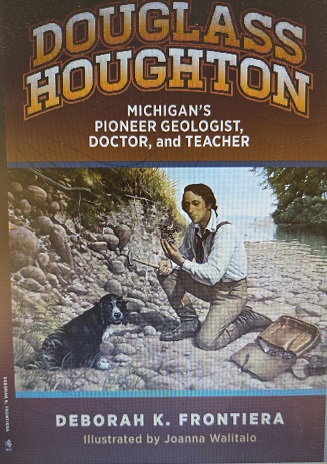



 This story is autobiographical, but I have changed the names. It is a tribute to my oldest sister and our relationship, her art and my writing. I'm only sorry it took me 13 years since she passed away to perfect it.
There are parallels to my life in your story, but with my brothers. And my mother, Born in 1925 by a midwife that came to the farm through the fields in the snow with a sleigh because the roads were blocked with drifts.
She sent me, My Story, about her childhood in the early 20th century. But she told me not to share it, so I haven't. Her mother, my grandmother, gave me her album that I have scanned and shared all of the pictures; including many of my mother as she was growing up.
Time marches on, with or without us. You and I both wonder how it will turn out long after we're gone.
Ron