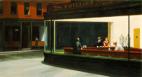
I'm one of the guys in the Edward Hopper picture. You know the painting; well after midnight, lonely diner where no one ever leaves because it's filled with desperation and lost in some two-bit film noir set piece. There's just been a shattering of silverware onto the floor as Hopper sets brush to canvas in his head. I look down and see it scattered about like so many lost battlefield weapons from an urban war. Knife, fork, spoon, all switching viewpoints with each other, facing new directions, pointing the way out of this god-forsaken hole of a diner.
It's 1942 and I can see that little bastard painting me and my girl into this little corner of lost city scape. Well, it was lost until he conjured us up and slapped us into place.
Now, there's never anybody joining us at Phillie's. That's the name of the diner. We can see the coffee in our cups and, though it mercifully never needs a re-fill, it never gets joined by some good ham and eggs, either. Or a well-down-the-gut greasy burger.
And I'm sick of the yellow light. My girls skin looks like shit under these lights. Outside and in the daylight she's a pretty thing. She's got these long legs that shine and when she slides on those stockings in the afternoon to go to work or meet me,---see, I'm a sex dreamer all set for the night. I've been hungry for her touch and mad about sliding into her since I woke up today. Horny as hell all the time, even now.
You might like to know where we went tonight, how we ended up in this cheap diner in the heart of the Village, captured by a passing painter in a picture he conjured up and dropped on the world which never let it go. Hung around and kept staring at us, trying the place out for himself, over and over again until we became a part of the family. Your family, too.
Because you keep staring at us, as well. You printed us into your imagination and kept disturbing my horniness,--- never considering my desire and the sweet sex me and my girl like so much.
So I'll tell you more, but I won't talk about who we are, no names, no personal biography, because god damn it, you've already taken too much of my guts watching me all the time. Inside, I have to hold onto some privacy. Otherwise you blood suckers will take it all. Hopper didn't give a crap about our privacy. He just had this driven, compassionate need to capture his own loss and separation, his own black night of despair where he could hang out on a corner and dream of film stars. Dropping paint on the floor like the silverware that's scattered on the diner's floor in front of me. His little dabs of sickly green, which he spread across the sidewalk out there, and black, sad yellow onto dim-white dawn. It's all a mess around his easel, all a mess what he did to me and Carol.
Alright, I said no names, but that's hers. I'm James and I'm lying. But I know you're so enamored with James Dean, you latter day rock and roll kids, you wouldn't mind taking my name and turning it into his because that's where your head leads you when you look at Hopper's picture. It's all bent around that time, that myth. Don't get me wrong, I'm not trying to be cute now, not trying to put you in a cage too, or take away your dreams of movie stars.
Look, we had a typical day, you know? I'm tired and beat and disgusted. The hat I'm wearing was thrown out to Goodwill by you kids. You stuffed your hair with braids and later, with flowers. You donned those black leather caps that Brando wore in The Wild Bunch.
Carol has been a peach, that girl. She dropped me off this afternoon at work, (I ain't got a car you see), and she is very generous with her Pontiac Coupe. That red job, as bright as her dress, carts my sorry ass around the city most days, and she don't complain or bitch about it. Just a typical day for us both, trying to survive this jungle of city pavement and rolling, sunken eyes that surround us.
Today I got bit by a dog. The mangy half-breed spread his jaws open and slashed into my ankle pretty deep. I had to get a shot for it, and now I got it wrapped up in several layers of gauze. It itches me and my coffee is getting cold. Where's the god damn cook?
He's probably hiding out in the kitchen back there, snoozing off. Or he's wise to Hopper. He knows that slick little artist is out there capturing us and won't have no part of it. He may own this joint for all I know and is satisfied to have it immortalized without his portrait to confuse things. Hell, don't he know, even sitting back there, or sleeping back there,---whatever the hell he's doing,--- no matter how he's hiding from immortality,--- that we're all caught here at exactly 3:23 in the morning. No place else to go, nobody looking for us, wondering where we are. All the world asleep around us, we're the only one's awake, Me, Carol, the waiter bending over to pick up the silverware, the stranger sitting across from us with his back to you, and that fucking Hopper.
That's made me mad, as mad as I was at that dog who took a piece of my ankle for his appetizer this afternoon. He just bit me out of spite, was going crazy sitting on the porch and probably saw his master coming down 72nd street and knew he'd get a whipping for no good reason, just because he was a dog and men loved to whip their dogs for nothing in 1942.
Christ, I ramble on don't I? No sense in denying it. I'm bone weary and sick of the itch on my ankle and fed up with the stale, getting colder by the minute coffee. I'm pissed off at a dog and a painter. Gives me no direction and no hope for change.
That's not how Carol feels though.
When you see her in the picture you might remember that she's a doll. She likes me a lot. Always talks about us getting married and having kids. She's a doll, mister. Nothing itching her ankle under those stockings tonight. She don't even notice the coffee, or the silverware. She's feeling no pain. Probably could care less about Hopper, too.
Actually, neither of us are sober. I'm drunker than she is, but her head will start to ache in about ten minutes and we'll have to get out of here. But we won't be able to. We'll have to sit here for eternity, stuck in a place where no service arrives, no coffee ever gets warmed, the silverware scatters and points, the ankle itches and the dream never ends. I hate Edward Hopper.
I hate the sickening yellow he covered us with, the florescent pitch of the light against Carol's white skin, the dank smell of this place, all mixed with sausages and bacon from thirty years of mashed potatoes slung onto greasy plates, and burger meat that's not quite fresh, and cheap food that's rank and bland.
No one walks around the corner anymore, either. Up the street from the diner, where I got bit in the leg by that mangy mutt, there's a place we could sit and get comfortable. I could take Carol there tonight and invite her to a bench, and watch her legs cross and the water pool on the street gutter because it rained earlier tonight and the glisten of the pavement would be a nice little distraction. I could fondle her, make her feel good and kiss her. Better than staring down a fork and knife and spoon that shine on a tiled floor under my feet. One of which isn't getting any circulation because the idiot Doc wrapped it too tight and cut into my skin.
I'm going to hold my girls' hand now. Place my palm over her little knuckles and squeeze them. It's just us four here, five, if you count the artist, maybe six if it's you over there under the street light, --- and I'm more grateful than mad at the moment because at least I have her.
I guess Hopper had a heart for something, after all. I mean he could have stuck me in this joint by myself. Like the guy sitting across from us, turning his back on the artist and any kind of living. Staring into his past and lost to his future. But then that would be just too depressing, too lonely and unromantic.
This is a barren year, 1942, barren and stretched out into a few thousand moments of never-to-return plain, drab dots of experience that will turn into a vanishing memory. A forgotten year that was born to be forgotten. That is, until Hopper got hold of it. He'd make it stand out and be more than a memory. He'd grab the soul of the time and never let it go. He'd make it a year of the diner, with us in it.
Then you kids would come along and turn the picture into something from 1953. You wouldn't really discover it until poor Hopper was dead and gone. Edward Hopper, the best-known American realist of the inter-war period, you'd call him.
He was born in the small Hudson River town of Nyack, New York State, on 22 July 1882. His family were solidly middle-class: his father owned a dry goods store where Hopper sometimes worked after school. By 1899 he had already decided to become an artist, but his parents persuaded him to begin by studying commercial illustration because this seemed to offer a more secure future. But you probably know all this stuff about him. You fell in love with his work. You just waited too damn long and he never got to know what he did made you attach your loneliness and alienation to his.
Too bad for him.
He had dreamed of going to Paris, because that city was at the heart of what he loved to do. So he went. But it didn't do much for the guy. I heard him say:
"Whom did I meet? Nobody. I'd heard of Gertrude Stein, but I don't remember having heard of Picasso at all. I used to go to the cafés at night and sit and watch. I went to the theater a little. Paris had no great or immediate impact on me".
That makes sense to me and Carol, even though she don't know him; don't care. I'd tell her about him if I could and then she'd agree. She's sweet like that.
If Paris had made a big impression on him he wouldn't have brought his America to life, as I see it. He was enamored with Europe for years and that made all his work a failure. He should have dropped that continent right away, and passed it up like he did Paris.
In 1913 Hopper made his first sale - a picture exhibited at the Armory Show in New York which brought together American artists and all the leading European modernists. In 1920 he had his first solo exhibition, at the Whitney Studio Club, but on this occasion none of the paintings sold. He was already thirty-seven and beginning to doubt if he would achieve any success as an artist - he was still forced to earn a living as a commercial illustrator.
Blame it on Europe, his travels there. His desire to meet it instead of finding this diner.
Hopper eventually settled in Greenwich Village, which was to be his base for the rest of his life. He had his Carol, too. That's probably why he ended up putting us together in Phillie's. Jo (Nivison),was her name. Funny name, Jo---short for Joanne, or Josephine I suppose. He had met her when they were fellow students under Chase and Henri, two important art teachers. She was now forty; Hopper was forty-two. In the following year they married. Their long and complex relationship was to be the most important of his life. Fiercely loyal to her husband, Jo felt in many respects oppressed by him. Especially, she felt that he did nothing to encourage her own development as a painter, on the contrary, did everything to frustrate it. 'Ed,' she confided to her diary, 'is the very center of my universe... If I'm on the point of being very happy, he sees to it that I'm not.'
Carol and I fight. Every couple does, as you know. But I ain't vicious and she ain't jealous. This couple often quarrelled fiercely; an early subject of contention was Jo's devotion to her cat Arthur, that Hopper regarded as a rival for her attention. Christ, that's so petty and small. I wonder if you kids knew that about your hero?
Sometimes their rows exploded into physical violence, and on one occasion, just before a trip to Mexico, Jo bit Hopper's hand to the bone. But always, her presence was essential to what he did, sometimes literally so, since she now modeled for all the female figures in his paintings, and was adept at enacting the various roles he required.
That's why the rumor started that my Carol was his Jo. Not true . Carol never bites my hand, and is sorry for the dog that did my ankle.
Women bring you luck. Without Carol I'd be hoofing it all over town. She's got a new car, as I mentioned, and it's safe inside, comfortable and nice. I get around real good because of her.
From the time of his marriage, Hopper's professional fortunes changed. His second solo show, at the Rehn Gallery in New York in 1924, was a sell-out. The following year, he painted what is now generally acknowledged to be his first fully mature picture, The House by the Railroad.
You kids keep saying one of the themes of The House by the Railroad is the loneliness of travel, and the Hoppers now began to travel widely within the United States, as well as going on trips to Mexico. Their mobility was made possible by the fact that they were now sufficiently prosperous to buy a car. I'm telling you, a car is a godsend. The artist got lucky like me with Carol. But this became another subject of contention between him and his wife, since Hopper, not a good driver himself, resisted Jo's wish to learn to drive too. She didn't acquire a driving licence until 1936, and even then her husband was extremely reluctant to allow her control of their automobile.
My Carol does all the driving; I'm the one without a licence in this relationship. We don't fight about a car, or a cat, or because Carol doesn't get enough attention for what she does.
In 1929 our jailer was included in the Museum of Modern Art's second exhibition, Paintings by Nineteen Living Americans, and in 1930 The House by the Railroad entered the museum's permanent collection, as a gift from the millionaire collector Stephen Clark. In the same year, the Whitney Museum bought Hopper's Early Sunday Morning, its most expensive purchase up to that time. In 1933 Hopper was given a retrospective exhibition at the Museum of Modern Art. This was followed, in 1950, by a fuller retrospective show at the Whitney.
That's when most of you finally 'discovered' him---and us. It must have been the turning of the decade, or something. That year was the real beginning for the art that Hopper created. We'd been sitting in here for seven long years already.
You started calling him a pictorial poet who recorded the starkness and vastness of America. Some paintings, such as his celebrated image of a gas-station, Gas (1940), anticipated your precious Pop Art.
The theme of loneliness - his theaters are often semi-deserted, like our little diner, with a few patrons waiting for the curtain to go up or the performers isolated in the fierce light of the stage. Hopper loved the movies, and there is often a cinematic quality in his work. That's why I gave my name as James (Dean) to you. All you post-war kiddo's made movies into a cult experience, and Hopper was your father.
I could never express this to Carol, or casually instruct the guy sitting over there with his back to you, but when the link between the outer world he observed and the inner world of feeling and fantasy broke, Hopper found he was unable to create.
But that's always true of artists. If it don't start in a dream and grab the white hot emotion of the unconscious, it don't exist. It can't be born.
Anyway, Abstract Expressionism left him marooned artistically, he disapproved of many aspects of the new art. He died in 1967, your Summer Of Love, isolated if not forgotten, and Jo Hopper died ten months later.
Us? We're still alive. Like I said, immortal.
No, as long as there are two young people in love, holding each others hand, sitting at a counter, his hand placing her knuckles down flat on the counter, warmed a bit from the bleakness, in the middle of an uncaring, desperate city night somewhere; then I'm sure there is a bit of jazz playing and some dull hope of some kind, which can continue on into the circle of tinged, green half-halo that Hopper created, until the morning finally arrives and we all get to stand up and leave this place for another year, another painter, another time.
I've got $9. in my pocket but I can't get a cup of coffee. The waiter has joined the cook and the morning light isn't far way. We nighthawks will join it soon.