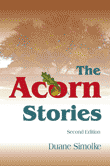
My first book was The Acorn Stories, an irreverent and often comical story cycle. I set it in West Texas, where I happen to live, but created the fictional town of Acorn for most of the scenes.
From the story "Mirrors: A Blackmail Letter."
“I’m not a bitter person.” I certainly couldn’t say the same today, but it was the truth at that time. Growing up black and gay in a town that didn’t care much for blacks and didn’t allow anyone to admit gays existed was enough to make me bitter, but I’d resisted up until recently. Besides, I’d seen the racism dwindle quite a bit over the past several years, and I had a lot of distractions to keep me happy. I had my buddy Keisha, I had my notions of starting an art house in some big city, and I had my little out-of-town excursions.
“Sometimes, I’m a little bitter.” The steadiness of your deep voice divulged a slight crackle during that admission. I had never guessed you were in your forties, until I saw you sitting there with the cup of coffee I handed you, the wrinkles around your eyes folding up as you sipped. Before our little talk, I had only seen you in the dark or at a distance. I had never been able to study your features. Up close and in the light, you actually looked much less handsome.
I sat down beside you, after adding some sugar to my cup of coffee. “Now you can’t be getting tired of being a rich, white man.” I meant that strictly as a joke, not a dig of any kind, but you looked offended. After all, you had spent most of your life protecting that station of privilege by hiding the part of you that might have excluded you from it. “Sorry. No more ethnic humor. Tell me your troubles.”
Then you told me that story; it was too insane for you to have made it up. Besides, I’d heard plenty of stories just like it. “My parents found out about me while I was in college. They said that they were going to have me cured, or that they’d disown me and cut me off from the family money. Over the past thirty years, I’ve been through shock therapy, exorcisms—you name it. At least they took me away from this one group that told me I had to blame my parents for how I was and cut them out of my life. I was trying to keep them in my life. My parents were all I had, and I couldn’t imagine living without them.”
From the story “Paying the Rent.”
I couldn’t help but notice how fat Lisa had become. She looked like one of those women who see themselves as big-boned, full-figured, girthful, well-rounded, plump—the kind who get blind dates as someone with “a nice personality.” She barely resembled her former self. Sure, she had always carried a wide load in the back, and her face retained baby fat all the way through twelfth grade, but I expected more—or rather, less—when, after a seven-year disappearance, she called to say “Guess who?” I still loved her bright blue eyes and bouncy blonde curls, but the rest of her looked like something created in a misshapen Jell-O mold.
From the story “Timothy Fast.”
“Very well,” said Memphis Lee. “But first, I have a gift for you.” He reached behind his back and retrieved something furry.
“A stuffed tarantula!” Ruth Feinstein grabbed the oversized toy from him and cradled it against her neck. “You’re so sweet. I’m sorry I called your place a dump and everything.”
Rubbing his temples, Timothy Fast said, “About those ties. . .”
“Look by the cash register,” said Memphis Lee. “We have the new graphics line. Senator Briggs was complaining about their violent imagery leading to street gangs and the disintegration of the American family, but the company made a contribution to his party, and now he calls them ‘the family values ties.’ I just love politics!”
From the story “Mae.”
As the afternoon train rushed by the graveyard, shaking the ground, an oak tree dropped an acorn near Cleburne’s grave. Mae wondered why nature made itself that way of acorn and oak remaking and dying and becoming something big to make something small to become something big, that way of making, that way of becoming, that way of everything becoming itself only to look for something else, and everyone else looking for everyone else looking to become, becoming in the process of looking.
Mae thought these things at her husband’s grave because she thought she and Cleburne would continue always in their becoming and remaking until the dying happened, but that somehow the dying would happen to both of them together, just as everything else happened to them both together. She always thought the becoming married made them become one, because she thought two people who existed as one for fifty-eight years could not become only one person who existed as one alone for even one minute, because this becoming . . . it could not lead to this point.
From the story “Survival.”
As he drifted away, he dreamed he visited Seventh Street Baptist Church. When he pulled onto Seventh Street from Carsons Avenue, he saw the steeple, its golden football glimmering in the Sunday morning sunlight. Football? A dove flew down from Heaven but flew into the football and fell to the ground, where church-goers scalped season football tickets and exchanged AIDS jokes.
Inside, some football players set a bound cow on the altar, in front of another golden football. Coach Jacobs patted all the football players on their butts then picked up a knife. The cow looked into Chandler’s soul as the blood drained from her slit throat.
The sound of a siren in his driveway pulled Chandler from the dream, back to his bleeding foot.
From the story “Flip, Turn.”
I pulled myself up enough to see the alarm clock just across my room. 10:15! It had happened again: after dreaming during the night that my alarm clock was buzzing, I had gotten up and turned it off, realized I was dreaming, stayed in bed wondering whether I had also dreamed turning it off, then fallen asleep without turning it back on.
“Swimming,” I mumbled into my pillow. I was supposed to have met Jimmy Jacobs at Acorn College’s indoor pool around ten. Since I hadn’t gone swimming in weeks, I had no idea where my alumni I.D. was. I searched my disintegrating wallet, pulling out shreds of napkins, envelopes, and newspaper with scribbled numbers. Some of the numbers looked like combinations for P.O. boxes or lockers, while others looked like phone numbers, but none of them had words on them. My wallet housed numbers detached from their purpose. I thought I should keep them in case I needed them one day. But how would I know if I needed them, or which ones to use? Then I found a phone number with a familiar handwriting.
I could have called all the phone numbers to see if I recognized the voices of the people who answered. Then I could just hang up. Maybe that’s what people are doing—the people who call me then hang up. Maybe they sorted through old wallets and purses, found my number on a scrap of paper. After finding my I.D. in the dark recesses of my wallet, I stuffed all the numbers back in to recreate whatever equation they had formed, knowing I would probably not see them again until my wallet fell apart.
After pulling on swim trunks, T-shirt, and tennis shoes, I walked outside into Mom and Dad’s yard sale and suddenly remembered that I really need to get my own place.
Jimmy Jacobs wasn’t even at the pool when I got there. I decided not to mention it to my mother—never mind that I’m twenty-eight—because she would just say, “I’ve told you about that Jacobs boy.” From junior high ‘till well past high school graduation, no teenagers within a forty-mile radius of Acorn could get drunk, stoned, beat up, arrested, or pregnant without their parents asking, “You’ve been hanging around with that Jacobs boy, haven’t you?” By the time I graduated from college—a lot of good that did me, the new assistant manager at Ice Cream Dream—he was a husband, a father, and the pastor of Zionosphere Baptist Church.
From the story “Acorn Pie.”
People tell me a little more than they should. Well, a lot more than they should. Actually, people tell me way too much. Or they say too many things where I can hear them, which is just the same as telling me, as far as I’m concerned. Do they really think I won’t share what I heard with anybody? I mean, stories like these can’t just sit on a shelf in somebody’s brain. The more I think about it, the more sure I am that my neighbors want someone to tell their Acorn stories, that they don’t want to be just a small part of a small town in a big state in a big country. People aspire to leave something behind other than babies, a mortgage, and a nasty rumor or two. And they certainly want someone reliable telling it, like what my grandmother did when she chronicled the early folks of Acorn.
Want to review or comment on this short story?
Need a FREE Reader Membership?
Reviewed by Steve Talbot
1/25/2004
Thes were some great excerpts. Duane, you are a very visual writer. I could actually see the people and places in my mind, painted there by your well-crafted words. I will definitely have to get my hands on some of your books.
Steve
Martin Powers wanted an ironing board for Christmas. Instead, he got . . . Matthew Kieler, a non-returnable gift, but a gift that kept on giving. A powerful tale of survival, compassion and unapologetic love in the time of AIDS.
Martin Powers wanted an ironing board for Christmas. Instead, he got . . . Matthew Kieler, a non-returnable gift, but a gift that kept on giving. A powerful tale of survival, compassion and unapologetic love in the time of AIDS.