Beached! High and dry! Saturday morning found young Charlie Hagglund sitting on the split-log bench at Morro Bay’s public boat ramp. After saving a vessel adrift in bad weather the storm broke over his own roof. His Auntie Lillian may have been proud of him for saving the life of the man aboard the derelict boat. If so, it was not her pride that was on display.
Charlie had put himself in a perilous situation, sneaking out at night in the middle of a storm. To top it off, when found by the Harbor Patrol, Charlie was not wearing his navy gray life jacket. The fact that both boats were safely aground was not accepted as a plausible defense by an Auntie who had lost her husband to the sea.
Saturday matinees at the Bay Theatre were blockaded for four weeks. Two of those weeks sported Doris Day comedies and one a cowboy flick. These were not much of a loss, but he would miss “Francis in the Navy”. Having watched other “Francis” movies, Charlie found the talking mule amusing and the kissing strangely tolerable given his recent involvement with Peggy Phillips, a girl sea scout from Alameda. He wondered if she would ever return to re-visit her uncle in Morro Bay. He quit wondering and re-examined his current dilemma.
His fourteen-foot yard boat “Bob’s Comet” suffered a damaged Evinrude outboard motor that was over-taxed while forcing the larger boat onto the sandspit during a fierce storm that swept in from Estero Bay. The Hunter Hull had broken loose from its mooring in Fool’s Anchorage, a backwater haven for forgotten boats.
Abandoned by her owner the boat was not unoccupied. While credited with saving the life of Edmond Julius Elliott, Charlie found mitigation from heroics with the realization that, if it wasn’t for his seeking shelter for the man, Mr. Elliott wouldn’t have been put at risk in the first place. Charlie had more faith in Mr. Elliott’s abilities than most people, for he had witnessed the actions of the former Cal Poly rodeo star in lassoing a piling to save both boats from being swept to sea.
Charlie’s twelve-foot rowboat “C-Weed” was impounded along with the Saturday matinees. Thankfully, Auntie Lillian did not bar Charlie from the use of his candy-apple red Schwinn, a fixed-gear bicycle with a wide saddle and comfortable pneumatic tires. The rear fender was bolstered by a heavy-duty rack suitable for mounting canvas saddle bags for delivering newspapers. Charlie didn’t deliver papers during the summer months spent away from his home in Santa Maria. He used the bags to ferry parts and provisions from the house to the boat basin. Now the bike was his only form of harborside transportation.
Restless, Charlie mounted his bike and headed north along Morro Bay’s embarcadero, waving to shopkeepers who were preparing to open for business, and early morning artists who had canvas ready to receive the colors of inspiration. Scant automobile traffic gave little hindrance to his progress as he passed the Morro Rock Yacht Club. He was heading north, beyond the tourist pier where idle fishing boats laid as bait to foot traffic, and seafood joints advertised freshly cooked crabs with steaming pots of boiling crustaceans.
Securely moored starboard side to the north pier, the United States Coast Guard Ship “Alert” glowed in all her whiteness, catching the early rays of a summer's sun. Known as a “buck and a quarter” to those who sailed in them, all one hundred and twenty-five feet of the Action Class Patrol Boat seemed to reach out and embrace Charlie.
He found in “Alert” a source of inspiration, a place where meditation was possible. He saw in her a future spiced with blue seas, exotic isles, and high adventure. He knew even then that he was Navy bound, for no other branch of the service, neither Coast Guard nor Merchant Marine, offered him the level of excitement he felt when sighting a hull of haze gray. Impatience was spiked by the emptiness of his day.
“Alert” posed with the special effect that characterized any gracefully designed ship. Tied to the pier she seemed to be moving through the water at flank speed. With low freeboard, her main deck was even with or just below the pier for all but the highest of tides. Darkened porthole skylights along the hull hid secrets of shipboard life that Charlie yearned to be a part of.
Standing on the dock alongside the superstructure that reached from wheelhouse to flying bridge the ship blocked from Charlie’s view the mass of Morro Rock rising behind her. He felt the throb of a diesel engine idling in readiness along with the vibration of an auxiliary generator churning away to power blowers encased in steel ventilators. The pulsing and breathing of machinery convinced Charlie that the ship was a living being.
Early morning odors of coffee and sweet rolls came from an open watertight door which led to the small mess deck area where the crew ate their meals. A sailor stood watch at an opening in the ship’s railing that allowed access to those authorized to board. Charlie was not amongst the chosen.
“Hey, kid. ‘What’cha up to?”
“Morning sir.”
“Don’t call me sir, boy…”
“I know. ‘Ya works for a living.”
“Har, har kid, that’s a good’n.”
“Been on ‘er long?”
“Naw. Just got sent down from Alameda. Shipped me out on a goddamned Greyhound. Had to hitch from San Louie Obispo.”
“Luis.”
“What?”
“San Luis Obispo. Way she’s pronounced.”
“Yeah. Whatever. Get along with ‘ya before the Chief chews my ass out ‘fer lollygagging with a kid.”
Charlie was used to getting the cold shoulder from the “Coasties”. While they were there to protect and save fishermen and civilian sailors from the perils of the sea at the risk of their own lives they were not readily accepted as members of the community. Their nomadic existence as visiting sailors going from port to port without taking root forced them to insularity. When ashore frequenting local bars in too-close contact with the girlfriends of local fishermen, they were tolerated at best or brought to combat at worst.
“Us versus them” was a reality for both sides.
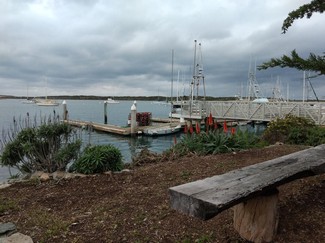
Off to shoreside of the pier was the shack that served as headquarters for the Morro Bay Harbor Patrol. Charlie dismounted and sat on a planked seat bearing the roughly carved title “Liars Bench”, a testament to the well-known lack of fisherfolk veracity. Leaning over, he rested elbows on knees, chin in palms and gave a deep sigh. He had never been so bored in his young life.
Idleness wore on Charlie with the dull ache of a sore tooth. Jumping up from his perch he remounted the Schwinn and headed back down the embarcadero in search of diversion or activity. He found both at the harbor’s fuel dock.
Jim Saenger was a difficult man to have as an employer. He expected those that worked for him to give efforts that outreached his ability to reward with praise or wage. Employee turnover at the Marine Service and Fuel dock was high. It was not unusual for Saenger to be left to run his business on his own.
Charlie watched with amusement the efforts of a large purse seiner attempting to come alongside the fuel dock. The boat was obviously from another coastal port, Monterey or Moss Landing probably, and her skipper, unfamiliar with the strength of the bay’s ebb, had attempted to drive the boat to the dock. As soon as he reached a spot opposite a mooring cleat he dis-engaged the engine. Before a line could be secured the boat was pushed stern-first away from the dock.
“Pull her up a length, throw on some opposite rudder and let her back down to the dock,” Saenger yelled, as he waited for the bow line. The bow hook was able to get a messenger line to land on the dock. As Saenger grabbed the line and started to take it in Charlie realized there were two immediate problems that put boat and landing at peril.
First, the skipper of the fishing boat misunderstood which way to throw the rudder and was forcing the boat’s stern away from the dock. Second, Mr. Saenger was working alone with his hands full of bow line. There was no one to receive the stern line. Charlie laid down the Schwinn and ran to the mooring cleat furthest aft of the boat.
“Put ‘yer rudder hard over,” he yelled. From fifty feet out the crewman standing in the stern sheets threw a monkey-fisted line that went over Charlie’s head. He quickly snatched the light line and hauled in the heavier mooring line. Slipping the hawse eye over the cleat he stood back and watched as three crewmen hauled in the line slowly bringing the stern even with the dock.
As Mr. Saenger approached, Charlie retreated to his bike, rescuing it from any danger of being run over by a service vehicle.
“I could’ a handled ‘er, ‘ya know,” Saenger said.
“Yes sir, I know that.”
“Well, let me get her fueled and iced ‘n we’ll talk, ‘less you got somewhere ‘ya ‘gotta be.”
Charlie recalled his day so far. “No sir,” he said, pushing his bike over to the fuel shack. He set a fish box on edge and had a seat.
“You’re that Hagglund kid, ain’t ‘ya?” Saenger asked as the purse seiner chugged back towards the south pier to take on groceries.
“I’m Charlie Hagglund, yes sir.”
“Saved that old rummy during the storm?”
“Mister Elliott did as much to save me as I did to save him.”
“What’ve ‘ya heard about me, kid?”
“Nothing I’d care to repeat, sir.”
“Yeah. I can be a son of a bitch sometimes. Tried to square away these knot heads say they want a job, but none of ‘em wants to work a job. Get’s their feelings hurt ‘n off they run.”
Charlie let the comment hang in the air until Mr. Saenger felt a need to fill the vacuum.
“You ‘want ‘a work a job, boy?”
“I would have to ask my aunt. She’s not exactly in a mood to grant me any favors right now.”
“Lil?”
“My Aunt Lillian, yes sir.”
“I know your aunt. Knew your uncle Charlie too. Hell of a fisherman he was. Always topped off here before going to sea. Hard to work for I hear. We had that in common, coming from the same school.”
“School, sir?”
“Hard knocks, boy. The school of hard knocks. Let me talk to your Aunt Lillian. Haven’t seen her in an age.”
“Mister Saenger. If I was to go to work for you there is one thing we would have to agree on first.”
“What’s that, boy?”
“My name is Charlie Hagglund. Charles if you’re pissed at me.”
“Fair enough, Charlie,” Mr. Saenger said, extending his hand.
Charlie celebrated his fourteenth birthday on the fuel dock. He was allowed to work only so many hours a week due to his age. By the end of his month-long restriction, he had earned the money needed to pay for the repair of his Evinrude outboard motor.
In his four weeks of working for Mr. Saenger, Charlie had learned many things. He knew of the different grades of fuel used by power boat and fishing vessel. He could monitor and maintain water flow into the cascading ice machine that preserved a fisherman’s catch. He had boarded many a vessel and had learned to assess the quality of a skipper by the condition of his boat. He had learned that fishermen come in both genders and was no longer surprised when a skipper wore bandana and lipstick. His vocabulary of nautical cusswords tripled.
Charlie began to despise the calendar. Finally, back on the water, he had only a few weeks left before the State of California would require his return to school. He had hoped to remain in Morro Bay but the lack of a high school there would mean being bussed into San Luis Obispo. He had life-long friends in Santa Maria. Some of them were old enough to drive.
“Bob’s Comet” left the boat basin and rounded White Point with “C-Weed” in tow. Approaching the boat ramp Charlie stood offshore as his Auntie Lillian backed the boat trailer hitched to her big Buick down the ramp with expertise that had been years in the making. With the “Comet” made fast to the trailer, the Buick pulled up the ramp without the spin of a wheel. Charlie rowed “C-Weed” down harbor to the south pier.
By the time he arrived Aunt Lillian had backed the boat trailer to the coin-operated crane perched on the edge of the pier. She lowered the slings that Charlie put in place under “C-Weed”, ensuring they would lift the boat in balance. Shipping oars and removing oarlocks he climbed the ladder from boat to dock. “C-Weed” returned harbor’s water to it’s source as she gained altitude. Nested inside “Bob’s Comet” she held in her bosom the precious Evinrude outboard motor.
Aunt Lillian backed the boat trailer into the empty yard space along the row of pallets storing trawl nets behind his Uncle Charlie’s gear shed. Tarps were secured over the nesting boats to keep them weatherproofed. As the Buick pulled away he didn’t look back.
And what a summer it was! Charlie certainly had a great coming-of-age in Alameda, San Luis Obispo, and Morro Bay. Once again, so autobiographical. You make me remember my three years in California. Spent some time on Alameda with a friend/neighbor from Wisconsin who served his Navy duty as a driver for the commander 1967-69. Studied while waiting in the car and got his GED.
Reminded me of my fourteenth summer when I started working for Mr. Nowaki. My twin brother and I learned everything about raspberries helping him grow, pick, and trim his city plot by the railroad tracks. He also taught us a lesson about fishing one day, taking us out when he was drunk, but still outsmarting us catching a nice 28 inch northern that my brother Roger missed.
I Made My Boy Out of Poetry is a powerful literary vision of rare scope, beauty and emotional intensity composed of stories and poems that flow in and out of each other like the most lucid and articulate of dreams. These are portraits and studies of
The bulk of the collection is eight short stories that are set in yesteryear. The compilation is filled out with four entertaining fantasy pieces and three poems.


 Charlie and the Fuel Dock