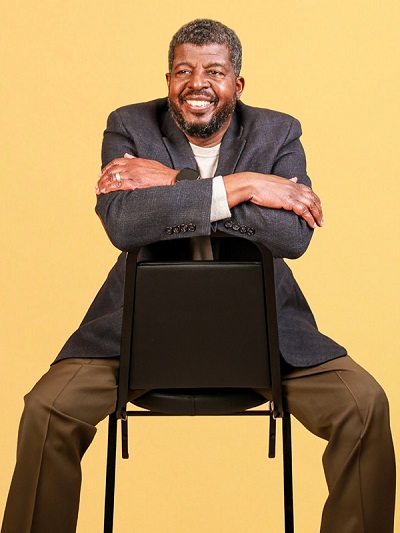
Before becoming a Pulitzer Prize-winning journalist for The New York Times, he drove an NYC taxi.
In this in-depth conversation, we discuss race in America, bias in journalism, and the challenges of writing a novel set during WWII.
"One-to-One with John DeDakis" goes 1-2-1 with author Steven A. Holmes.
See and hear it here:
https://www.youtube.com/watch?v=FH3KtZ5kzoE&list=PLXDV_HPUqtvvV-j0lyb2BsaZNSW3GCcDP&index=1&t=3766s





Like you, John, in Lacrosse, I spent my grade school in Wausau in a deteriorated neighborhood with criminals as neighbors. Classmates bound for reform school and prison. But by high school, we moved to Marshfield. During growing up experience, there were no blacks. In high school, a only girl who seemed to have some native roots. But in our junior year, the pipeliners came along with the building of a gas pipeline across the state. They were all from the south. They were all white, but from different classes. Later, while taking a educational sociology course, I wrote a paper on the five or six cliques in high school that were more evident at our 50th anniversary than our 20th anniversary where we danced all night to The Beatles.
I credit my lack of prejudice to my affable father whose mother was a school marm for an eighth grade rural school for a small black community near Owen, Wisconsin. I never heard him utter a racial epithet and my mother was a well educated cleaning lady with two sets of twins who welcomed all the misfits I brought home to her a great cooking.
While I sensed some prejudice during my three years at Atlanta University as and an associate professor, when I joined Texas Southern University in 1981 as a special assistant to the vice president of administration, I observed there was a great deal of prejudice on campus, often characterized by the darkness of skin. I also was privileged to be accepted generally by the initial carefully picked black students who were first allowed to go to the University of Texas in Austin. They all had doctorates from there or elsewhere. The school was run by academics. The previous president had been gay. But by the mid 1990s the board became filled with failed black business people who thought they could run the university better than the academics and installed accountants in charge. I suffered very much discrimination of a different kind for my disability during the last 15 years of my 30 years of service there. I was so glad to get away in 2011 to write fiction full-time in retirement.
I immediately thought of Eric Hoffer when I heard Steven talk about his experience as a cab driver. I don't know his reason for leaving Rutgers, but I left Stanford with mixed feelings, especially the way they treated me with my disability when they could've enhanced it. I owe my underpinnings to UW-Stout like Steven with CCNY where I participated in civil rights and got to see Martin Luther King speak.
World War II stories never seem to grow old. I wish Holmes good luck with Black Messiahs. I'm currently following Tom Hanks version presenting mostly World War II news reels that I've seen before.
Ron