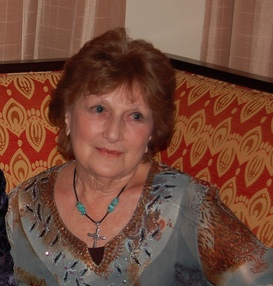
It would be 12 years before the Civil Rights Movement officially began when our church in a small southwest Oklahoma town decided to conduct Vacation Bible School for the children in colored town. Here I met friends with whom I would keep in touch all my life, and two women with whom I credit helping me get through college. It is our story.
One Woman’s Memories
By
Lona Smith
When the announcement of my 50th college reunion came, I didn’t give it much thought. If I thought anything at all, it was, why would I want to go? I hadn’t been back to the campus since that day in May, 1956 when I, my last name beginning with an “A”, was the first one to walk across the stage, shake the Dean’s hand and receive my diploma. Nor had I kept in touch with any of my classmates.
E-mails from former classmates began arriving—people I hadn’t been in touch with for 50 years. Then the message came from Margie. “I remember you in my mind’s eye, so seriously studying on your bed. I remember the trip to your home and your giving me first hand, up close and personal experience with being around blacks. That was a precious experience for me.”
The memories that came flooding into my consciousness were not of campus activities or campus romances but of two black women to whom I give great credit for getting me through college, and those black friends of my youth whom Margie met the weekend she came home with me.
It was the summer of 1951, thirteen years before the Civil Rights Movement would officially begin, that the pastor of our Baptist Church in the southwestern Oklahoma town of Snyder, decided that we should hold Vacation Bible School for the Colored children. Pastor Foster Brown was a Choctaw Indian, a preacher so fervent that he kept a white handkerchief in his hand to wipe away his saliva and perspiration when he really got going on a sermon. He was also one of the most compassionate men I have ever known. I was the youngest of the eight or ten volunteers who taught that first Vacation Bible School. I was fifteen years old.
Until that summer I had never given much thought to the 200 or so dark individuals who made up approximately ten percent of the population of our small town. I was aware of a couple of black men who sat on stools at the local filling station and visited with the proprietor, and a few of my friends had parents with enough money to have one of the colored ladies come to clean their houses.
Colored Town was across the railroad tracks to the north of town. It consisted of 30 or 40 primitive houses; white, or not painted at all, a couple of churches, the local café and general store where everybody gathered, and the white, one story, clapboard school house. Barefooted, and sometimes bare-bottomed children played in front yards devoid of grass.
Vacation Bible School was held in the school house. It was the only building large enough to accommodate the 50 or 60 children who showed up that first day. They ranged in ages from Thaddeus who was four, to seventeen, and in height from two feet to Leroy who was the oldest and tallest at six feet five.
Their wide smiles were all the brighter in their very dark faces. And, they were as curious about me as I was about them. Cautious fingers reached out to touch my skin. Does white skin feel different? Then, touches became holding hands—holding hands became hugs, and by the end of the first week I knew what their oiled skin and their crinkled hair felt like and I had new friends.
It was a glorious week. We had Bible stories, taught them new songs, had crafts and Kool-Aid. They were well behaved and eager to learn. Fights didn’t break out until recess. Usually they were between teenage girls—over a boyfriend, but sometimes other family members jumped in. Brother Brown was the one who broke up the fights. When they picked themselves up we brushed off the dirt, straightened their clothing, treated scratches and when the bell rang for us to reassemble, all was forgotten, and I guess, forgiven.
What I didn’t understand was that we, the white teachers, were supposed to share the “Good News” and then walk back across the tracks as though we’d never met these people. So I, having recently gotten my driver’s permit, continued to visit my friends. I was the closest with my teenage peers. When Celestine decided to get married, she asked if I would do her hair for the wedding. “I want it fixed like yours.”
“Sure,” I said, having no idea how I was going to accomplish that.
In her bedroom she handed me a jar of Elephant Grease. “You have to use this.”
“Okay.” I scooped some grease on my fingers, parted a section of hair and began rubbing it on.
“No. No,” she said. “You put it on the scalp and work it down.” I hadn’t a clue how time consuming, how labor intensive and yes, how painful it was for African American and other black women to manage their coiled, nappy hair. I for one rejoice in the beautiful natural styles black people wear today. Finally, with help from her sister, Duralene, we had a style that was enough like mine to be acceptable. I was in college when Celestine’s baby was born. She sent me a picture. Her little girl lived only a week.
We held Vacation Bible School in that white school house for two more years, then I went off to college and Brother Brown moved on to another pastorate. I kept in touch with my friends.
My parents were older than the parents of most of my friends. My mother was 35 and my father 40 when I was born. I credit their wisdom and understanding for my view of life. They never forbade me to see my colored friends. In fact, when ten year old twins Herman and Dean wanted to trade comic books, they would walk to our house. It never occurred to me until years later how uncomfortable it must have been for them to come into our home. My mother always made them welcome. That was not true of all the good people who went to our church.
One hot day in August I ran into three of my friends on Main Street. One of them was Leroy; I can’t remember the other two. Our town was so small you could walk anywhere in fifteen minutes. “Let’s go get an ice cream cone at the Dairy Isle,” I said.
“We can’t do that.”
“Why not?”
“They won’t serve us.”
“Well, they will serve me. I’ll buy them for you.”
As we walked the three or so blocks to the ice cream place a car pulled to the curb. “Lona Lou,” someone called (when I was growing up everybody in Oklahoma was called by their double name). “Do you want a ride home?”
It was a lady from our church.
“No thank-you,” I said. “We’re going to get an ice cream.” We kept walking.
The car crept along beside us. “I think your mother would want me to take you home.”
“I’ll ask her when I get there.” I could be sassy when I wanted to.
A large elm tree shaded the Dairy Isle. While my friends waited under that shade I shuttled ice cream cones to them. It was the first of many ice creams we would share.
The week before I left for college I drove to colored town to say good-by. Herschel and Jerry were going into the military (I still have snapshots of them in their uniforms). Herschel said he had something he needed to talk to me about. We sat in my car and he told me his girl friend was pregnant. “I’m leaving for boot camp and I could just go, but I don’t think that’s the right thing to do.”
I wanted to believe that coming to vacation bible school and hearing the story of God’s love would influence his decision. “You’ll do the right thing,” I told him.
I stopped to say good-by to Martha and Ed Johnson. I’d met Martha through her nephew, Jerry, whom she and her husband were raising. Not only was she saying good-by to me, but to Jerry too. How warm and wonderful and jolly she was. I’m convinced it was her burnt sugar cake, which she always had ready for me to take back to school when I came home for a weekend, and her burnt sugar cookies which she regularly sent helped get me through school. I’ve never tasted any like them since. I’ve often wished I’d had the foresight to get the recipes, but, when you’re 18, 19 and 20 you don’t think about there being an end to things.
When I was married in 1958 my vows were said in the church in Snyder where I grew up. I wanted Martha and Ed to come to my wedding. I sent them an invitation.
“We can’t come to your wedding,” they said. “We wouldn’t be welcome in your church.”
“But you’re my friends. If I invite you to my wedding I dare anybody to say anything,” I protested.
“Honey, we wouldn’t do anything to ruin your wedding day.”
I went back and told my mother and her friend who was giving my reception in her home. I don’t remember who came up with the idea but we decided that if we asked Martha to help with the reception maybe they would come.
She did. Ed didn’t. She came in her white starched uniform. She sat in the back pew during the ceremony and at the reception she carried punch cups and plates to the kitchen and washed them. Nobody said anything.
The other woman I credit with helping get me through school was Sidarthur Johnson and her husband, Herb. (No relation to Martha and Ed Johnson, but then, Johnson is a common name.) Sid and Herb owned a tiny diner in colored town in Shawnee Oklahoma, also home of Oklahoma Baptist University where I went to school. When I say tiny, I mean tiny. It had a long, low counter and maybe a dozen stools. There were no tables or booths. When you ate you sat on a stool and Sid entertained you, while Herb served up the best hot roast beef sandwiches I have ever eaten—still, to this day. That was all they served. Officially they were French Dip sandwiches, served on a French bun with au jus and mustard so hot tears rolled down your cheeks. But sometimes you were crying because you were laughing so hard, at Sid who “cranked you up” while you ate. That was her job, she said, to “crank you up” before an exam or even afterward if you hadn’t done well. She would not allow us to feel sorry for ourselves.
Sid was also the first black person I’d ever seen with freckles. Her skin was the color toffee and she had darker freckles scattered across her cheeks and her nose. She did not weigh more than 80 pounds but her laugh could be heard a block away.
I don’t remember how my friends and I found out about Herb’s and Sid’s, probably from some upper classmen because half the campus went there. In fact, half of the population of Shawnee went there, but most of the white folks would drive down, pick up their order and take it home.
They had a fantastic business. They served more than 500 pounds of Grade A, Armour Star beef each week, Herb in his white apron slicing up that tender beef. They did so well they built a new house behind their diner—Sid’s dream house. Herb adored Sid and gave her everything she wanted.
Sid and Herb had no children and somehow, my friends and I became her favorites. When her new house was finished, she invited us to come see it and have coffee. I didn’t drink coffee, but I was not about to miss the invitation. The house, I remember, was a brown ranch style. After the tour, she seated us in the living room in front of a stone fireplace and excused herself. A few moments later the side of the fireplace opened and out popped Sid.
She had always wanted a house with a secret passage, she said. I’ve since wondered if something in her memory bank of times long ago made her want an escape route.
Then, there was graduation, marriage and eventually, divorce. We went our separate ways. Jerry was killed in an automobile accident in his 20’s. I heard that Herschel moved to California after he got out of the service. Martha and Ed; Sid and Herb are all gone.
A few years ago I went back to my hometown for a visit. I drove across the tracks to see what was left. There was little of what I remembered. The tiny houses and shacks were gone, replaced by neat brick houses. The little café where things got lively on a Saturday night was still there. The churches were still there, but the schoolhouse was gone. All the children from the community were integrated into the school from which I’d graduated in 1964.
Word got around that I had been there asking about people I had known. The next morning the telephone rang at the friend’s home where I was staying (the same friend who’d given my wedding reception forty-five years earlier). It was Leroy. “Ask him to come over,” she said.
The same tall Leroy for whom I’d bought ice cream fifty years before stood at the door, but he was not the skinny 17 year old. He had filled out. He was massive. Leroy and I sat in the den and visited for two hours.
Our area of Oklahoma is known for its granite. He told me he’d retired from the granite quarry where he’d worked since he left school. He told me about his family; about the beautiful brick house he’d built, and that he’d quit drinking. Then, he told me why.
Leroy showed me a scar on his throat that went from one ear to the other. His wife did it, he said. “I could a been dead.” Although he worked hard all week he liked to get drunk on weekends. He didn’t tell me what he did that made his wife so angry, but the close call made him realize that he could have lost everything for which he’d worked all his life. Five years later he’s never had another drink.
The last time I talked with him he said his wife was in a nursing home in a town 35 miles away, that she had gotten very heavy and couldn’t walk. Every day he drives the 70 mile round trip to help lift her so the staff can care for her.
Then Leroy told me Herschel had moved back to Snyder. I called him and we agreed to meet for breakfast the next morning. I cannot say how happy I felt, sitting across from him in a booth at the local café that had been there forever. He carried a framed 8 x 10 photograph of a handsome family—his son, daughter-in-law and three grandchildren.
“Remember that conversation we had a long time ago?” Herschel asked.
I nodded. “So you did marry her?”
“It was the right thing to do and I’m glad I did.
“We were married for 12 years,” he continued. “It was hard on her with my being in the service and gone so much. She did a wonderful job of raising our son. He grew up to be a good man. I married again and have another family, but she and I are still friends.”
And so are we. Herschel and I finished our breakfast and our reminiscing. I handed the waitress the camera I’d brought along. She took our picture.
TRUE STORY. Bella survived an abusive powerbroker father with organized crime ties, a drug-addicted mother and a physically/sexually abusive brother. Shocking & inspirational. When she couldn't cry, she tattooed a crying angel to cry for her.
TRUE STORY. Bella survived an abusive powerbroker father with organized crime ties, a drug-addicted mother and a physically/sexually abusive brother. Shocking & inspirational. When she couldn't cry, she tattooed a crying angel to cry for her.