An Arrow for Amaterasu
Back in 2017 (some 8 years ago), I was up in Gold Beach, OR, just north of Brookings, taking a writers’ sabbatical. My very old and close friend from Bezerkeley days, Terry Riley (now demised, sadly) had offered to let me use his guest cottage on the side of a hill just outside of Gold Beach. It was a beautiful setting for any writer to draw inspiration from, since on the upper, inner, uphill aspect of the property, it was heavily forested and overrun with natural flora. California Oak, pines and fragrant undergrowth gave it an almost wilderness setting, and each day a host of forest critters paid me a visit just after dawn and before dusk.
The lower slopes below the cabin commanded a magnificent view of Oregon’s rugged coastline, which in the Gold Beach area is as splendiferous as one could hope for whenever the perpetual fog banks stayed a bit offshore. The setting sun itself, as it sank into the deep blues of the coastal Pacific, created a golden haze as its orb extinguished itself in the off-shore waters that would charm even a stolid Calvin Coolidge clone.
By coincidence, I had been thinking vaguely about writing a book that would somehow draw in the story of the amazing German Dornier Aircraft Company’s highly advanced Do-335 ‘Pfeil’ aircraft, how it came about, was developed and flight tested, with its twin supercharged engines...one in the very front and another in the rear of its fuselage. At the time, in the last few months before the European War came to a conclusive finish, it was regarded as the ultimate expression of propeller-driven aircraft design. With a top-speed very near 500 miles per hour, the huge fighter aircraft had taken conventional prop-driven technology to the very apex of the possible and even in the face of radically advanced turbojet engine powered aircraft, it constituted a formidable aerial weapon.
At that time, with Germany nearing the point of total collapse due to the overwhelming combined might of the Allied Forces closing in on the Nazi regime, aircraft systems such as the Dornier Do-355 (named the ‘Pfiel’ or “Arrow” in German) constituted a last ditch, supreme effort to resist the nearing collapse of the Reich. The Do-355 was, along with other radically advanced weapon designs (such as the V-1 and V-2 rockets, the Me-163 Komet, and the many turbojet fighters and bombers still on the drafting table, as well as the Kriegsmarine’s Typ XXI and XVIII U-boats) considered a ‘Wunderwaffe’ (or ‘wonder weapon’). The nearly exhausted German Wehrmacht looked upon all these radical weapons systems as a true game changer that might totally alter the conflict’s inevitable outcome.
From a purely realistic standpoint, however, even if these developments had been successfully deployed in actual combat numbers, Germany would only have achieved temporarily staving off the final collapse that the sheer numbers of Allied counterpart systems promised to deliver as a fait a compli.
Given the formal alliance Germany had with its Axis partner at that time, Japan had followed many of these specially advanced German aeronautical and sea weapons programs with keen interest, and in the case of the twin engined Do-355, the Imperial Japanese liaisons had expressed an interest in obtaining blueprints of the Pfeil so that copies of the aircraft could be made to resist the Western Allies advances in the Pacific as they closed in upon the Japanese homeland. To this end, Japan had already obtained permission to license-build a copy of both the Messerschmitt Me-262 (a twin turbojet fighter) and the Gerhard Fieseler Werke GmbH Fi-103, the world’s first operational cruise missile; both of these had actually been tested and flown before Japan surrendered (following the two nuclear bombs that were dropped over Hiroshima and Nagasaki). A specimen of the former (the Me-262) had actually been dismantled and transported to Japan in a German U-boat, which helped speed up the process of fielding a Japanese version of the twin-engine jet fighter/bomber.
Given the technological advances that the Do-355 Pfiel incorporated, the Japanese were eager to access plans for the Pfiel as well and build their own clones of the formidable machine. An inspired plan certainly but never carried through due to the sudden collapse of Nazi Germany in May of 1945. This, however, provided my inspiration to prepare a fictional account of this pending Axis Powers collaboration on the Do-355.
The date was 22 October 2017 when I sat down in front of the huge picture-windowed spectacle that the gorgeous Pacific presented me with and at a rate of roughly 4000 words per day, I had reached a total of some 50,000 words of my fictional story.
At that exact moment, approximately 6 November 2017, I woke up feeling a bit odd. Nothing I could put my feeling on, really...just ‘odd.’ And being a retired member of the cardiovascular medicine fraternity, I thought it best to have myself checked over.
Fortunately, Gold Beach had just opened a brand new six-floor, full-service medical center in Gold Beach so I presented myself at the ER, where I was informed that I seemed to have gone into a condition known as ‘atrial flutter.’ This condition is one in which the heart’s atrium and its ventricle miscommunicate, causing an arrythmia that is similar to atrial fibrillation (but potentially more serious). With a resting atrial heart rate of 166, it was clear that I needed some intervention, since sustained atrial heart rates like that can spur far more dangerous ventricular arrythmias (e.g. V-tach, or ventricular tachycardia) if not caught and corrected.
Cardioversion (restoring NSR or Normal Simus Rhythm) was therefore mandated ASAP and so after trying to unsuccessfully ‘cardiovert’ me with repeat doses of Adenosine, they finally used a defibrillator on me, which did knock the atrial arrythmia back to NSR. (For the record, being defibrillated while fully CONSCIOUS is definitely NOT a pleasant experience!
As a former runner, bicyclist and climber, having to experience something like this seemed not only improbable but grossly unfair...especially for someone who worked professionally in the field of heart medicine for over 40 years!
Finally, we found out that I had severely dehydrated myself, thanks to not drinking enough water (the cottage had no bathroom, so I hated to load up on water due to the need to visit the john in the middle of the night...which was at Terry’s house, a bit of a trek uphill from me!). I was also in the habit of sitting and watching TV with Terry in the evening, at which time I downed what had to be 16 or so ounces of red wine before hiking down to my cottage. Terry and his wife were both rabid baseball fans, so despite my dislike of professional team sports (NFL, NBA, etc., etc.) I sat through the ball games and sank into a state of semi-cranial anaesthesia as the Yankees continued to intimidate and trounce their opposing numbers.
The wine, plus not enough H20 had, it seems, resulted in a lowered blood magnesium level, which presumably had triggered the AF situation.
I was subsequently admitted for observation and spent 7 days in the Gold Beach Memorial CCU before being released, so that I could drive back down the coast to home (in Suckatomato), but it was also a wake-up call to me that I could no longer push the limits of reason by drinking a daily disproportionate draught of my favorite Rhone Valley wine and skimping on the H20 intake.
I’ve written a separate article on this whole unhappy (and rather avoidable) episode in my life elsewhere at AUTHORSDEN.COM (‘The Other Side of the Bedrail’), but I repeat some of it here as an explanation of where my work-in-progress (‘An Arrow for Ameratsu’) stemmed from and why it remained incomplete for a whole eight subsequent years!
Given my inherent interests in both aviation technology and Asian culture, these two areas of focus resulted in the manuscript I have once again turned to for completion. Hopefully, there will be some interest in it once it is published. The next challenge will be to start stumping for some wide-ranging marketing exposure, since as She Who Must Be Obeyed has already noted, it’s very likely that I’ve struck out even before the first pitch of the audience-capturing game has begun! Oi gevalt! Unconsciously, I seem, given my oddly eccentric proclivities and rather quirky interests, to have seized upon the very subjects that will completely shut-down any reader enthusiasms. We’ll see.
However, if anyone is interested, an early draft of the book (completed up to the point where I had the above bit of unexpected bad luck) may be viewed at the URL given on my AUTHORSDEN.COM home page ( www.authorsden.com/kalikianokalei ) and the projected cover illustration for the book is presented here, at the head of this backstory on the project.
Meanwhile, I am tempted to say that I’m “all a-quiver” to bring this potential thousand-year-old-egg to its predestined conclusion before it degenerates into a cloud of pure, noxious H2S (Hydrogen Sulfide)! Bows and arrows may have suddenly become popularized in the fascinating NETFLIX series, The Hunger Games, but it’s not likely that a story line combining ancient Japanese erotic courtesan arts and state-of-the-art aeronautical weaponry will generate a similar audience of wildly enthusiastic followers!






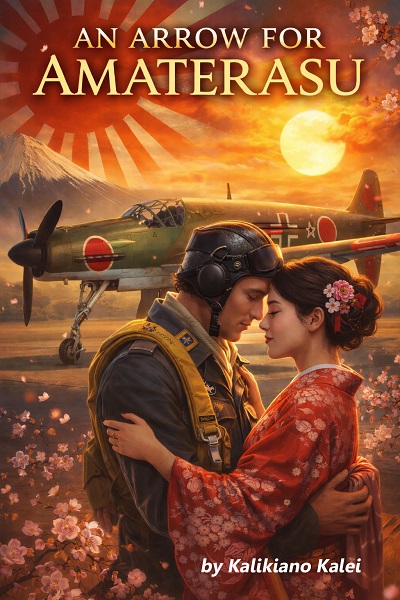 I seem to have become, herewith, an apologist for some of my failed or not-as-yet-completed writing projects. One that has remained incomplete for more than eight years is a rather unique experiment I began which attempts to combine advanced WW2 weaponry with some of the more exotic Japanese erotic arts (such as asphyxiophilia, etc.). It is also what I call an 'historical romance' but is at this time is only half completed and still a work in progress. I recently dug the manuscript out from a pile of moldering drafts and am back to work on it. Since beautiful Asian women are (and had been) frequently associated with spy and intelligence fiction, I guess I am just following a not-unfamiliar path here. It may appeal to the shrinking 'bodice-ripper' reader crowd or, on the other hand, it might attract some of the military history readers out there but that remains to be seen. Comparisons with an over-ripe 'Thousand-year-old-egg' are odious, but this is one egg (if it is indeed that) that you'll never have to jeopardise your GI system with! Shibui, anyone?
But your love affair strikes home. Making me wish that I had received the subtle marriage hints from that master's degree student from Taiwan who's doctor father owned a city block residence. And her private seamstress who sewed her ravishing silk outfits. Alas, I missed the boat in 1969.
Ron