Catenary Roe, by Juan Stonebreak
A Highly Elastic Chronicle of the Lower, Wetter Sort...
Monterey in the 1930s was a place where the fog arrived punctually, the sardines did not, and men of ambition were frequently mistaken for loafers of distinction. The street that pretended to be industrious and succeeded mainly in being aromatic was known, in polite cartography, as Ocean View Avenue. In practice, it was called Catenary Roe, because everything along it sagged in a graceful curve between hope and insolvency.
I, Juan Stonebreak, served as both resident scribbler and witness to the tidal absurdities of the district. My notebooks were salted with brine and beer. I had come to Monterey to write something serious and stayed to observe something ridiculous. The serious never showed up. The ridiculous? Well, read on...
At the center of our aqueous circus stood Doc Fred Ruckus, US Marine Biologist, amateur philosopher, and full-time collector of improbable specimens. He lived in a corrugated laboratory that looked as if it had been assembled by a committee of optimistic seagulls. Inside the small lower level that served as a garage for 1911-sized Electric Hupmobiles, were jars, nets, charts, microscopes, and a terrifying assembly of weird creatures of the deep. On the first floor, a phonograph that played opera with the conviction of a foghorn attempting Giacomo Puccini was braying forth with something the Maestro would have vomited upon, hearing.
Doc’s present obsession was the discovery of nano-sized French Poodles inhabiting the tidal pools of Monterey Bay.
You may assume I jest.
Doc did not. Doc never jested about his oceanographic passions.
“I have observed,” Doc declared one damp morning while adjusting his spectacles and peering into a tide pool with the intensity of a jeweler inspecting a flea, “that the foam collects in spirals resembling coiffure. And what is a French Poodle if not a coiffure with ambition and a wet nose?”
“It is also a dog,” I offered.
“Details,” Doc replied. “Science thrives on the overlooked.”
He believed, with a fervor normally reserved for revival tents and discount Kenyan Wildebeest oyster vendors, that beneath the anemones and barnacles lived a microscopic canine civilization. He theorized they subsisted on plankton pâté and communicated in tiny barks pitched above human hearing. He had even named the species Canis minimus pomponicus.
“Pomponicus?” I asked
“They are French,” he said gravely.
Doc’s aspiration was not merely to discover these diminutive poodles but to publish his findings in a reputable journal of marine biology. He longed for a byline that would read: F. Ruckus, United States Marine Biologist. He repeated the title as if polishing it for inspection.
“You are already a marine biologist,” I told him.
“Yes, but not yet United States enough,” he sighed.
Across the street from Doc’s laboratory stood Gee Whiz’s grocery, an establishment of such variety that one could procure soy sauce, bootlaces, existential advice, and occasionally a fish that had not fully resigned itself to mortality. Gee Whiz himself possessed the serene, inscrutable patience of a Zen monk and the accounting instincts of a Go grandmaster. It was ironic then, that he could never seem to acquire any Sardines!
When Doc explained his poodle hypothesis to Gee Whiz, the grocer nodded slowly.
“If tiny dogs live in tide pool,” Gee Whiz said, “they will need tiny bones. I can order wholesale.”
“From where?” I asked.
“Small factory,” he replied, inscrutable as always.
Further along Catenary Roe, in a building painted a red that had aspirations toward patriotism, operated Bertha Basoomas and her celebrated establishment, The Bear Flag House of Advanced Gentlemanly Hospitality. Bertha was a woman of amplitude, both physical and managerial. Her laugh could curdle milk at twenty paces, yet her heart was upholstered in scarlet velvet.
It was to Bertha that Doc brought his first serious account of the poodles.
“They are invisible,” he explained over a glass of medicinal whiskey (with a label that clearly stated ‘Kickapoo Joy Juice’ on it, for emergency use only!).
“So are most of my good intentions,” Bertha said. “What do these tiny dogs do, besides evade detection?”
“They may be the missing link between terrestrial vanity, aquatic persistence and Gallic persnicketyness.”
Bertha blinked. “Honey, if they pay rent, I’ll knit them tiny l''ill sweaters."
Snack, who was reclining nearby with the elegance of a damp overcoat, lifted his head. Snack was the unofficial mayor of loafers, a man whose plans were as expansive as his follow-through was minimal.
“Doc,” Snack said, “if them poodles are French, do they smoke?”
“Possibly,” Doc answered. “Although they may prefer seaweed cigarettes.”
“Then we might could market them,” Snack said, eyes alight. “Miniature aquatic poodles. Ladies love poodles. Gentlemen love anything French if it comes with a label, or a size 44DD brassiere.”
Suzuki Hyundai, who had arrived in Monterey by way of Fresno and a misunderstanding involving a pleasuring-house contract, laughed. Suzuki possessed the kind of beauty that made men poetic and women practical. She had taken a shine to Doc’s lab, perhaps because it contained more books than men.“Doc,” she said, batting her dark almond eyes provocatively, “have you actually seen one?”
“I have perceived the suggestion of one,” Doc replied. “Under magnification."
Juan Stonebreak, that is I, scribbled in my notebook: Perceived suggestion of one. Science begins where certainty ends and imagination rents a room.
Doc’s research intensified. He began spending entire nights crouched over tide pools with a lantern and a microscope mounted precariously on driftwood. He spoke to the pools in his French-Canadian schoolboy dialect, which he did not actually speak, but valiantly attempted.
“Bonjour, petits chiens,” he would murmur. “Montrez vous.”
The crabs regarded him with professional skepticism.
Then later, one afternoon he burst into Gee Whiz’s grocery in a state of electric agitation.
“I have found evidence,” he proclaimed grandly.
Gee Whiz looked up from weighing rice. “Evidence on sale?”
“Incontrovertible,” Doc insisted. He produced a slide. “Observe the filamentous structures resembling fur.”
Gee Whiz peered. “Look like mold, boss.”
“Ah,” Doc said triumphantly, “but French mold. And observe the vestige of teeny-tiny sardine roe around the edges!”
Snack proposed a celebration. “If Doc is on the verge of publication, we dang well bettert throw a party. A scientific soirée. Invite everyone on Catenary Roe.”
“Who will pay?” I asked.
Snack smiled. “We shall operate on credit. Credit is faith in future income.”
Bertha clapped her hands. “I’ll provide the venue. The girls could use a little non-physical culture, for a change.”
Thus, began preparations for what Snack termed The First Annual Nano Poodle Symposium and Dance.
Doc prepared a lecture titled Subaqueous Coiffure: A Study in Canine Microfauna. He practiced before me in the lab, gesturing with a pipette as if conducting a symphony of skepticism.
“Gentlemen and ladies,” he intoned, “the universe is vast, yet it curls.”
“Perhaps simplify the curling,” I suggested.
“Never,” he said. “The curl is the thesis.”
Meanwhile, I found myself in extended conversation with Doc about matters beyond poodles. We would sit on the lab’s rickety steps at dusk, sharing a bottle of cheap red wine whose label had surrendered to condensation from sheer imbibatory fatigue.
“Juan,” Doc said one evening, watching the tide withdraw like a cautious debtor, “why is it that women are as mysterious as the Lunar sea-tides, yet infinitely more articulate about it?”
“Because the sea does not have to explain itself,” I answered, with no small self-satisfaction at my cleverness.
“And we,” Doc sighed, “are left to interpret the tides.”
Suzuki Hyundai had begun assisting Doc with his notes. She possessed a tidy hand and a sharper mind than most men credited. She also possessed a skepticism that kept Doc’s flights of fancy tethered by the slenderest of lustrous silken threads.
“Doc,” she said one night, “what if there are no poodles?”
He looked at her as if she had been Copernicus suggesting to the Pope that the moon was a bookkeeping error.“
Then,” he said softly, “we will have discovered the absence of poodles, which is itself a contribution.”
Suzuki smiled. “You are in love with possibility?”
“And you?” he asked.
“I am in love with not starving,” she replied rather firmly.
The night of the symposium arrived with fog thick as unbuttered chowder. The Bear Flag House glowed like a patriotic lantern. Inside, Bertha had rearranged the furniture to accommodate folding chairs borrowed from a church that would never know they were missing.
Gee Whiz supplied rice crackers, Pu-Er tea and a punch of ambiguous origin. Snack managed invitations that ranged from earnest to illiterate.
Doc took the stage, which was in fact a reinforced pool table.
“Friends,” he began, “we gather at the farthest frontier of verifiable science.”
A bottle shattered in the back, possibly in agreement.
He projected magnified images onto a sheet. Blurry shapes appeared. They might have been algae. They might have been ambition.
“Behold,” Doc said, voice trembling with fervor, “the curvature indicative of the poodle.”
A murmur rippled through the crowd.
Bertha squinted. “Looks like my Aunt Clara’s perm after a thunderstorm.”
Doc launched into his thesis. He spoke of micro ecosystems, of evolutionary whimsy, of how life insists on expressing itself in curls. He quoted philosophers and possibly a recipe.
Halfway through, Snack leaned toward me. “If those be poodles, Doc, I is the Archbishop of Sardines.”
Suzuki stood at the side, watching Doc not with mockery but with a peculiar tenderness, trying, as subtly as possible to imagine him without any pants on. Gee Whiz nodded at intervals, as if approving the wholesale cost of the universe.
At the lecture’s climax, Doc unveiled what he called a live specimen. A small glass vial containing seawater shimmered under the lamp.
“In this vial,” Doc declared, “swims a whole colony of nano poodles.”
Everyone leaned in.
There was, undeniably, movement. Tiny motes drifted and swirled.
Bertha held the vial to her ample bosom and peered. “Honey,” she said, “if that’s a dog, they’s the quietest ones I ever did see!”
At that moment, a drunk fisherman named Lyle sneezed violently. Doc started, involuntarily. The vial slipped, struck the floor, and shattered.
The nano poodles, if present, escaped into the general democracy of the Bear Flag House.
A silence fell, punctuated only by the phonograph’s distant, brutally murdered aria.
Doc stared at the wet floor as if history had mopped itself up.
Snack coughed. “Well,” he said brightly, “free range poodles.” He seemed quite pleased with himself.
Laughter erupted. It began as a trickle and became a tide. Even Doc, after a moment that felt geological, joined in. The absurdity was too complete to resist.
Later, as chairs were folded and theories dissolved into hangovers, Doc and I returned to the lab.
“You see,” I said gently, “science is a slippery animal.”
Doc nodded. “Perhaps they never existed.”
“Perhaps they still do,” I said. “In the cracks of our certainty.”
He smiled. “Juan, if I cannot publish the poodles, I shall publish the search.”
And so he did. He wrote not of definitive discovery but of longing, of how the human mind projects curls upon chaos. He sent his manuscript to journals with titles both august and obscure. He even tried Playboy, Penthouse and GQ.
Weeks passed. Life on Catenary Roe resumed its habitual sag. Gee Whiz extended credit. Bertha extended hospitality. Her girls extended their ‘assets.’ Snack extended naps.
Then, one morning a letter arrived, bearing the seal of a scientific society whose name required deep breathing to pronounce.
Doc opened it with fingers that trembled only slightly.
He read, and his eyes widened.
“Well?” I asked.
They are intrigued,” he said. “They call my hypothesis imaginative. They request further evidence.”
Snack, who had materialized at the word imaginative, grinned. “Doc, you are now officially almost respectable.” He looked around slyly, trying to see if Doc had left any open tins of sardine roe lying around near a box of crackers.
Doc laughed, a sound like glassware chiming in agreement.
That evening we gathered at the tide pools once more. The fog hung low, conspiratorial. Doc knelt, microscope poised.
“Bonsoir, petits chiens,” he whispered.
Suzuki stood beside him, hands folded mysteriously into her silken sleeves. “If they are there,” she said, “what then?”
“Then,” Doc replied, “the world is stranger than we deserve.”
“And if they are not?”
He looked at her, and the sea reflected in his spectacles.
“Then we must invent them,” he said.
I, Juan Stonebreak, observed that Catenary Roe required no invention. It was already a carnival of the plausible and the preposterous. We were all nano poodles in some vast tide pool, curling against the currents of obscurity.
Doc adjusted his focus. In the lamplight, something flickered briefly in a specimen dish. A pattern. A suggestion of fur where none should be.
He inhaled sharply.
“Juan,” he said, “do you see it?”
I leaned in (I did a lot of leaning-in, looking back on it). The water shimmered. A tiny spiral of foam turned upon itself with aristocratic flair.
“I see,” I said carefully, “that the ocean has a sense of humor.”
Doc grinned. “So do we.”
Behind us, from the direction of the Bear Flag House, drifted Bertha’s laughter. From Gee Whiz’s store came the faint clink of bottles and the crackle of rice crackers. Snack’s barely coherent voice carried on the wind, proposing a second ‘symposium’ with improved glassware.
The tide advanced back of Doc’s lab, then retreated, like applause reconsidering itself.
Whether or not nano French Poodles ever frolicked in the tidal pools of Monterey Bay is a matter for future scholars and braver microscopes to determine. What remains certain is this: on Catenary Roe, between philosophy and foolishness, between longing and laughter, we found our own improbable species.
We were men and women of modest means and extravagant speculation. We chased curls in the surf and called it science. We mistook mold for magnificence and were none the poorer for it.
And in the curve of that sagging street, redolent of the stink of processed squid and sardine guts, beneath the fog and above the tide, we lived as if the universe were perpetually on the verge of revealing something small, French, and entirely delightful.
“Doc, pass the cheap red wine,” I intoned, reaching for a dollop of sardine roe...



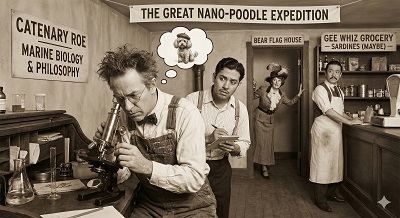 In modern Hawai'i we have a phrase that goes, "Wan poke squid?" It translates into rather suggestive language that is best left to magazines like Playboy, Elle and the Police Gazette. It meant something entirely different on Steinbeck's Cannery Row of old, where the Chinese and the Portuguese fishermen daily battled each other for the over-fished swarms of squid in Monterey Bay, back in the 1930s. We humbly extend sincere apologies to John Steinbeck (may he rest in peace) for borrowing some 'local flavor' from his epic tales of the Central California Coast. I hasten to assure you that no squid or sardines were hurt or abused in the creation of this tale (since they were long-since fished out there), but there may be a few extra empty Rhône wine bottles in the recycle bin (that gave their liquid lives to help bring this story to life).
The place that totally lost the flavor that you describe for it back in the good old 30s when everything was real.
My grandfather was part of the demise of the sardines. His favorite snack and highly processed, food that led to his early diabetes and strokes. Rest his soul. I guess I'll have to crank open a tin for him and Monterey. That old roe was caviar by any other name. More Russian than French on the California coast.
Ron