|
Flo Fitzpatrick, click here
to update your web pages on AuthorsDen.
|
|
|
|
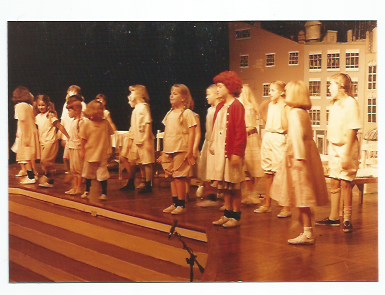 A musical "orphan" learns a lesson.
Mary Carter, age six, tiny, with big green eyes and unruly blonde curls, waltzed into the auditions for Annie at noon with the confidence of a Tony-Award winning actress. She handed her music to the accompanist and flashed a winsome smile our way. The director, Linda, and I had spent an excruciatingly long morning listening to scores of young girls, more than a few with their hair dyed red, as they warbled their way through “Tomorrow.” We were ready to quit and go eat a giant Tex-Mex lunch at Trujillo’s.
Then Mary Carter began singing “Castle on a Cloud” from Les Miserables. We were instantly enchanted and impressed with a voice as sweet as a face which was as innocent as a Christmas angel. Bowled over and thrilled pretty much completes our reaction. She was too young to play the part of Annie, but we immediately cast her as the youngest orphan, Molly.
Rehearsals started two days later. We quickly learned that Miss Carter was known around town as “Bad Mary.” And we quickly learned why. Carlos the Jackal might have been an equally suitable nickname, albeit a bit too tame. Blessed with talent, beauty, and brilliance, Bad Mary could out-talk, out-maneuver, and out-smart any authority figure unfortunate enough to cross her path. She had shattered the psyches of teachers, coaches, and choir directors all around Waco, Texas. Sunday School teachers changed churches (and counties) to escape the possibility of having Bad Mary as one of their charges. She could have taught courses in the art of terror without need of preparation or textbooks.
In the original script of Annie, the number of orphans is set at seven. Linda and I, in an attempt to bring as many of Waco’s talented youngsters into the show as possible, had insanely tripled the amount to twenty-one. And Bad Mary was determined, and had the skills, to organize a mutiny, inciting all twenty of them, with herself as leader. She had every “orphan’ terrified into instant compliance with her wants and demands.
Bad Mary was a talker. Constant. The night I was teaching choreography to “Hard-Knock Life” (using all twenty-one) Bad Mary decided to go for the Gold in the Chatterbox marathon. Five times I stopped the action to yell, “Quiet!” I refused to let my frustration show but I needed to change strategies if I were to succeed.
I stopped the number. In a pleasant, but solemn tone, I made my announcement, “The next person who talks, thereby causing us to lose time during this rehearsal , will, I promise, be thrown into (beat, beat) THE PIT.” Now, this was a community theater. There was no orchestra pit. When we were lucky enough to even HAVE a full orchestra they were seated with the audience, looking up at a stage about 15 stair-steps above them. But I knew the imagery evoked by the words The Pit should be enough to horrify twenty orphans. I was also more than confident that Bad Mary (orphan number 21) would be first to break the silence. I nodded at the accompanist to start the music again. And watched and listened as the little blonde mouse with the big blue eyes fell into the trap. With admirable tenacity and no fear, Bad Mary was loudly attempting to engage another terrified orphan in bright conversation. The one voice heard in tihs bright conversation was Bad Mary’s.
I motioned for the accompanist to cease playing. She did. I looked at Bad Mary. She looked back. She flashed her angelically sweet, dimpled, winsome smile my way. I took a deep breath. Using a calm, clear, exceedingly well-projected voice, I ordered Bad Mary into… The Pit. She began gasping for breath. Her affect began with amazement, changed into trepidation, then finished with complete humiliation. Chin set, she slowly crossed down the stairs and took a seat in the theater house.
Twenty orphans were now in shock and trying to avoid staring at the fallen vixen. I ignored the drama. We continued the rehearsal. I snuck a peek into The Pit about thirty seconds after Bad Mary’s banishment. Her beautiful face drooped with sadness, the cupid lips quivered, the huge eyes blinked back tears. I let her stay in The Pit for five minutes (she WAS just six, after all!) Without a doubt, they were the longest five minutes of her young life.
At the end of the banishment, I cheerfully told her to rejoin the cast and taught her the step we’d all been working on. Then I showed her a new step created just for her character of Molly. She beamed at me. When rehearsal ended that day, Bad Mary ran over and hugged me. We exchanged mutual grins of understanding and admiration.
I cast Mary Carter in the next three shows I choreographed which included children.
She never spent another second in The Pit.
|
|
Web Site:
Flo Fitzpatrick
|
|
|
|
|
|