Fresh out of Airborne Radio School, I arrived in France in July of 1956, assigned to the 12th Troop Carrier Squadron, 60th Troop Carrier Wing (Medium), based at Dreux Air Base in Normandy. The primary mission of the wing, equipped with shiny new C-119G aircraft, was combat cargo. Except in England, European air traffic control was primitive. In North Africa and the Middle East, even radio navigation was mostly nonexistent, with only a few radio compass stations from the early 1930s. There were two Flight Information Regions (FIR) that had no voice high-frequency capability -Basra in Iraq and Marseille in France. A few others had limited voice, but because we couldn't count on it, we frequently worked those regions in Morse code.
High-frequency (HF) radio transmissions don't move along a line of sight but rather follow the curve of the earth and bounce off the ionosphere. They can be transmitted for very long distances, but every receiver on that frequency, however remote, can send or receive. It' s a giant party line.
Visualize a situation in which, say, 20 aircraft are flying in the FIRs of Rome, Athens, Cairo, Tunis, Lod (Israel), Casablanca, and Algiers, along with Ankara and Istanbul, the two stations in Turkey, all using the same frequency. If you know anything at all about citizens' band radio, the word "chaos" will come to mind.
But it wasn't chaotic because we adhered to a mostly outdated principle called radio discipline: Know what you have to say, say it, and GET OFF THE AIR!
My relationship with the FIR controller, Mr. Marseille, began on my initial training flight en route to Athens. I was flying with an experienced radio operator who was to expose me to the real world of airborne radio operation and check me out.
Approaching southern France, the Paris controller handed us off to Marseille, and I listened as the trainer made contact in Morse code.
Marseille's call sign was FNM. He answered on the fourth call. He was using an automatic telegraph key, known as a "bug," and transmitted faster than I could read. The trainer sent our position report and the estimated time of arrival over Marseille using the international system of "Q" signals, which meant it wasn't necessary for the communicating parties to speak the same language. For 3 years, I carried an inch-thick book of Q signals everywhere until it was in tatters.
Wow, I thought as I listened to the traffic. This is real radio operating. Then the trainer told me he wanted me to make the next transmission to Marseille. Although I acted in what I. thought was a confident, devil-may-care manner as I changed seats with him, I knew I would blank out, forget the code and end up as an Air Policeman, forced to wear one of those funny white hats.
My trainer told me to write out what I was supposed to send. Then I listened to Marseille work other aircraft and tried to make some sense of it. I got a word or a Q signal here and there, but not enough to read his work on that bug. More thoughts of grounding: They would send me to the motor pool to do oil changes.
I needed a cigarette, but before I could light one, the trainer tapped my arm and pointed to the big radio compass needle which indicated we were passing Marseille. I was out of time. With the unlit cigarette dangling from my mouth, I hunched over the key.
I guess all those months of code school had some impact because I found my fingers tapping out what 1 wanted to send. Marseille replied, telling me to go ahead, and I even understood him. The Morse character for "Go ahead" is the single letter "K," which isn't a big deal, but at the time it seemed like great progress. I sent the position report, remembering to note the time for the log, and ended with "AR" (end transmission).
By God, I did it! I thought. I was so excited I forgot to listen to the reply and had to ask him to repeat it. He did, and still I couldn't read it. I was about to send another repeat request when the trainer pushed my hand away, sent "R" (roger, for "understand"), and then the letters "TU" (thank you). After a short pause, Marseille answered with two dits on his key – a radio operator's "you're welcome."
Not sure of what I should do next, I just sat there. The engineer, sitting on the floor because there was nowhere else for him to sit with an extra crewmember on the flight deck, lit my cigarette. He and the trainer had their poker faces on, but then the smiles came and they shook my hand and pounded me on the back. I could only grin stupidly with relief.
I stayed in the radio chair and sent the next report over the FIR boundary, slower this time, and copied Marseille's reply without having to ask him to repeat. Following the trainer's example, I sent him a TU. After a long pause, Marseille replied with two dits. Much later, I found out that Mr. Marseille reserved those two dits for a select few. In my case, knowing I was a student, I'm sure he thought about it before deciding to throw me a morsel. I guess he thought I was barely smart enough to develop into a real radio operator.
Several weeks later, I was a newly checked-out operator, new wings on my cap, flying through the Marseille FIR without a trainer. Mr. Marseille was on duty. At the end of my last position report, I sent him a TU, and after a short pause, he sent back two dits. As time went by and I became more proficient, he came to know my "fist," a radio operator's unique individual style, and I his. I could communicate on a level acceptable to him, and as my speed went up, I seldom had to ask him to repeat.
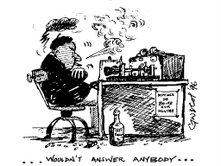
I began to wonder about him – who he was and how he got so good. I could hear him working other traffic, mostly civil aircraft, and marveled at his speed. When he was on the air, he was in absolute command. He was a stickler for proper radio procedure and etiquette, and God help the operator who wasn't ready when he called. When he got angry, his speed would go up and up until nobody could read him. That, of course, made him even angrier, and he would just go off the air for about 20 minutes and wouldn't answer anybody. He got mad at me a time or two, but mostly we got along. He recognized me when I flew through his domain. There was a quality of "welcome" in his reply to my call-up that wasn't there for just anybody. He would occasionally ask me to relay to other aircraft he wasn't able to reach, and I flattered myself that he was asking me because I had become such a polished radio operator. More likely he knew our aircraft had the most powerful transmitter in the air.
I had been flying about a year now, and I felt my skill and proficiency were at their peak. I thought I was a Morse code whiz, and I could work Marseille like nobody's business. But all this expertise was hampered by the old manual Morse key that was screwed down to the radio desk. Couldn’t get any faster with that. What I needed, considering my fantastic proficiency level, was some way to improve my speed. Man, if I had a bug – an automatic telegraph key like Mr. Marseille – I'd be right up there. I would be the Worlds Greatest Living Radio Operator if I had a bug. Attempts to find one in Paris were unsuccessful, so I wrote to my father in Santa Fe, whose boss was a ham radio operator. They found me a bug, and it soon arrived.
The guys in radio maintenance were kind enough to make me an oscillator with a little speaker so I could practice with my new toy. A standard key is pressed down against a spring, and the length of time one holds it down determines whether the signal is a dot or a dash. One has to have good rhythm to make the hand do what the brain is thinking. An automatic key has a long rod with a weight that bounces against a spring, sending the dots very fast. Pressed the opposite way against a regular spring, it sends dashes. One doesn't pound up and down on a bug – one caresses it from side to side. A really fast operator can get that weight bouncing so fast it chirps like a cricket – hence the name "bug."
I practiced diligently, and my speed began to climb and I could send very fast with my bug. I was ready, I thought. Ready for Mr. Marseille.
During preflight for a mission to Athens, I disconnected the leads from the standard key and hooked up my bug. When we reached the Paris-Marseille FIR boundary, I listened to Marseille for several minutes before Paris handed us off, took a deep breath, and blasted off with my new bug: "Marseille, this is Air Force 3-8145, over." He ignored me. A short time later, I called again. Could he read my fist on the bug? After another pause, he told me to go ahead.
I sent our position report as fast as I could make that bug go, probably about 45 words per minute, and ended with a BT (break) and a K (go ahead). I could have been Artur Rubinstein ending a Beethoven concerto, waiting for the applause to begin.
The elation was fleeting. Mr. Marseille came blasting back on his bug at what must have been a hundred words a minute. I couldn't copy.
I asked him to repeat, along with the Q signal to send slower. He slowed – to about 75 words a minute. I still didn't get it all. Once more I asked for a repeat and a slowdown. This time he replied very, very slowly; maybe 5 words a minute. Humiliated, I copied his acknowledgment and his instructions to report passing Marseille and to maintain altitude.
I was about to send my usual R (copied) and my usual TU when he sent, in plain English, "Go back to the radio school, 38145. Marseille out."
I had violated the first rule of Morse/carrier wave transmission: Never send faster than you can receive because that is the speed at which the reply will come. Mr. Marseille had put me very securely in my place. We both knew who was the amateur and who was the professional.
Crushed, I disconnected my bug and used the standard key for the next call over Marseille. He answered in the normal way, slowing his speed to match mine. At the end I sent TU and, after what seemed like an overly long pause, he replied with dit-dit. He and I never referred to the incident again, but I think a kind of mutual respect came out of it. He knew it was me who had made a try at him. Who knows? Maybe he was flattered.
As time went by, I became a standboard check operator, and when I took a new student through Marseille FIR, I would make the first call and then turn the key over to the student. I think Mr. Marseille, who made it quite clear he didn't suffer inept radio operators, was just a little easier on my students because he knew they were with me. But no dit-dits for them. On departing the FIR, I would take the key and send FNM TU and back would come my two dits.
My last flight through Marseille was in the spring of 1959. I had no student this trip and was flying alone on return from Tripoli. I knew it would be my last flight this way. I listened ahead, hoping Mr. Marseille would be on duty. But it was someone else – just another fist.
Crossing the boundary, I opened my key and called Marseille. The operator replied with a crisp go-ahead and I sent him our track, altitude, and estimated time of arrival over Marseille, and waited for his reply. There was a rather long pause, unusual for any of the operators at Marseille. I was about to ask if he copied when I recognized Mr. Marseille's fist telling me he copied and to report over the beacon. Happily, I sent him a TU and got my two dits.
I was elated. I listened as he scolded some other aircraft for being late on his call and missing his arrival time. Twice he asked me to relay. Did he do it to make me feel good?
Eventually, the time came for the last call leaving the Marseille FIR. I sent the report, and he acknowledged, ending with "Marseille out."
I knew it was a violation of radio procedure, but risking his wrath, I sent "M. [Monsieur] Marseille TU for working my flight. Leaving for USA 6/29 will miss you, go ahead." Normally, he would have given me hell for cluttering the air with unnecessary chatter, but he replied, "M. Air Force, good luck from M. Marseille." I sent "Goodbye TU." He replied with two evenly spaced dits, then in plain language: " Au revoir."
It was a tear-jerker.
I think he was in the radio room, heard my fist and decided to work my flight. If he did, it was an honor for me.
Au revoir, Mr. Marseille. You were the best.
__
AR