Ladle Lines (a prosetry memory)
I remember the soup kitchen the way you remember a face in a crowd—by the light first. It came in through tall windows clouded with years of breath and fry oil, slanted and chalky, turning steam into ghosts. Back then I mostly watched that light fall across steel tables scarred with initials, nicked by knives that never quite cut clean. I watched hands move—brown, white, cut, swollen—curling around bowls like they were worried the bowls might bolt.
You’d sniff the place before you reached the door. Boiled bones and onions, a sweetness from carrots that had gone soft, the tang of disinfectant trying vainly to be in charge. My nose always knew what day it was by the soup: lentil thick as mud, chicken thin and clear, tomato days loud with acid and bay. Some days the bread smelled like it had given up; other days it surprised you, warm and yeasty, a kindness.
You could hear it all—the scrape of chairs, the coughs that came from deep places, the low river of talk that swelled and ebbed. Spoons rang against bowls like little bells. Somebody laughed too hard. Somebody else went quiet. That room had its own weather. When winter leaned on us, you heard it in the way people breathed—short, guarded. In the heat, the air stuck to your skin, and you could feel sweat bead along your spine, the back of your neck doing its own thinking.
Touch mattered there. The bowl burned until you learned how to hold it, palms rough from work I no longer had, thumbs hooked along the rim. The table was cold even in summer. The sleeves of my coat smelled like street and smoke, and when they brushed another coat, we both flinched, then didn’t. There’s a kind of permission you learn in places like that—how close is close, how much is too much.
Taste was the truest thing. Salt when it was cheap. Pepper when the volunteer felt brave. Meat that pulled apart if you waited. Fat that slicked your lips. There were days the soup tasted like patience; days it tasted like hurry. I swallowed fast, then slower, stretching the warmth, counting spoonfuls. Once in a while there was a leaf of parsley floating like a promise. Once in a while there was grit between my teeth from a carrot that hadn’t been loved enough by the sink.
I spent so many afternoons there I could walk in with my eyes half shut and still know where to sit. Funny thing is, that’s the part that slips now. The order of the room. Who sat where. I reach for names and come up holding air. The edges of things blur. Sometimes my own face, back then, won’t come when I call it. What remains are patches—light, steam, the sting of hot broth, a woman’s laugh breaking like glass, then putting itself back together.
You hear me pause, boy? That’s the forgetting stretching its legs.
I tell all this to you because you listen without needing it to add up. Because you tilt your head when I say “windows” even though I don’t have them anymore. Because when I describe the way the soup rolled, you press your chin into my knee as if you can taste it too. When the memory turns sharp—cold fingers, empty pockets—you let out that soft whimper, like you stepped on a thought.
It’s alright. I’m here. You’re here.
Those days fed me more than food. They taught me how a room can hold a hundred stories and still make space for one more bowl. Time gnawed at my eyes, and the world went dark in stages, polite at first, then sudden. The kitchen disappeared, but it didn’t leave. It just moved inward, where smells and sounds have longer shadows.
Hey, Rex, don’t be sad. Listen to me. Rex whimpers periodically as: “Hey... it’s alright. I would’ve never had you as my best friend if I hadn’t met you in my darkness. It’s ok, boy. It’s ok.


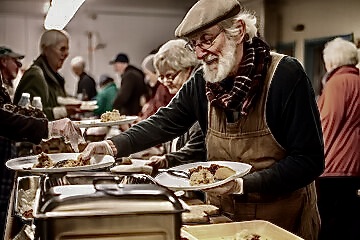 There was a time in NY when things didn’t go as I’d hoped. I ended up a bit on the street… hanging out a lot at The Bowery soup kitchen in the Bowery, Manhattan. There was a particular patron I couldn’t take my eyes off of whenever I ate there. He was special. Always wondered if he experienced the place and it’s many sensory attentions as I did.
I believe it was there, in the soup kitchen, that you acquired all your empathy for those less fortunate.
I recall my dollar a day regimen of the Bakery Café in the morning for coffee and sweet rolls. Mid afternoon at the Anchor Café for the hamburger basket. With a dime left over for orange Fanta at the Rendezvous, where others all drank tap beer.
But no experiencing humanity like you did, until my junior year end I had breakfast at Erv's Café, listening to the regulars with their morning chatter.
Ron