A look at one of the considerations of writing Fantasy literature.
First published in The Illuminata in March 2003.
Reality of Writing Fantasy
Creating Realistic Worlds
By Bret Funk
I had originally intended to title this article, Your Series is How Long, Mr. Jordan?!?, but I realized that, to some, it might seem that I am picking on him, as he has been the recipient of numerous comments on my part. Robert Jordan and his writing are mentioned in several of my past articles, both here and elsewhere, and The Wheel of Time is currently being dissected book by book for my latest series of reviews; but my feelings toward Jordan are far more positive than negative: part awe-struck reader, part eager student, and part impressed colleague.
The thing that I like the most about Jordan’s writing is the depth and detail of his world, and, in that, he stands in good company. The titles that line the shelves of my fantasy library, and thus have captured my continued interest, hold far more intricate worlds than simple ones. From The Lord of the Rings to Dune to the Dragonlance novels, I see realms that have been carefully designed and developed, sometimes in the space of a few books, sometimes over numerous volumes written by scores of authors. By giving substance to more than just the characters, these authors have made their worlds more real, and that believability helps draw (and hold) a reader’s attention.
In this aspect of writing, fantasy authors face the greatest challenges. General fiction takes place in our world, or a world very similar to ours. The rules, the places, the names, and the history are the same, allowing the author to focus on developing the characters and plot. The world has an intrinsic believability (for most readers, at least) because the reader already lives in it. This applies to historical fiction and alternate realities as well. In historical fiction, the story is built around the framework of Earth’s past; the same is true of alternative reality, up until the one small difference that makes in an alternate reality, at least. Without the need to develop detailed histories, unique cultures, and complex magical systems, a story can be told much more concisely than when those elements must be explained.
Matters get slightly more complicated for science fiction writers, but they still retain some advantages over fantasy authors. By and large, science fiction takes place in our own universe and around our own planet, sometimes a few years in the future (Kim Stanley Robinson’s Mars Trilogy), sometimes thousands (Asimov’s Foundation Series). Even in works like Herbert’s Dune, when Earth is but a distant, barely remembered thing, its history is there, and events need only be written from the present on.
Moreover, science fiction—true science fiction—is devoted (and rightly so!) to science. The rules of physics rarely change—though sometimes they are ignored, and other times circumvented—and the extrapolation of modern biological and chemical hypotheses to the next level is hardly comparable to designing a complex magical system from scratch.
This is not to say that world (galaxy?… universe?) creation does not play a part in most (if not all) science fiction. There are alien species to create, each with its own civilization, history, and culture; splinter groups of humanity; lost colonies; and the ever-popular artificial lifeform. Instead of creating a single continent, science fiction writers must create planets, sometimes hundreds of them. They have the same considerations as fantasy writers, but in some ways, though the scope of their design is greater, their level of detail need not be.
The bulk of most science fiction is in space—on board ships or stations—so not as much background is needed as in a fantasy world. Creating a frog-like species tells a lot about its planet of origin. A few casual comments about geography and social structure, and a little information on culture is sufficient; unless the story actually visits the planet in question, little additional effort need go into designing it. Similarly, knowing that the Kzinti (from the Man-Kzin Wars) are a ferocious tiger-like warrior species is enough; one need not have chapters devoted to their hierarchy, evolution, and psychology. Tiger-like says it all.
Additionally, mankind expects to find itself in space one day. Only a tiny leap of faith is required to imagine us among the stars, colonizing planets and exploring strange new worlds. And the universe’s immensity makes accepting the possibility of alien life equally effortless; those who staunchly refuse to believe are most likely not reading science fiction anyway. These elements make it easier for readers to accept the story and be drawn into it.
But creating a fantasy world, even a simple one, is far more complex. For every detail that is considered, a hundred are not; and while the majority can be overlooked without serious consequence, occasionally one arises that poses a serious threat to the integrity of the world, and thus of the work. A fantasy has to work harder to make a reader believe; accepting a world of dragons and magic, orcs and ogres is a far more difficult because the mind rebels against the possibility instead of embracing it. Each flaw, each unexplainable happenstance makes it harder to immerse in the story, and immersion is necessary to truly enjoy a book.
Fantasies often employ standard races—elves, dwarfs, orc, etc.—to help minimize the amount of background needed. Disregarding occasional differences in culture, elves are long-lived, pointy-eared and arrogant; orcs ugly, dumb, and mean; and the mere thought of a twenty foot dwarf with a penchant for woodworking is enough to send a fantasy reader into fits. Yet these cookie-cutter races tend to get old after a while, and many authors experiment with new formulas. While this creates a host of interesting possibilities, it also tends to increase the length of a work. For a reader to appreciate a new race, time (space, actually) much be given to fleshing out their past, their motivations, and their desires.
The same is true of human kingdoms. Without the advantages of a common history, a fantasy author must show the differences between the nations of man with words. The justification for hatreds, the cultural differences between peoples, the history of each land—histories that sometimes span thousands of years—and the social factors that affect each character can not be explained in a couple of sentences. And the comparisons do not stop at the national level. Differences between commoner and noble, mage and man, man and woman, and a thousand other combinations must be explored to make the world complete; and the more complete the world, the more immersive it becomes.
Moreover, to keep the voice of the work sufficiently ‘fantasy,’ the author cannot use the descriptive phrases and analogies that other fiction writers—even science fiction writers—take for granted. It is conceivable that man in the distant future will retain some of the analogies and slang of the modern world, or will use Earth-specific comparisons to identify something; but using those same phrases and comparisons in a fantasy work weakens it. Likening a witch hunt to Salem or comparing a vicious, genocidal tyrant to Hitler is not appropriate in fantasy, yet those simple words convey volumes of images and information.
But are these considerations enough to explain the encyclopedic length of some fantasy epics? Not entirely. For one, there is the trilogy convention. For some reason—perhaps those listed above—the trilogy has become the standard in fantasy literature. Shorter works do exist, and longer works are gaining in popularity (at least among authors), but the trilogy is the base around which many fantasies are written. Also, some authors (or groups of authors) write several different works in the same world: Redwall, Pern, Forgotten Realms, and the Saga of Recluse all come to mind. As each of these stories revolves around different characters, they should not be likened to epic works like The Wheel of Time or The Sword of Truth.
Two more factors affect the length of fantasy series. The first is author pride. The world that authors create are real; there are people, places, and events that exist in their minds which have no direct bearing on the story, but have had a significant influence on one of the main characters, or on one of the secondary characters that influence the main characters. What proud creator wants only part of a work appreciated? There is a desire, a need, to make readers see the world as the author sees it, to understand all the details and nuances that affect the world and its characters, to immerse themselves in the world as completely as the author has.
And the final influence on fantasy, perhaps the most important one? The fans. Despite our grumbling, despite our complaints at having to wait two years between stories and our complaints that the end result was not as satisfying as we would have wanted; if not for our love of the works, our demand for more, they would not exist. Would Jordan be writing book eleven if not for the fanaticism with which his readers approach The Wheel of Time? Would Harry Potter have graduated his second year of wizard school if no one cared enough to want him to?
My advice: Cast not too many stones, fellow readers, lest we discover that the cure is worse than the disease.
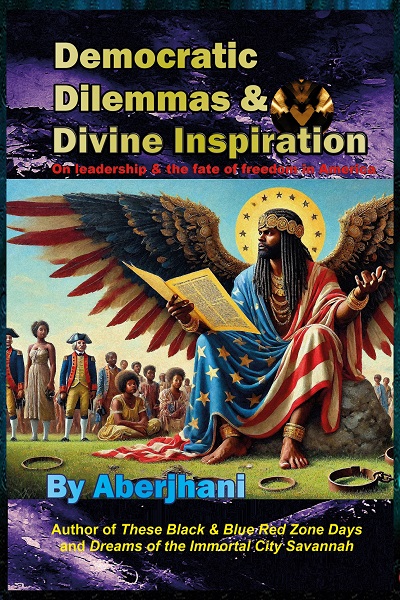
Democratic Dilemmas and Divine Inspiration examines the significance or relevance of the idea that the U.S. Constitution was, as many believe, divinely inspired. How much did that belief matter to founders of the nation and how much does it matter no
Democratic Dilemmas and Divine Inspiration examines the significance or relevance of the idea that the U.S. Constitution was, as many believe, divinely inspired. How much did that belief matter to founders of the nation and how much does it matter no