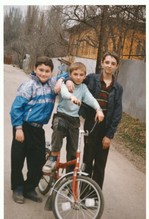
The impending destruction of a neighborhood in a Central Asian city provides an important lessons about the limits of planning anywhere.
In the 18 years since I began my still tortured efforts to speak the vast and subtle Russian language I have never found a good translation for the English word neighborhood.When I went to live in the former Soviet Union for the first time 16 years ago I needed this word for two reasons.First, I had been sent by USAID and International Development (USAID) as resident advisor for housing and land reform.
The fact that I found it difficult to talk about reshaping cities without using the word neighborhood may indicate I was a prisoner of my culture where even decaying and crime ridden pieces of a city are thought of as neighborhoods.Well, hoods, but you get the point.Second, the city of Almaty, then the capital of Kazakhstan, had well established neighborhoods that were worth talking about.
Maybe it’s worth telling a story about a neighborhood I knew in Almaty because in its fate lies the central challenge for city planners worldwide.
As resident adviser, finding a place to reside was important as both a personal and professional decision.Like many foreign aid workers, I had a very liberal housing allowance.I could have lived like most ex-pats in a big modernized house or apartment, complete with cook and chauffeur.Given the nature of my work as adviser on housing reform, I believed I should learn what it meant to be a resident rather than a visiting foreigner.
I chose half of a duplexed cottage on a one lane street named for the war hero Oleg Koshevoi in a neighborhood called “Kompot” ( Russian for compote).I know no place in the world that has embodied the meaning neighborhood better than the Kompot, a neighborhood named for its many fruit trees and for streets named after their fruits.More important, the residents who lived in the two or three dozen blocks of tiny ramshackle houses themselves were something of a social compote.
Most of the families in the Kompot had been there for a few decades.My landlady and her first husband had built their 70 square meter home after the war on a tenth of an acre that they had been granted because he had been an army officer.They and the people around them built their own homes, largely with their own labor and often with materials they begged or stole from a government that could not provide them with housing.Here they made their homes and they made their families and they had begun to watch their grandchildren and even great grandchildren begin to grow up.
I chose to be resident there exactly for the reasons the Kompot is now doomed by urban renewal—it was a well established, old neighborhood where children played in the streets and any housewife knew everyone who walked by the gate.A neighborhood.
I was over 50 when I first came to the Kompot, but I knew within a few weeks that I had come home.I was glad to walk through my gate after a long day of work, change clothes and go out into the street and talk to grandmother Kim about her garden or Uncle Vanya about his Lada’s brakes or Mikhail the gulag survivor about samizdat literature and Kazakhstan’s artists.Most of all I felt at home when I played football with the kids where two streets crossed or when we used the electric lines as the top of our imagined badminton net.
I had grown up in such a neighborhood in America during the war when we were poor enough that we had to heat the house by picking pieces of partially burned coal out of the dirt road where other people dumped their ashes.There was no shame in being poor in such a neighborhood, not any more than there was shame in being short or tall, thin or fat, old or young; Mexican, Armenian, German, or American.I chose to live in the Kompot because this kind of neighborhood is a universal human garden, always alive with ripe fruit and new seeds.
Yes, a garden complete with society’s evil bugs and weeds, but a place that shelters its seedlings from the wilder world beyond and that nourishes and grows people and friendships.The Kompot, of course, has always been a garden that also grows the usual vegetables and fruits from which it gets its name.It has been a place full of cherries, pears, apples, apricots, peaches and plumbs as well as grape arbors, currant bushes, berry bushes and vegetable gardens.And wild and cultivated flowers too.But this natural bounty is part of the human garden. Not only do the trees and bushes and gardens feed the human body, but they feed the soul as they grow old with the people who planted them and express the hope and optimism of the people who care for them.
I knew when I moved to the Kompot in 1993 that it was doomed.I told many of my neighbors that soon the Kompot would become one of the most desirable places in Almaty to live and that it would undergo what we call “gentrification”—the coming of people with money who renovate and enlarge the old houses or tear them down to build new palaces.My neighbors laughed at me as if to say, “Who but we fools and unlucky people would want to live here?”
I was not smarter than my neighbors. I had simply seen the same thing happen to such neighborhoods all over the world.However, I never imagined that gentrification would be forced on the Kompot by planners who decided that they knew better how people should live.I was naïve because in America I knew such planners and their powers very well.Only three years ago we had a celebrated case in the Supreme Court that confirmed that planners could justify the destruction of an old neighborhood to build modern homes and commercial buildings in the name of progress and a better tax base.
In America we are blunt, and the planners say the old neighborhood must be torn down because it is “blighted”.Blight is something that happens when a plant or a garden is infected by a disease, and planners ask us to believe that these neighborhoods are fatally sick.This kind of planning has strewn human and development disasters across America because you can’t destroy the neighborhood without destroying the fertile human garden that the word names.
Maybe соседство (sosedstvo) suggests some of the meaning and nuances of the word neighborhood, but I don’t remember that I ever heard it used to describe a place like the Kompot.A neighborhood is both a place and a state of mind.
I know from experience that planners are intelligent people with good intentions.I also know by experience that intelligence is neither wisdom nor compassion.Planners can build a city, but they cannot grow a neighborhood.A wise American once wrote, “I would rather be governed by the first 200 names in the Boston phone book than by the faculty of Harvard.”And I say I would rather live in the unplanned neighborhood of the Kompot than in any bright and shining city created by professional planners.Why?
After working for 20 years in the former Soviet Union, I understand very well that central planning is limited to the small collection of brains and experience of the planners. It inevitably fails the needs of the much larger community and requires that community to be their collective captives.After living a life time in America, places like the Kompot have underscored our nation’s central lesson—in collective freedom great wisdom works.
Democratic Dilemmas and Divine Inspiration examines the significance or relevance of the idea that the U.S. Constitution was, as many believe, divinely inspired. How much did that belief matter to founders of the nation and how much does it matter no