Some years ago when I was a resident of Los Angeles, California, I was invited by a self-rehabilitation prison group to speak at the Calfornia Institution for Men, The prison is located in Chino, about 40 miles from Los Ageles. A number of the more than 3,000 inmates in that prison had received by mail a personal copy of my book, "Be the Best: Do It Easy, Do It Now."
Subsequently, I wrote what follows about my experience at the Califonria Instituton for Men in my book, "The Mutuality Warrior":
Facing the setting sun and viewing
the rainbow bedecked sky, Omoro Kinte
(alias for Uriah J. Fields) stetched forth
his arms toward the horizon and stepped
into the Warrior-speed syncopated stride.
As the legthening shadows greeted him
he danced a waltz-like dance to the moon
light and gracefully moved toward his next
adventure.
That next adventure for Omoro Kinte was at the California Instittution for Men.
His next assignment was a special one, for he had been invited to speak to a group of prisoners concerning "Mutuality." Arriving at the prison just at the appointed time he found a captive audience waiting to hear him. He was introduced by a prisoner who was the leader of a prison group committed to "self-rehabilitation." This man, in his sixties and gracious, was obviously in much agony.
Omoro Kinte began by playing his Native American drum. Afterwards he said "I want to sing a song made popular by Paul Robesson who was himself a warrior. Included in that song are these words, "I must keep fighting until I'm dying." Paul Robeson used this song as his fight song, while endeavoring to bring about more justice in society. Omoro Kinte sang, "Ol' Man River," to the delight of the audience
"Mutuality," he told these prisoners, "is a way of life--a better way." Continuing he discussed the principles and methods of the Mutuality philosophy. He admonished the prisoners to go within and find what many people seek externally but miss. "There is freedom and peace," he said, "that nobody or no situation can deprive you of." Those who understand this even though in prison, they are free.
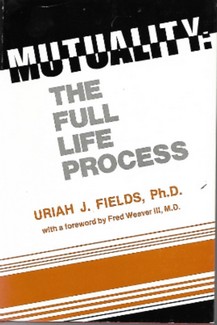
No sooner than the question and answer period began several prisoners, in near-unison requestet that Omoro Kinte play his drum and sing another song. He complied with their request. A prisoner complained that they did not have adequate books in the prison liberary. Omoro Kinte told them that he had brought two of his books (a book and booklet) with him for the library, namely, "Mutuality: The Full Life Process" and "Twenty-First Century Salute to Paul Robeson." The prisoners wanted to continue the question and answer period but the employee in charge said that the allocated time for the meeting had been spent and that the meeting would have to adjourn.
At the close of the meeting Omoro Kinte was approached by the man who introduced him. This man thanked him for being there and told him how he, a realtor, had been framed and fallen a victim of racism. His enterprise had been taken away from him and he had been sent to spend two years in prison on trumped-up charges. He wanted to know how he could contact Omoro Kinte. He would be released from prison after serving another six months.
Having completed that task, Omoro Kinte departed, leaving healing and enlightenmnt energy with those who had heard him. Again, a sense of ugency beckoned him, and he assumed Warrior-speed to advance him rapidly toward his next adventure. (Taken from "The Mutuality Warrior," by Uriah J. Fields, pp. 80, 88-89)
Copyright 1990 and 2015 by Uriah J. Fields
Follow me on Facebook and Twitter








Ron