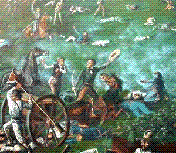
After the Texian victory at San Jacinto in April 1836, a flood of animosity was unleashed first on Bejareños (citizens of San Antonio de Bexar) and later on all Tejanos in the new Republic. Anglo-American volunteers who participated in the revolution were largely ignorant of Tejano culture and politics. This lack of knowledge led to a belief that all Mexicans were dubious in their intentions toward Anglos and held hidden loyalties to General Don Antonio Lopez de Santa Anna's centralist government.
Under a swell of Anglos surging into Texas from the United States, Tejano families who had fought valiantly alongside Anglo-colonists and volunteers found themselves fighting once again, only this time for ancestral property and land. In a short period, Texas, a once-proud colony of Spanish acculturation, now embraced Anglo-American values and manners. The homogenous tide of settlers into the Republic viewed Spanish culture and its caste mentality as mongrel and inferior. Moreover, those Tejanos who had rejected centralism became pariahs in both Mexican and Texan society.
Perhaps one of the greatest tragedies inflicted upon loyal Tejanos involved the aristocratic family of Empresario Don Martín De León, founder of De León Colony and Victoria, Texas. Don Martín died in 1833, but his wife, Madam Doña Patricia De León provided both sons and money to the Texas revolution. After San Jacinto, the family suffered the cruel prejudices and antipathy of the new Anglo citizenry. Victims of racial hatred, the De León family fled to New Orleans, where they lived in abject poverty for three years before returning to Mexico.
In 1844, Madam De León returned home to Victoria only to discover that her family's homes, property, and livestock were all gone, seized by ruthless and dishonest newcomers into the Republic. The De León family, who contributed much to the independence of Texas, found their repayment to be ostracism and banishment. Madam De León died in 1849 and was buried next to Don Martín in the Victoria churchyard.
Victor Rose concludes his History of Victoria (1883) with, "Alas, what a sad commentary upon the administration of human justice, to say nothing of its ingratitude, is that presented in the misfortunes of this most worthy family."
Sadly, the De León family discovered, albeit too late, that new governments tend to organize much like the corrupt governments they replace.
This was never true r than in 1848. After the end of hostilities in the Mexican-American War (U.S. description) or La Intervención Norteamericana (Mexican description), the two countries signed the Treaty of Guadalupe Hidalgo. The peace document ceded 525,000 square miles of Mexican land to the United States, and contained provisions, (articles VIII and IX) intended to hold safe, existing Mexican property rights. Unfortunately, as is the result in most cultural conflicts, the victor's desire for the defeated's resources, meant that many Mexican citizen property rights were ignored, unvalidated, and eventually lost to Anglos through circuitous land laws.
Lord Acton's words, "Power tends to corrupt, and absolute power corrupts absolutely. Great men are almost always bad men." rang true in his time, and one need only look at today's world leaders to see that his words indeed ring true in our time.