This article details the motivating force behind my first novel.
As a youth growing up in Mineral Wells, Texas, I spent most Saturday afternoons locked away inside the Grand Theatre watching John Wayne, Kirk Douglas, or Burt Lancaster starring in big movies about the larger than life West.
I read voraciously - Louis L'Amour, Clair Huffaker, Lauran Paine, and Elmore Leonard - books featuring ordinary men and women accomplishing extraordinary feats.
In 1968, as a junior in high school, I worked after school delivering furniture. I worked with a sixty-eight year old black man whose name was Hilliard Smith.
One Saturday, Hilliard and I delivered two full bedrooms of furniture to an officer stationed at FortWolters, at the time the largest primary helicopter base in the world. After completing our delivery, the officer presented both Hilliard and I, with a dollar tip, a large sum of money in 1968. A growing boy of seventeen, my thoughts turned immediately to food. I asked Hilliard if we could get a hot lunch before returning to the shop.
Hilliard said, "That would be fine," and then asked, "Where do you want to eat?"
I mentioned a local establishment that served what was once termed a blue-plate special.
Hilliard's face turned serious. He looked at me in disbelief and said, "I can't go in there."
I, of course, knew exactly what he meant, but being naïve in the ways of the world, I replied, "Don't worry. If you go in with me, no one will ask you to leave."
Hilliard shook his head and said, "You don't understand. It's not what happens to me if I go inside. It's what happens to me after I go inside."
Then I understood.
As a black man in my hometown in 1968, there were certain things you had to know.
You had to know where you could go and where you couldn't go. You had to know what you could say and what you couldn't say. If you knew these things and followed the "rules", you might be allowed to live your life in peace.
So what might have happened that Saturday if Hilliard had walked inside that diner?
Maybe he would wake up Sunday and find that someone had doused his lawn with gasoline and set it ablaze.
Maybe he would wake up Sunday and find that someone had painted that word on his house.
Maybe while walking to church that Sunday, a truck might pull up beside him. Maybe several men would jump out and give him a beating.
Hilliard didn't know.
He only knew one thing.
He wasn't going into that diner.
I later realized these types of events were not unique to my hometown. They were occurring in every town in America. I began to wonder, How far back would I have to go to find a man who didn't know the things that Hilliard knew?
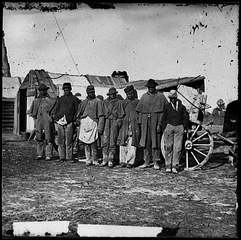
The answer is of course . . . all the way back to the Civil War. If you were a freedman during that period and you were foolish enough to believe that the Emancipation Proclamation granted you the same rights and privileges as all other Americans, it could very well cost you your life.
Although some may say The Road to a Hanging is just another Western, what the story really explores is the cost of a man's freedom.
Painting an accurate picture of the freedman in the frontier west is very important to me. History now tells us that one-third of all cowboys working in the west were African American. Freedmen also worked as Buffalo Soldiers, teamsters, lawmen, fur traders, cooks, and bankers. The book's protagonist, Free Anderson, is a combination of Bose Ikard, Britt Johnson, and yes . . . Hilliard Smith.
The Road to a Hanging is the first book in a trilogy featuring Free Anderson. I hope you enjoy the books and continue to read about other African Americans who helped settle the west . . . men and women like Neptune Holmes, Robert Lemmons, Henrietta Foster, and Addison Jones.
|