Homer recorded one of the first amphibious operations in history when the Greeks attacked Troy in 1183 BC. During the succeeding three millennia weapons have changed, but the basic strategy governing amphibious operations has not.
In 1838, the Swiss-born French general Baron Antoine Henri de Jomini published Précis de l’Art de Guerre (The Art of War) in which he listed key points for any amphibious landing. First, the attacking force should deceive the enemy as to the point of debarkation. Next, they need to select a beach with hydrographic and terrain conditions favorable to the attacker. Before landing, naval guns should be used to prepare the way for the troops and then land artillery at the earliest practicable moment. Landing troops have to strenuously push the invasion forward by seizing the high ground commanding the landing area, thus securing the beachhead from enemy gun-fire, allowing a quick build-up of supplies ashore and permitting the transfer of the conflict from amphibious to land warfare.
It was not until World War II that formal principles for amphibious assualts evolve. For the first time, specialized units trained in the skills necessary to handle large amounts of men and materiel were employed during these operations. Concurrently, specific types of ships, landing craft, and amphibious vehicles were developed to apply ever-evolving strategies.
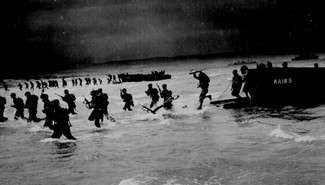
There are two primary types of amphibious landings: shore-to-shore and ship-to-shore. In shore-to-shore operations the attacking force is loaded directly onto the landing craft and off-loaded at their target. Ship-to-shore involves embarking the troops onto transports and then off-loading them into smaller landing craft. During World War II many landings were a combination of these two types.
Whether it is a shore-to-shore or ship-to-shore operation, each one is broken down into five phases: (1) planning; (2) embarkation; (3) rehearsal; (4) movement; and (5) assault. The planning phase extends from when the first directive to attack a target is issued to the end of the operation. This period can be as short as a week or as long as several years, as with operation overlord, the invasion of northern France on June 6, 1944. Embarkation involves assigning and assembling the ships and troops that will compose landing forces including the necessary equipment and supplies.
In North Africa and the European Theatre of Operations (ETO), six major amphibious operations were mounted by the Allies between November 1942 and August 1944; each operation coming months after the preceding one. All six were massive undertakings involving hundreds of ships and thousands of men. The ETO, though, was primarily a land war in which amphibious operations were essential for forcibly reentering German-occupied Europe.
The Pacific theatre was divided into two commands. The first, South-West Pacific Area (SWPC), based in Australia, covered the Philippines, New Guinea, the Bismarck Archipelago and the Dutch East Indies. The second, Pacific Ocean Command (PTO), based at Pearl Harbor, covered the remainder of the Pacific and was sub-divided in to three areas: the North, Central and South Pacific Areas (SOPAC).
The central Pacific was a maritime theater in which each new offensive required a landing to secure additional bases for further operations. The Central Pacific forces mounted ten major landings with numerous smaller ones launched to secure islands surrounding the primary target.
Southwest Pacific and South Pacific amphibious operations were different. Often an invasion force consisted of but a few landing ships and craft supported by destroyers and land-based aircraft.
Controlling the flow of men and materiel onto the beach and inland was the responsibility of the Beach Master and his supporting Beach Party. The ETO, PTO, SWPC, and SOPAC shared common problems, but established slightly different ways of handling them. Men in the Naval Beach Battalions or Parties were assigned to one of four duty classifications: communications, hydrographics, boat repair, or medical.
In Europe, Naval Beach Battalions were created handle all of these duties. When a beach battalion went into action, it was organized along the lines of an Army battalion - three companies, with each company divided into three platoons whose interlocking duties embraced every phase of the battalion's task.
The Beach Parties were smaller in the PTO, SWPC, and SOPAC. In the central Pacific, the Shore Party was an integral part of a combat division and was organized around a Marine Corps Pioneer Group or Army Combat Engineer Group. In both services the Shore Party formed the nucleus to which the various elements were assigned for an operation. The attack transport ships supplied the Beach Party elements of the Shore Party by providing a Beach Party Team of approximately two officers and thirty men to support a battalion of landing troops. The Beach Party Team would land at the objective area and take charge of the beach, but were normally withdrawn with the parent ship. The Shore Party was considered an instrument of the assault and would be relieved promptly by garrison elements, including a garrison beach party.
These methods were employed in approximately 200 amphibious operations (D-Days) during WWII. The last large scale amphibious assaults took place during the Korean War at Inchon. With today’s technology and the shifting nature of combat from symmetrical to asymmetrical warfare it is unlikely the U.S. will need to mount a major amphibious operation in the foreseeable future.