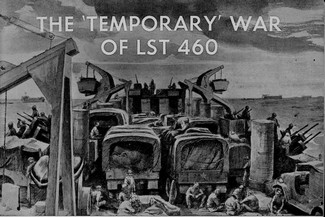
IT shouldn't happen even to an LST:
Getting stuck on a sandbar right in front of Jap artillery . . . wandering accidentally, at night, to the head of a convoy about to land on Leyte . . . dropping her ramp on a beach that hadn't been secured yet . . . and being assigned to "temporary duty" that included several invasions, plus her own sinking.
Those were only a few of the events in the life of one LST, the 460, recently lost in the Philippines after a long and lively combat career that ranged from Munda to Mindoro.
They call the LST the backbone of invasion armadas—a lumbering, 328- foot, 4,000-ton hunk of steel that crunches up on an enemy shore, drops its huge jaw on the beach and spews out tanks, trucks and men.
Large Slow Target
To the logistics man, an LST is "the largest floating garage in the world." In the book, it's listed as a Landing Ship, Tank. To the men who live on one, it's the Large Slow Target.
LST 460 was only one of many, but her life was typical of what can happen on (and to) an LST. It included the mishaps of a green and untrained crew in the early stages of the war— and it included also a remarkable series of combat missions: Rendova, Munda, Vella Lavella, Bougainville and Treasury Islands, Creen Island, Hollandia, Morotai, Leyte and Mindoro.
The beginning of that career was anything but glorious. One of the 4 60's surviving officers recalls that in the days when the 460 first started out, back in the winter of 1942-43, training was sometimes so fast that if you bent over, you missed most of it.
"We had one week of training at Norfolk," he said. "Then we went out to the West Coast to take over our ship."
At Norfolk there had been seven crews training aboard the LST at the same time, ail trying to squeeze into quarters meant for one, and trying : to learn about the ship without stumbling over each other. The officers had had their seagoing indoctrination at Tucson, Ariz.—"riding the mirages." They were trained for any one of three kinds of landing craft: LSTs, LCTs and LCIs. When they arrived | at NOB, Norfolk, they were asked what they'd done in civilian life and what kind of ship (of the three) they preferred for duty.
Teachers and Lawyers
Three of the officers had been teachers, three lawyers. “Lawyers?” said NOB. “And teachers? We’d better put you fellows on a big ship—you’ll have more people to talk to.” So they drew an LST.
Assignment of billets followed. The only officer who'd been to sea before was the skipper, an old regular, formerly CQM. Не assigned the three teachers as communications and navigation officer, first lieutenant and engineering officer. One lawyer became exec. That left two to choose between gunnery and supply. The one who'd gone duck-hunting once became gunnery officer.
With the billets settled on this engagingly informal basis, officers and crew of the 460 set off across country by special train for the Kaiser Ship- yards at Vancouver, Wash. The first time they set foot on their new ship was a half-hour before the commissioning.
"We ail lined up on the fantail and got the regulation spiel: we were a green crew now, but the country had confidence in us and we were destined to become a glorious fighting unit of the United States Navy. Then, before we had time to think, they cast our lines off."
Down the Coast
That was 15 Feb. 1943. The LST 460 had a crew of about 75 at that time, although it increased to about 108 later. Only four men in the whole crew had ever been to sea before. "You can imagine what nerve centers they were. Anything from lines to nuts, we had to find out from them and then go do it."
They sweated it out down the Columbia River to Portland, picked up their supplies and headed down the coast for San Diego. In the swells of the Pacific they got their first taste of the peculiar roll of the lumbering LST—a quick, six-second roll that was something between a snap and a hic- cup. Officers and crew promptly got seasick.
On the way down they got to know a little more of the feel and nature of their ship, explored its huge tank deck which would soon be ferrying tanks and trucks and amphtracs to invasion shores, learned the workings of its elevator to bring things down from the top deck, studied the huge bow doors and the bow ramp which had yet to drop on its first beach. When equipment wasn't being carried, there was plenty of room on the tank deck for a basketball court, and it was put to this use later in many a Pacific port. The 460 developed one of the best LST basketball teams in the Pacific, playing 50 to 60 games and losing only two.
Across the Pacific
At San Diego they got orders to go up the coast a ways for a period of "training." This consisted, as it turned out, of one practice beaching. With everybody coaching, it came off ail right. Just as they were retracting from this first beaching they'd ever tried, orders were blinked to them to pick up an Army group to give them a "demonstration."
It was a demonstration, ail right. Although they did everything they'd been told and tried to repeat the happy success of that first beaching, the 460 broached. They stayed there helplessly ail night, and about noon next day a tug came up to pull them off. The Army group, having had a demonstration of modem landing techniques, went away very quietly while the 460 was towed to a drydock for repairs to its screws and bottom.
Orders to move on to Pearl Harbor were received with mixed emotions. Other LSTs had set out for Pearl, but nobody ever seemed to hear whether they arrived or not. The 460, full of gloomy rumors, expected to break in two half way across the Pacific. When they finally left, everybody was sympathetic and kind and gave them a party. It was sort of like a last friendly funeral service, they recalled.
From Pearl they went on, via Samoa and Espiritu, for Guadalcanal. The men were manning their guns a day and a half out of Guadal', scan- ning the sky for enemy planes as the LST crept cautiously along. "You'd have thought we were about to make the original landing," they said. Actually, the island had been secured five months before—just about the time the 460 was being commissioned.
Jap planes were still active, though. The 460 moved across to Purvis Bay and the first night there they had 12 general quarters, starting at 1800. When the first came they thought: well, this is it. After the fifth, they decided, well, anyway, they don't get you every time. After the 12th they decided that it might not be so dangerous but it certainly was tiring.
Up the Slot
About a week later they learned they would get their first mission "up the slot," to Rendova. The two preceding LSTs that had gone up had been lost. First the LST 340 went up; they heard she'd been bombed. Then the 341 went up; only one surviving officer came back from her. Rapidly counting on their fingers, the men of the 460 figured there was still some time before they'd get up to 460 at this rate.
But word came for the 460 to go up next. They felt a little like a scared boy walking into a dark cavern. Two minutes out of the harbor they were at général quarters, ail set and rarin' to fight. Ail went well, the night voyage was quiet except for a few dog- fights overhead, and the 460 discharged her cargo. From there on she was a "veteran" and was off on a series of combat missions excelled by few LSTs in the Pacific.
Between missions there were occasional restful periods in port. Then the basketball court on the tank deck would come into play. The 460 would usually have movie showings on the top deck around 1830 or 1900. Often they'd invite the opposing basketball team over as guests for the movie show, then go down to the tank deck afterward, turn on the lights and put on a basketball game.
Biggest routine job, they found, was keeping an LST clean. The ship's first lieutenant used to refer to himself as "chief janitor." Tanks and trucks and motorized equipment meant oil and dirt and mud. When this cargo was discharged, everybody turned to and cleaned the tank decks and top deck before the oil and grease got too firmly stuck. Then men from shore parties would come aboard, tracking the mud and dirt of invasion shores with them. It kept the LST crew scurrying around like a frantic housewife trying to keep her kitchen clean with a neighborhood boys' club running in and out. The steel tracks of the tanks chipped and cracked the paint, too, so the paint brush became the most used weapon aboard, with a complete paint job for the decks after each mission.
Rain, Beautiful Rain
Only time they didn't have deck swabbing to do was when ' it rained. The men can still remember with relief a spell in Milne Bay when it rained for 30 days. At Leyte there was one spell of about 23 inches rain- fall in a month.
Another busy man aboard the LST was the shipfitter, for something was always breaking down and needing repair. When the shipfitter wasn't busy himself, his shop was. The men would use it to make things for them- selves or their families or their girls, hammering out a knife or ornament or bracelet.
Sometimes the LST's cargo would be human instead of armored—several hundred soldiers heading for an enemy island, or several score of wounded being brought back from a bloody beachhead. The LST's huge tank deck would be turned into a floating hospital then. They carried one and sometimes two doctors, and two pharmacist's mates. Whenever there were casualties, though, practically the whole crew became volunteer corpsmen and pitched in to help make the wounded men as comfortable as possible.
Kibitzers in the Galley
Chow usually varied according to who'd talked to the cook last. The Italian boys would wander down into the galley and show the cook how spaghetti could really be cooked. Day or two later a Greek in the crew would be giving the chef pointers on some native dish of his own. Then the southerners would chime in with some tips on how to make hot bread. Word of this varied fare apparently spread. In the Philippines a group of guerillas came to the СО of the LST and asked if they could serve aboard. Talking with them brought out the fact that they'd heard the food was pretty good. The СО couldn't take them anyway but decided that they were less interested in serving than in being served!
Holidays usually brought a fancy meal for ail hands—turkey, if possible. One LST group commander used to send his men ashore at island ports and have them gather up hearts of palms. They varied the diet a bit and made a good salad—sort of crunchy, like celery. Best chance for diet varying came when another ship would come in to port. If it was a big ship, word was passed to lay up to the conning tower to identify it, then find out who knew somebody aboard. A "sponging party" would soon be formed and would set out in the LCVP to see what could be wormed or bargained out of the new arrivals, LCVPs were the 460's liberty boats. they had two of them, so they decided to fix one up real pretty, making ( it their "Saturday night sports road- ster." They did a good job of it. Too good, in fact. The flotilla СО, took one look at it and said, "That's fine, just what I need."
Large Stranded Target
The 460's first really close call came when they got orders to go up a little creek in the Munda area. It was twist and turn ail the way, and they knocked several blades off one screw in the narrow channel. Just as they got stuck on a sandbar, the Japanese opened up from Kolombangara with artillery and laid down a barrage, coming step-by- step closer to the 460 as she lay there stranded on the bar. For some reason nobody yet can figure out, the barrage stopped about a hundred yards short of the ship. "I guess the deck was pretty well washed from the sweat which flowed from our pores."
The next combat mission was to be Vella Lavella. There wasn't much point in her zig-zagging on the way as the général motion of an LST was pretty close to a zig-zag anyway. In one convoy they were in, the instructions were sent out to ships as follows : "Destroyers and transports will zig-zag. LSTs will waddle."
The LST 460 was breezing its slow way along to Vella when word suddenly came to turn back. They found out later that the Battle of Kula Gulf was taking place, and the Navy apparently didn't figure that the LSTs' 20-mms would turn the tide.
They went in at Vella Lavella the following afternoon around sunset, looked around, and ail they saw was bodies floating around the water. No- body came out to meet them. They didn't know whether our men ashore had been wiped out or not.
The skipper got out maps to see if they'd hit the wrong place. Just then the general's aide crept out of the bushes and told them to get the hell off the beach. They retracted and that night spent nine hours under constant torpedo attack from Jap planes. Thanks to a beautiful smoke screen ] put up by our destroyers, the 460 , came through OK, but one LST was , lost and another damaged.
Any hopes the crew might have had for a short war were abruptly dispelled after Vella. When survivors came back to Tulagi, some from an LST and others from a destroyer, the crew of the 460 noted with grim amusement the different orders that resulted. Two different sets of instructions rang through the barracks. The first was: "Ail survivors from
DD No. ___ lay down to the dock for transfer to another destroyer and return to the States." This was shortly followed by: "Survivors of LST No. ___ lay down to the dock in working clothes prepared to unload cargo."
LST vs. Pillbox
Hitting Treasury Island and Bougainville next, the 460 went in on the second echelon, missing most of the heavy mortar fire that met the first group. Most exciting adventure there fell to another LST which rolled up on a beach where there were two pill- boxes. In what must be one of the first recorded engagements between an LST and pillbox on land, this LST nosed right up to one pillbox at the edge of the beach and dropped its heavy bow ramp smack on ton of it, crushing the pillbox and smothering its crew inside. Then a bulldozer rolled off the ramp and headed for the other pillbox, the Seabee driver raising the shield before him for protection. Rolling over the pillbox, he crushed it and then backed up and pushed loads of sand over it. Later on, when men dug it out, they found about a dozen dead Japs inside and a couple of new guns.
After that came the Green Islands ("no excitement"); several weeks of resupply movements and then—orders to head for New Zealand for leave. Their welcome at Auckland was an enthusiastic one. When the New Zealanders saw the LST coming into the harbor, they lined up to meet them at the pier. Before they could even get their lines over, people were trying to pass ice cream and strawberries and other delicacies aboard to the crew.
Women! With Shoes!
This reception caught the 460 at an emotionally vulnerable time. As the months went on, they had found that their US sweethearts were more and more writing them letters which be- gan, "Dear Joe, you know we always said we'd come right out with it if it ever happened that way, and this boy I used to know, etc., etc. . . ," As a result, officers and crew were in a fine mood of romantic melancholy. As one of them put it, "Here were the first women with shoes on that we'd seen in over a year. We ail fell madly in love."
It was catching—even to the 460's mascot, a nondescript feline known as Kittypuss. Every time the 460 beached, Kittypuss would be down there at the bow doors and be the first to go ashore, sniff around and come back. When the crew went on liberty, they'd always bring things back for the Kittypuss. New Zealand's reception was too much for Kittypuss, who found herself a perfectly lovely tom-cat. That was Kittypuss' first AOL; she stayed away from the ship overnight, for the first and last time.
After a spell in port, the 460 got orders to go to Pearl Harbor. The lift in morale was spontaneous; the war was over for a while and they were headed home. They put the engines at ail flank ahead and turned them up a few knots higher than they'd ever gone before. A day and a half out the order came: "Return to Guadalcanal."
Low Spot of the War
"That," they recall, "was the low spot of the war." Spirits sank and even the ship seemed to ride lower in the water as she slogged dispiritedly back to the Solomons. Back at Guadal', they learned that the 460 was going to get temporary duty in the 7th Fleet. The "temporary" duty lasted through four major invasions, until the ship went down.
After training at Milne Bay and later at Buna beach, the 460 started to get in on some real man-size operations, beginning with Hollandia. The first beach they headed for there was actually so hot it was on fire, so she was directed to another beach. That was too shallow. The 460 headed up a creek and tried several times to beach, but could only get so far and then have to stop, so they pulled off and took up a position just off the creek entrance. That night Jap planes came over and dropped flares. The 460 had then so much ammunition and high-octane gas aboard that they would have had to treat the crew for shock if even a flare landed aboard her. Destroyers came in and drove the planes away in a running fight.
After further training, and a landing on Morotai, the 460 went up to Leyte and nearly became a one-ship task force. She was 'way back in a convoy due to hit Leyte on D-plus-2. The ship's radio went out and they couldn't see or hear anything, so they just kept plugging along through the dark, hoping for the best. When day- light broke, they suddenly found out where they were—and gulped. They were out in front, about to lead the convoy in ail by their lonesome.
Towed to Mindoro
After Leyte, they went back to Hollandia and laid around awhile, after which they were ordered up to Leyte again. Something had happened to another LST so the 460 was told: "We're going to put you in on D day at Mindoro." On the way up, one engine went and the 460 kept dropping back further and further. LCIs and PTs kept going by and waving fare- well to them. The prospects were not too inviting; instructions had been, "If you fall behind we will be unable to give you protection." After several hours someone apparently took pity on them and sent a tug back, another LST taking the 460's regular position in the convoy.
The change saved the 460's life—for the moment. They beached at Mindoro on 15 December. Cruisers and destroyers had shelled the beach thoroughly beforehand, but Jap planes came over and got an LST laying off the beach—the 472. It was the 472 that had taken the 460's place in the convoy line.
On Borrowed Time
From there on the 460 felt that she was living on borrowed time. A formation of Jap planes came over, cleared her but got two ships nearby. Usually the Army unloads the LSTs while the LST crews stand gun watches. But this time the Army was busy and the beachmaster said they'd have to go down to another beach. The other beach, he added, somewhat as an afterthought, had not been se- cured yet. There were some troops down there, though, and he thought they had the Japs "cornered," so the 460 was to go in and unload anyway.
Of course, when they got there the Army had its hands full with Japs and didn't feel like taking time out to unload the LST. Wait around, they said; "Just as soon as we get this here oeach secured, we'll give you a hand."
With seven to eight hundred drums of high-octane gas aboard, and Jap planes buzzing around in the air, the 460 had no intention of waiting. Ail hands turned to, secured the gun mounts, and cleared that cargo out in 32 minutes flat. Then, by way of anticlimax, it took them three hours to get off the beach. Finally a tug came along to give them a lift and they rejoined their convoy.
It was quiet on the way back, but lively at Leyte. You could tell when an alert was coming because the lights would start to go out on the beach. Then, when it was black, you'd see tracers going up, searching the night sky for Jap planes overhead.
Five LSTs were picked to load up again that night and leave the next day in the second echelon for Mindoro. The 460's crew figured they'd only had a 50% chance the first time, so here went the remaining 50%.
About noon next day three Jap planes came down through the convoy with bombs, missed and went off. It seemed the Japs liked to attack around mealtimes, which was regarded aboard the 460 as a dubious aid to digestion. About five o'clock that afternoon the ship's doctor looked up at the sky and said, "I hope those little so-and-sos aren't going to screw up our chow again." Minutes afterward, a report came in that Jap planes were headed for the convoy. They came down the outside column and peeled off, each picking a target. That was when the 460's borrowed time ran out; she went down shortly afterwards.
Of the 460's seven officers, three survived—the doctor, the first lieutenant and his relief, who had arrived only shortly before. About 20% of her crew was lost. Fire had ruined the small boats and davits. The 460 was towing an LCM at the time and many of the men got picked up by her. One group headed for a destroyer and threw their lines to her. Most of the survivors were picked up by landing craft. At Mindoro they headed for the fox-holes ashore. They had decided it was safer there!
Heroes
The surviving officers had many words of praise for the heroism and self-sacrifice of the men on the 460, many of whom lost their lives on that final day. "Several gave their life- jackets to wounded men, although they knew their own chances were lessened." One of them was Gordon Spredeman, SClc. After giving his jacket away, he tried to make it to safety himself, but is listed as missing in action.
One motor mac gave his jacket to a wounded soldier aboard (the 460 was carrying about 300 of them at the time), although chances were against his swimming to the nearest LCM. As he waited to go off over the fantail, off the stern anchor, the body of a dead soldier floated by. His shipmates told him to grab the jacket for himself, since the soldier had no use for it now. The motor mac shook his head at that, but jumped in and held on to the jacket; he got picked up later, after floating around with the dead soldier for a while.
The 460's final injury was also her first one. Despite ail her combat missions, she hadn't been scratched before (except by sandbars and such). She'd accounted for at least four planes, including the one that got her. With the possible exception of the 472, which got it at Mindoro in her place, they think the 460 had about as many combat missions as any LST in the Pacific. Her surviving officers, brought back to BuPers to make their survivors' reports and aid in establishing casualty status and straightening out accounts, think that the 460 turned out to be a pretty good ship despite those first strange wanderings on the Pacific Coast two years ago.
[This article originally appeared in INFORMATION BULLETIN, Bureau Of Naval Personnel, May 1945]