ALL her action-packed life the escort carrier USS Block Island lived precariously in the midst of battle. And in battle she died, her freighter hull holed by three torpedoes from an enemy U-boat. Her grave was the Atlantic where, for 14 months, she led a diminutive task force in scourging the sea of German underwater raiders.
The Block Island was the only American carrier lost in the Battle of the Atlantic. In announcing her loss on 29 May—a year to the day after she was sunk—the Navy also disclosed the dramatic story of her career.
The Block Island first went to sea in March 1943, under command of Capt. Logan C. Ramsey, USN. Except for about 50 survivors of the old USS Lexington, most of her crew had never seen a carrier before they were as- signed to her. A few days after she started out on her first sub hunt, the baby flat-top flushed several U-boats during the night. Crewmen lined her flight deck to watch star shells and gunfire and an escort rushing in for the kill.
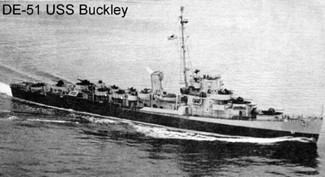
War was almost always like that on the Block Island — close, personal, thrilling. With her DEs she slugged it out in close surface actions and depth-charge attacks by sea and air, even witnessing a hand-to-hand scrap between crews of a damaged U-boat and the DE USS Buckley.
A plane from the carrier spotted that German submarine at 0300 on a bright moonlit night. The Buckley, directed to the spot, opened fire with three-inch guns and scored a direct hit on the sub's forecastle. The enemy, electing to fight it out on the surface, returned fire with her deck gun and semi-automatic weapons while swerving sharply to get out of the moon track. Torpedoes from the U-boat's tubes swished through the water but missed. Tracers flashed across the Buckley's superstructure but only one hit—in the stack. Lt. Comdr. Brent M. Abel, USNR, the DE's skipper, decided to ram. A hard right rudder drove the Buckley up on the sub's forecastle.
The submarine's crew swarmed out of the conning tower and up on the DE's forecastle. The Buckley's crew used anything handy for weapons. Two Germans were felled by heavy coffee mugs, others by empty shell cases and by small-arms fire.
Finally, to avoid too many boarders, the Buckley backed off and resumed fire. As the DE closed in again the submarine swerved suddenly against her side and remained pinned beneath the Buckley's hull. Rolling to 60 degrees, the submarine gave men on the Buckley a full view of the flaming shambles that was the interior of the conning tower. Torpedomen on the DE tossed grenades into the open hatch. Slowly the sub drew away again; but one three-inch gun on the Buckley scored three direct hits, and the U-boat plunged beneath the surface with her diesels still running at full speed. Both the con hatch, spouting flames, and the forward deck hatch were open as the submarine dived. Heavy underwater explosions followed.
The Buckley captured five German boarders and picked up 31 other submarine crewmen from the water. The entire action lasted only 16 minutes.
In March 1944 Capt. F. Massie Hughes, USN, took over command of the Block Island and with it the luck of the task force in tracking down and destroying the enemy. Four days later the Block Island was at it again.
Patrolling planes detected another U-boat and tracked it along with the escorts. Two of the DEs closed in as the sub surfaced and began pounding it with their guns. The sub's crew abandoned ship without a fight.
Two days later one of the carrier's Grumman torpedo planes found a submarine lying dead in the water, with her crew enjoying a swim. The pilot, Lt. (jg) Mark E. Fitzgerald, USNR, cut loose with a determined depth- charge and strafing attack before the Jerries could scramble aboard. One of the depth charges cracked the sub in two.
His plane damaged by AA fire from the U-boat, Lt. Fitzgerald was forced to land in the water nearby. As he drifted in his rubber boat he saw a man swimming toward him. Hauled aboard and treated by the flyer for severe head injuries, the swimmer turned out to be the 23-year-old captain of the submarine. Later Lt. Fitzgerald rescued and captured eight other Germans before being picked up by a destroyer.
The final battle of the fighting carrier was yet to come. Six planes were out on patrol when the Block Island shuddered as two violent explosions rocked her beneath the waterline. Capt. Hughes, realizing that his ship was hopelessly damaged, gave the order, "Prepare to abandon ship."
All hands mustered on the flight deck. Shortly thereafter a third explosion shook the ship. "Abandon ship," ordered the captain. Most of the officers and men, including 18 wounded, went over the side and climbed aboard rafts.
Last off the stricken carrier, Capt. Hughes had been picked up by a whaleboat and was only a few hundred yards from her when she suddenly went down by the stem.
As the Ahrens proceeded to the rescue of survivors she positively located the enemy submarine which, after torpedoing the carrier, had sent another tin fish at the USS Barr, another escort, hitting near the stem and crippling her.
Exactly one hour after the first attack the Еugenе E. Elmore delivered her assault on the submarine. A tremendous explosion indicated that the U-boat had been destroyed.
Casualties for the entire action totaled six killed on the Block Island, five killed, 12 missing and 16 injured on the Barr and four aviators from the Block Island missing. The other two pilots who were in the air at the time of the attack were rescued.
[This article appeared originally in INFORMATION BULLETIN, Bureau Of Naval Personnel, July 1945]







You don't hear much about airpower in the Atlantic and the carriers there. Thanks for bringing this to us. But what was written, I take it that the Block Island was made at a shipyard that was building a freighter when the war broke out and the freighter was quickly converted to a mini carrier to get to war quickly. A smart move considering what the ship did during its career.
Ron