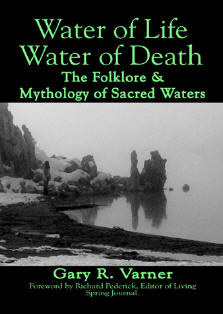
A chapter from the recently released book, Water of Life--Water of Death: The Folklore and Mythology of Sacred Water by Gary R. Varner and published by PublishAmerica.
The myths and folklore associated with water would not exist except that people have believed in them. That strong belief has survived from the pre-stone age to contemporary times. This chapter will present a look at the many folk beliefs associated with water and holy wells in particular, including treatments for physical and mental illnesses, wishes, children, curses, prohibitions, offerings of rags and pins, Faery lore and dreams. The information in this chapter has been culled from sources from all over the world and is a brief synopsis of almost limitless accounts of the powers that exist in water. It is hoped that some reader will undertake a much more thorough analysis in the future.
Babies and Children
Folk beliefs associated with water and children runs the gamut from where babies come from to specific treatments for medical conditions.
The age-old question “where do babies comes from?” has been strangely tied to wells. All of us have memories of our parents telling us as children that the stork brings newborns. The Brothers Grimm, in their story “The Two Travelers”, relate how the stork fetches the newborn prince out of a well. In Germany “Baby Wells” are responsible. This is similar to British folklore that links babies to wells, ponds and rivers. (1)
The birth of abnormal babies, obviously a terrible event, was not blamed on the Faery or elves in England and Germany but as the birth of Water Babies—not human children.
Childbirth was a much more dangerous event in the past than today but folklore provided many ways to deal with it—some consisted of folk medicine treatments which may have actually helped, and others mixed folk medicine and myth. Folklore from Pennsylvania specified that children should be delivered over water because the spirits of the Underworld could not cross over the water to harm the baby.
Methods to make delivery easier included dipping girdles into well water. A somewhat similar method, although this time it is a child that is dipped in the well—was used to insulate the child from pain. (2)
Children’s Illnesses
Holy wells were a common source of treatment for children’s diseases among people who had no access to medical treatment. This is one reason why the folklore of wells is so widely known and is so commonly associated with medical treatments of common maladies.
St. Madron’s Well was frequently used to dip children to cure rickets and other childhood ailments. In California the Indians not only “dipped” them but totally submerged them in the treatment of bedwetting. The Indians in Dunlap, California held the child underwater so that the evil spirits responsible were drowned.
Whooping cough was treated at certain holy wells in Scotland although a much more interesting method was used in Swabia:
“…to quiet the fever and excitement of little children with whooping cough…take three earth worms from the ground and three chips in the morning from three different well crank handles by which the water used to be drawn from the open wells, or three pump handles. These are all to be tied up in a little bag and hung for three days in succession around the neck of the child, but every day the gag must be replenished with fresh earthworms and chips.” (3)
A child’s tuberculosis was treated with rather unorthodox methods in Czechoslovakia in the 1940’s. It was believed that by bathing the child in water drawn from nine wells tuberculosis could be prevented –if the child is bathed at the same time as a dog or cat!
Other Medicinal Practices
Medical folklore is abundant concerning the treatment of illnesses with the water from holy wells. Some of these treatments undoubtedly were successful through a combination of the mineral content of the water and the psychological power of belief. These treatments continue to this day at individual wells and at larger sites, which swell with the number of pilgrims seeking cures for serious diseases. Lourdes has seen hundreds of thousands of pilgrims come year after year and there are approximately 65 individual cures confirmed by medical doctors here which have been acknowledged by the Catholic Church.
Some of the treatments are a mixture of ancient ritual, folklore and folk medicine. A treatment for fever in 19th century Spain included drinking the mixed water of seven wells, a similar treatment, also from Spain, for “bochium” was to drink the water from nine wells on the night of St. John.
Mental illness was subject to a variety of treatments, some harsher than others. In England it was common to immerse the victim until he or she was on the verge of drowning—at that point the individual was taken to a church where mass was said over the victim. Radford wrote “it is almost incredible that as late as 1844, Pettigrew in his ‘Superstitions Connected with Medicine and Surgery’, says, ‘Casting mad people into the sea, or immersing them in water until they are well-nigh drowned, have been recommended by high medical authorities as a means of cure.” (4)
A more civilized method used in Eastern Europe was to cook the extract of oak leaves in the water from nine wells (an all day process) and have the person drink of it. Again we see the common element of water mixed from multiple wells. If we analyze the ritual use of 7 and 9 in these treatments we must be inclined to view the Pagan symbolism as an active ingredient in the treatment. “Seven” symbolizes the order of the gods, the fates, and the sacred while “nine” represents fertility, religion and magic. Both of these numbers are also important symbols in Christianity. (5)
Other conditions treated with the waters from several wells were tuberculosis and baldness. In Czechoslovakia tuberculosis was treated by having the victim “pulled through” cakes made of oats, which had been mixed with the “pre-sunrise water” from nine wells or streams. (6) A treatment for baldness from Eastern Europe included the collection of grass from the area around nine wells, which was then cooked in the water from those same wells. While the application of the concoction was not divulged it was believed that the hair would grow as the grass grew back from where it had been taken.
Baptisms
As discussed previously baptism is a survival of ancient Paganism. The power of the water used in baptism is immense. It purifies, it washes away sin and it cures. In the 1800’s it was believed that baptism protected the individual from the plague.
During the early part of the 20th Century in the United States certain prescriptions surrounding baptism were common. Most of them were concerned with the baby’s need to cry during baptism as a sign of evil spirits being forced out of the child’s body. One of the folk sayings stated, “a child’s cry at baptism is the voice of an evil spirit being put out by holy water”, another that “a child’s cry means the devil is going out of it” and yet another that “a baby should cry when baptized to prove that the baptism is valid”. (7) Rhys noted that among the Laplanders if a child cries after baptism it is a sign that the right soul has not yet entered the child to be born. In these cases the best possible action to take is to do a fresh baptism. (8)
One of the more interesting rituals in Scotland associated with a child’s baptism at home consist of water being taken inside the home where it is poured against the north side of the house, and a piece of the baptismal cake being thrown over the left shoulder. Through these means evil spirits were believed to be successfully driven out. (9)
The Dark Side
As we have seen throughout this book most holy wells and waters were regarded as sources for miraculous healings, granting of wishes (even though some of those wishes may be more on the evil side), and homes to Faery folk. However there are instances where people believed that wells themselves contributed to illnesses and other human miseries. One example of this comes from Hungary. According to J.D. Rolleston it was believed that some wells actually caused pneumonia. (10)
Another comes in a letter written in 1841 by Benjamin F. Russell from Newport, Indiana. Mr. Russell wrote of widespread “ravages” that spoiled all food, including milk, butter, mutton, cheese, pork, and beef. He also wrote “and more than all this, springs and wells become spontaneously poison and destroy whole families together with their stock. This is not an exaggerated picture…” (11)
The American Indians also knew of the dual nature of these water sites. The Seneca believed that if a hunter was too arrogant in the hunt and acted “ungrateful” to the water spirits he would soon fall ill. The cure consisted of being sprinkled with spring water. (12) Likewise the Cheyenne believed that invisible arrows shot by well spirits caused illness. (13) Springs were thought by the Lakota Sioux to be inhabited by evil water spirits. The Lakota believed that drinking water from a spring at night would result in the spring “shooting” the individual. While he or she could be treated death sometimes did occur. The Lakota, states Lakota Indian Thomas Tyon, “are very much afraid of springs and no one drinks water from a spring at night.” (14)
A more ominous and intentional spread of disease through human agents appeared in Czechoslovakia between 1866 and 1892. It was believed in that time that cholera was spread by doctors, priests and teachers who poisoned wells among the Moravian population. (15) Why this spread throughout the country is subject to speculation. Obviously it was not the wells or the well water that created cholera but the doctors, priests, and teachers who had created the evil. Was this because these learned professionals had been responsible, or at least viewed as being responsible, for the eradication of Pagan beliefs and the associated folk medicine, which had been used to combat disease in the past?
Perhaps the darkest bit of lore comes from Ohio in the American Midwest, although similar beliefs are common in Europe and Great Britain as well. During the 1950’s, and perhaps beyond, it was felt that if an individual saw his or her reflection in a brook the water would steal the soul. (16) Similar beliefs were observed by the Diegueño Indians in southern California and Northern Baja, California. Delfina Cuero, an elderly Diegueño woman, spoke of certain fears which were associated with springs:
“If you look in a spring to see yourself, a black shadow could cause you to die.
“There are bad spirits in certain springs of water. If you drink from them, you get sick and die. There is such as spring above Neji, also one near Ha-a. Sometimes a witch would put a special stone in a spring and you could hear voices and see things if you drank from it. If you stayed around, you would not be able to think anymore. All the Indians were scared of the bad springs.” (17)
Wishes, Warts and Holy Wells
The water from holy wells has been claimed to cure everything from warts to cancer to insanity and death. There are some conditions that do respond favorably to certain types of water—especially mineral and hot springs.
Wells and warts seem to go hand in hand. The origin of dropping bent pins into wells as offerings is an example of disease transference. The success rate must have been high considering the number of wells that have large deposits of pins found near or in them. The treatment consisted to rubbing the wart with the pin and then dropping the pin into the water. A somewhat more elaborate method of treating warts in France was to rub the wart with peas, which are then thrown into a fountain or well.
Pins, however, have also been a favorite tool used at wishing wells. Predominately a practice in the British Isles, the bent pin was often used as an offering to well spirits or Faeries who had the power to grant wishes. (18)
Henderson noted that regardless of how hopeful the wisher was, the success was only certain if a crooked pin was dropped into the well at the time that the wish was made. (19)
Superstitions
I use the word “superstition” here solely to differentiate between folklore based on actual or perceived medicinal values, folklore based on Pagan survivals and the folklore, or “superstition”, which is part of the vast lore associated with rather fanciful prohibitions.
Some of these prohibitions make little sense to us today and are normally applied to women rather than to men. One of these is the prohibition for women to wash their feet in Irish sacred wells—this rule was not applied to men. (20)
Russian and Rumanian Jews insisted that to drive away evil spirits individuals should wash their hands following a funeral. Contemporary Hawaiian folklore stipulates that females should not wash their hair during the month of April as devils “will make the spirits of your departed relatives drink the shampoo water.” (21)
Dreams
Dreams and water. They would seem to have little in common but they are closely linked in healing and folklore. Folk-superstitions include the prohibition of dreaming about crossing a body of water—that foretells the death of a family member. Likewise folklore from Kansas says that you’ll have bad luck if you dream about walking in clear water; but don’t dream about muddy water either in the Dakota’s as that indicates an accident is imminent. Dreams about clear water mean good fortune also in Kansas and in Ceylon dreaming about bathing or swimming in a pool also portend good luck. This is contrary to lore in the Philippines in which such dreams foretell ill results. Dreams about fish are for the most part good. A simple dream about fish means that the dreamer will come into money in Kansas and to ensure that dreams come true in Kansas one is to eat three unwashed fish tails.
Dreams are also useful in healing. Mara Freeman proposed a very interesting theory in her article Sacred Waters, Holy Wells (22) that St. Madron’s well in Cornwall was not only a healing well but also a “dream-temple”. Evidently, many sacred wells have a mild, radioactive quality, which makes many people drowsy and actually fall into a sleep while visiting the wells. During this time dreams occur, many of a divinatory form. According to Freeman the altar, or dream-seat at St. Madron's, “was customarily used for dream-incubation purposes”. (23) This practice of soliciting sacred dreams appears to have been a replacement for the ageless oracles normally consulted at sacred wells prior to the arrival of Christianity. Such foretelling appears to be consistent with the characterization of sacred wells as being Wells of Wisdom. Earth scientist Paul Devereux noted that dream-temples occurred in 300 locations in the Mediterranean area in Greco-Roman times and that a dream-temple dedicated to the God Nodens (24) was built at Lydney near Gloucester in England. Devereux wrote:
“all dream temples were located at major water sources. The patient would bathe in and drink the waters, then incubate a dream in special cells known as abatons…Patients would be aided in recalling and interpreting their dreams by temple assistants called therapeutes, from which we derive the modern English word therapist. Ideally, the dream would reveal instructions from the god how the illness was to be dealt with, or, in some traditions, the ‘Temple Sleep’ was considered healing in its own right.” (25)
“Incubation” was also practiced at certain wells in Wales. Nigel Pennick defines “incubation” as “an ancient technique of psychological transformation and healing through sleep” (26) which, depending on the well required an individual to sleep in a special place associated with the well’s presiding spirit.
The size of the “chapel” at St. Madron’s is such that this site could very well have been a “dream-temple” used for healing and for its oracular powers. Hope noted that the “altar” or “bed” at St. Madron’s was used by “impotent folk” to recline on “when they came to try the cold-water cure”. (27)
As previously discussed, St. Madron’s Well in Cornwall is one of those wells that was known as an Asclepieum, or “dream temple”. Named for the Greek God of healing, Asclepius, these healing centers were very popular with the ancient Greeks and Romans combining traditional medicine with the healing waters of nearby wells and springs with dream therapy. Patients, called “incubants," would sleep near the water and wait for dreams that would either identify their ailments or tell the patient how to heal them, or provide an outright cure. The Asclepieum located at Pergamum, Turkey has been determined to be mildly radioactive—as has St. Madron’s—due to radon in the earth. (28) It is possible that the radon combined with the effects of the healing water and the spirit of the location created an atmosphere conducive to the healing of mental and physical diseases.
Willetts wrote, “incubation in the sanctuaries (in Crete) was a normal part of a cure. After bathing and offering sacrifices, the patients entered the temple and lay down. The God appeared to them in their sleep or in a waking vision, healed the disease or recommended treatment.” (29) In addition, Willetts noted that during the 1st and 2nd centuries BCE, as indicated by votive tablets, diseases including infertility, blindness, ulcerations, inflammations, sciatica and chronic coughing/vomiting were cured by the Savior God Asklepios during incubation induced sleep at these sanctuaries.
The Asclepieum at Pergamum is still visited for its healing powers by contemporary Turks who also continue to use traditional eye-shaped glass amulets for protection against evil and sickness.
There were over 300 Aesculapian healing centers in Greece alone with their own wells and reservoirs. Many of these centers were also oracular centers that had been used throughout ancient history even before the Greek Empire rose to power.
Dreadful dreams could also be treated at certain wells and water sites. St. Fillan’s Well in England was noted for its successes with the insane and their tormented dreams and the Cherokee believed that certain ferns, which grew near waterfalls, could ward off bad dreams.
The Navajo conducted an elaborate ritual known as the Waterway to deal with dreams. The Waterway ceremony not only treats dreams but also is a healing ritual and one to bring the life giving rains. It is unfortunate that the interest among Native Peoples in their own tradition has seriously declined since the 1930’s. Karl W. Luckert noted that the drop in interest, which occurred in the ‘30’s “may indicate the demise of an already weakened tradition, brought about when established Waterway and Rainway singers died without leaving behind fully trained successors.” (30)
In 1929 Fr. Berard Haile wrote, “whatever the Water Monster may be, this personified being is made singer and author of the ceremonial and it is, apparently, typical of water’s power to ‘draw persons into it’ as its name implies. Dreams relating to ‘falling into the water’ are ascribed chiefly to water horses, which seem to refer to water’s power of holding its victims.” (31) But the cause of the dream is symbolic of another problem. The meaning is transmitted by the Water Monster to the individual through dreaming. The real problem may be treated, and cured, through the Waterway ceremony. (32)
The Waterway is a complex ritual with Water Monster, Water Horses, Thunder People, and Water’s Child--all-important characters in the universal drama.
CHAPTER NOTES
1. Mckenzie, Dan. “Children and Wells” in Folk-Lore #18, (1907), pgs 253-282
2. Lean, Vincent Stuckey. Lean’s Collectanea, Vol 2. Bristol 1902-1904, 422
3. Radbill, Samuel X. “Whooping Cough in Fact and Fancy” in Bulletin of the History of Medicine #13, 1934, 38
4. Radford, E. and M.A. Radford. Encyclopaedia of Superstitions. London n.d, 44
5. Hopper, Vincent Foster, Medieval Number Symbolism: Its Sources, Meaning, and Influence on Thought and Expression. Mineola: Dover Publications, Inc. 2000.
6. Václavík, Antonin. Vy’rocní obyceje a lidové umenÍ. Praha: Ceskoslovenská akademie ved, 1959, 136
7. Cannon, Anthony S. Popular Beliefs and Superstitions from Utah. ed by Wayland D. Hand and Jeannine E. Talley. Sal Lake: University of Utah Press 1984, 21
8. Rhys, John. Celtic Foklore: Welsh and Manx. New York: Gordon Press 1974, a reprint of the 1901 edition, 658
9. Knortz, Karl. Amerikanischer Abergluabe der Gegenwart. Ein zur Volkskunde. Leipzig 1913, 17
10. Rolleston, J.D. “Respiratory Folk Lore” in Tubercle #25,1944, 10
11. Zefras, L. G. “Milk Sickness and the Lincoln Family” in The Journal of the Indiana State Medical Association 29:2 (Feb. 1936), 88
12. Vogel, Virgil J. American Indian Medicine. Norman: University of Oklahoma Press 1970, 15
13. Ackerknecht, Erwin H, “Primitive Medicine and Culture Pattern” in Bulletin of the History of Medicine #12 (1942), 555
14. Walker, James R. Lakota Belief and Ritual. Lincoln: University of Nebraska Press 1991, 170
15. Cizmar, Joseph. Lidové lekarství v Ceskoslovensku. Brno: Melantrich, A.S. vol.2, 1946, 41
16. Puckett, Newbell Niles. Popular Beliefs and Superstitions: A Compendium of American Folklore from the Ohio Collection of Newbell Niles Puckett. Edited by Wayland D. Hand et al. Boston 1981, 236
17. Shipek, Florence C. The Autobiography of Delfina Cuero: A Diegueño Indian. Morongo Indian Reservation: Malki Museum Press 1970, 49. Note: Neji and Ha-a are located in north-central Baja California near Los Cochas
18. Henderson, William. “Notes of the Folklore of the Northern Counties of England and the Borders”. London: The Folk-Lore Society 1879, 230
19. Ibid
20. Wilde, Lady. Irish Cures, Mystic Charms & Superstitions. New York: Sterling Publishing co., 1991, 121. A reprint of the 1919 edition.
21. UCLA Folklore Archives, Record Number 5_5659, 1970-1979
22. Freeman, Mara. “Sacred Waters, Holy Wells”, in Parabola, Volume XX, Number 1, Spring 1995, 53
23. Ibid
24. Noden was a healer God, and father of Gwynn ap Nudd. Noden’s symbolic form was that of the dog. Dogs were regularly sacrificed and interred in sacred wells.
25. Devereux, Paul. Earth Memory: Sacred Sites—Doorways into Earth’s Mysteries. St. Paul: Llewellyn Publications, 1992, 255-256
26. Pennick, Nigel. Celtic Sacred Landscapes. London: Thames and Hudson, 1996, 72
27. Hope, Robert Charles. The Legendary Lore of the Holy Wells of England. London: Elliott Stock 1893, 11 (Facsimile reprint by Llanerch Publishers, Felinfach Wales 2000)
28. Brown, Dale Mackenzie. “Sick? Try Sleeping”, in Archaeology, March/April 2001, 92
29. Willetts, R.F. Cretan Cults and Festivals. Westport: Greenwood Press Publishers 1980, 226-227
30. Luckert, Karl W. “Appendix” in Waterway: A Navajo Ceremonial Myth Told by Black Mustache Circle, Volume Five-American Tribal Religions by Father Berard Haile, O.F.M. Flagstaff: Museum of Northern Arizona 1979, 136
31. Haile, Father Berard. Waterway: A Navajo Ceremonial Myth Told by Black Mustache Circle. Volume Five-American Tribal Religions. Flagstaff: Museum of Northern Arizona 1979, 4
32. Ibid., 62
|


Tracy