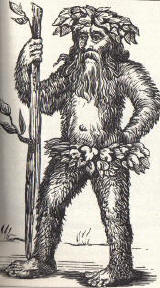
Bigfoot, Yeti, Sasquatch...are these ancient semi-human creatures only a part of humankinds mythic iconology or are they based on fact? An excerpt from "Creatures in the Mist", coming Spring 2007 from Algora Publishing.
Legends concerning a group of shaggy and primitive “Wild Men” have survived over the centuries and may be regarded as legends of either a common mythic creature or an as yet unidentified creature that possibly may still exist. The Wild Man most likely is based in reality. During the Middle Ages, a sub-culture existed on the fringes of society made up of outlaws and social outcasts. At times, individuals made their way into the towns and cities and the Wild Man-Wild Folk, stories began. At the same time, the term was applied to the mythical race of dwarves who were called “Moss-Folk”. One folklorist wrote, “they are considered to be dwarfs, and they live in communities. They are grey and old-looking, and are hideously overgrown with moss, giving them a hairy appearance.” (1) These Moss Folk weave the moss of the forests and protect it with a vengeance. They do help some people with their knowledge of the healing plants and herbs and they help crops to grow.
Other Wild Men were described as “often of gigantic proportions, dwell in woods or mountains, and originally were no doubt closely connected with the spirits of trees…From head to foot they are clothed in moss, or covered with rough shaggy hair, their long locks floating behind them in the wind.”(2) In folklore these Wild Men are sometimes helpful to humans in that they will locate lost cattle and have the ability to treat the illnesses of cattle, but, according to Philpot, they are “more often mischievous, having the propensity for stealing the milk and carrying off the children of the peasants.”(3)
There is another aspect of the Wild Man as a creature removed from accepted society. The Wild Man subculture came to represent those things rejected by the “civilized” elements—those being natural elements found in animal and vegetable life as well as those more “primitive” aspects of humanity. These very basic characteristics of nature came to be those most feared by the Christian society of the day. “For much of the Middle Ages, hairy, cannibalistic, sexually omnivorous wild men and women had represented the antithesis of the civilized Christian”, wrote British historian Simon Schama. (4) The many illustrations of the Wild Man of the Middle Ages show a naked individual completely covered in long, shaggy hair with only the face, hands, elbows (and the breasts of the female) exposed. Other illustrations show this very same individual covered in leaves instead of hair or fur.
Because of the association with leaves, some writers have linked the Wild Man to the Green Man archetype. I disagree with this and believe that the depiction of the Wild Man covered in leaves refers more to his habitat of the forest rather than as an agricultural or fertility symbol that the Green Man represents. An interesting folk festival-ritual held at Whitsuntide called “chasing the Wild Man out of the bush” was held in Saxony and Thüringen that lends evidence that this creature actually did exist, at least at one time in the past. Frazer wrote, “A young fellow is enveloped in leaves or moss and called the Wild Man. He hides in the wood and the other lads of the village go out to seek him. They find him, lead him captive out of the wood, and fire at him with blank muskets. He falls dead to the ground…”(5) In another village Frazer identifies as Erzgebirge there was an annual (at Shrovetide) custom that originated around 1600 CE. According to Frazer “Two men disguised as Wild Men, the one in brushwood and moss, the other in straw, were led about the streets, and at last taken to the market-place, where they were chased up and down, shot and stabbed. Before falling they reeled about with strange gestures and spirted blood on the people with bladders which they carried. When they were down, the huntsmen placed them on boards and carried them to the alehouse…”(6) Frazer noted that similar customs were still carried out in Bohemia during his day. Are these simply folk customs or are they a ritualized memory of actual Wild Man hunts?
Contrary to Frazer, Schama believes prior to 1600 society itself transformed the wild folk into symbolic guardians of nature. “…beginning in the later part of the fifteenth century…wild men were made over into exemplars of the virtuous and natural life.”(7) Over the next hundred years, the wild man was “turned into conspicuously gentler creatures.”(8)
The wild man became the symbol of popular discontent with the burgeoning cities and court society; he was, in a sense, a response of nature towards this unnatural existence and the destruction of the Wild Wood. According to Michael Cremo, the Wild Men “were said to be members of the animal kingdom, unable to speak or comprehend the existence of God.”(9)
Hundreds of centuries earlier, however, the Wild Man was depicted on a silver Etruscan bowl, “on which”, writes Cremo, “may be seen, among human hunters on horses, the figure of a large, ape-like creature.”(10) Cremo notes that the wild man figure was not one of the common mythological figures but “in the midst of a hunting party of well-armed humans mounted on horses. The creature has no satyr’s tail [as some have said that the figure is that of a satyr] and appears to be carrying a crude club in one hand and a large stone, raised threateningly above his head, in the other.” (11)
In North America, the Wild Man is present in the ancient legends of Big Foot and Sasquatch—huge human-like figures covered in long hair and leaves. Nineteenth century American folklore tells of a family of Big Foot who attacked a group of gold miners in their California cabin one evening, destroying the building and tearing the men apart. Was this a response to the encroachment of “civilized” man? The characteristics of the two are very similar and they react in the same way. As Matthews writes of the Wild Man “he can only dwell in such wild spots and avoids those places tamed by humankind, retreating ever deeper into the wilderness to escape the excesses of civilization—its cruelty, greed, and hypocrisy”.(12)
The Pacific Northwest forest is a breeding ground for Big Foot stories. An article in the April 1965 edition of Western Folklore gave the following account of an event that occurred 45 miles from Eureka, California in 1958:
“Two sturdy construction workers insist they have seen ‘Big Foot,’ whose 16-inch tracks have been spotted recently in the Northern California woods. ‘He—or it—bounded across the road in front of our car Sunday evening,’ said Ray Kerr, 43. ‘It ran upright like a man, swinging long, hairy arms. It happened so fast, it’s kind of hard to give a really close description. But it was all covered with hair. It had no clothes. It looked 8 or 10 feet tall to me.’” (13)
One Wild Man in particular didn’t dwell in the wild forests but rather in the sea. Known as the Wild Man of Orford, it is said that several fishermen caught this creature in their nets during the reign of Henry II. Taken to Orford Castle in Suffolk he was reported to be “completely naked and had the appearance of a man. The hair of his head seemed torn and rubbed, but he had a bushy beard and was shaggy about the breast.”(14) This Wild Man would eat most anything it was given but preferred fresh fish that he would squeeze between his hands until all of the moisture was drained out. According to Westwood, the Wild Man of Orford could not speak even though the local authorities hung him up and tortured him. He stayed at Orford for several months until one day he was able to slip by his guards and disappeared in the waves. At the time, it could not be decided if this Wild Man was a merman, man, fish, or evil spirit that inhabited the body of a dead sailor although fins and other fish-type characteristics were never mentioned in the chronicle. An 1870 edition of Murray’s East Anglian Handbook states, “A tradition of this monster, known as ‘the wild man of Orford’, still exists in the village.”(15)
Sightings of these Wild Men are not confined to an earlier time, however. The “Winstead (Connecticut) Wild Man” has been sighted off and on from 1895 through the 1970s and perhaps beyond. First reported in a local newspaper on August 21, 1895, a witness described his account thusly:
“…a large man, stark naked, and covered with hair all over his body, ran out of a clump of bushes, and with fearful yells and cries made for the woods at lightening speed, where he soon disappeared.”(16) The witness, a Selectman by the name of Riley Smith, added that the “man” was at least six feet tall and ran upright. The creature was seen again in 1972 and 1974. Both times witnesses described it as being six feet in height, approximately 300 pounds and covered with dark colored hair. Both times the witnesses were terrified.
As noted, however, it is not only in North America or in Europe that stories of these mysterious wood-folk abound. Among the Yupa Indians, living in Colombia and Venezuela a similar nature spirit is spoken of. Called the Mashíramũ, or “Bush Spirit”, he is described as being covered with hair with its feet turned backwards. This creature is regarded as a “devastating demon”, to be greatly feared. (17) Another Yupa spirit is the Karau, the Spirit of the Night. It too is covered with hair, has very large teeth and very cold hands. The Karau is said to rape women and to kill and eat his victims. (18)
The Wild Man and Wild Woman were known among the Nehalem Tillamook Indians in Oregon as well. “The Wild Woman”, wrote ethnographer Elizabeth Jacobs “was one of the most important of the supernatural beings. She was a large woman and lived in the forest.”(19) Described as having “long beautiful hair and wearing lots of dentalia”, Wild Woman was believed to be spiritually connected with the spruce tree. She could make people sick and die, cause insanity or simply make a tree fall on you. Should you be on her good side however, she would grant one with supernatural powers to diagnose illnesses and cure them or give skills to make beautiful baskets.
Similarly, the Wild Women of old Germany were not only kindly but beautiful. “…they are beautiful,” writes folklorist Thomas Keightley, “have fine flowing hair, live within hills, and only appear singly or in the society of each other.”(20)
According to local lore, the Wild Women began to appear near the German village of Grödich around the year 1753. The Wild Women would give bread to the boys and girls of the village who watched over the cattle. One day their kindness was extended to kidnapping a small boy, saying to the father “He will be better with us, and have better care taken of him than at home.”(21) Reportedly, the boy was seen by woodcutters a year later in the forest, clothed in a green dress, but was never seen again.
In Russian folklore, the Wild Women again are regarded as “handsome females, with fine square heads, abundant tresses, and hairy bodies.” (22) These Russian Wild Men also lived in communities in mountain forests and could be either dangerous (they were said to like to tickle people to death who happened upon them) or helpful. To any who ventured into those mountain forests and left offerings of food, the Wild Women would harvest their grain for them; tend their children and even tidy up their homes. In addition, like the Faeries, they could become invisible by applying certain herbal remedies and would sometimes leave golden leaves to village girls they favored.
While Wild Women were considered handsome and beautiful (although hairy) the Wild Man, on the other hand, is an ugly giant who lives in the forest, known to cause sickness but also to grant certain powers and skills. (23)
Clive Hicks, however, noted that the Wild Men and Wild Woman “are not necessarily malevolent and are depicted as helping humanity in some cases…The wild man represents an asset in each of us, the whole reservoir of qualities with which each of us is endowed…” (24) Again, we are faced with a paradox and one that is not likely to be resolved soon.
Similar tales of these large hairy ape-men are found in such diverse locations as the Pacific Northwest, Europe, Canada, southern Mexico, Belize, Guiana, Ecuador, Brazil, Malaysia, Indonesia, parts of Africa, and of course the Himalayas and central Asia.
The Wild Men in Chinese lore were said to have “long, thick locks, fiery red in colour, and his body is covered with hair.” (25) “Many” of these wild men were said to live in the mountainous regions of China although by 1922 only a few were reported to still be in existence.
These Chinese Wild Men were said to be powerful creatures, able to break large rocks with a single blow of its fist and capable of pulling up trees by their roots. The nearby villagers were rightfully fearful. “These wild men kill and eat all human beings they meet,” wrote Werner, “and other hill tribes live in terror of meeting them.” (26)
The first “Wild Man” appearing in the world’s literature was Enkidu in the ancient Summerian Epic of Gilgamesh. Created by the goddess Aruru (also known as Anu) to appease the prayers of the subjects of Gilgamesh who tired of his iron hand rule, Enkidu was made to match the strength of Gilgamesh and to do battle with him although he actually became Gilgamesh’s closest ally. Historian Fred Gladstone Skinner wrote that Enkidu was “a valiant god of battle, whose entire body was covered with hair, shaggy as a woman’s head. His clothes were of animal skins and, like an animal, he grazed in the fields and fought with the wild beasts for a place at the water holes.” (27)
Professor of Classics at the University of Cambridge, G.S. Kirk asks an important question about Enkidu, “we find that the main unexplained element is the insistence on Enkidu as a wild man from the desert. This at first sight arbitrary theme, inconspicuous in the Sumerian versions, is emphasized, not only in the earlier part of the poem, but also, by reminiscence, up to Enkidu’s death. What is its point, does it serve any real purpose in the epic as a whole, and how did it become so prominent a motif in the Akkadian elaboration?” (28)
In addition, we ask ourselves “What are we to make of these hairy Wild Men and Women?” Some researchers believe that they are common images to the human psyche because they represent man’s psychological desire to throw off the restrictions imposed by his society or culture. An ancient and universal mythic icon, if you will, of our desire to become once again “savage”. However, the common threads of these legends could possibly project another explanation. The universal descriptions of the creature’s physical characteristics, habitats, “smell,” and behavior would appear to describe an actual living being, one that perhaps survived thousands of years beyond its perceived origin. Like the “hobbits” of Flores, these beings may account for a large number of the world’s folklore and fairy tales and they may still be with us, surviving on the fringes of the world as they always have, in the unfrequented mountainous areas of the globe.
The psychic “importance” of the Wild Men is clearly seen in the architectural ornaments that include his image. According to anthropologist Dr. Myra Shackley, “His image permeates every form of medieval art, from architecture to heraldry, and in the latter he is often shown as a supporter of an armorial shield. Over 200 European families have wildmen as heraldic emblems… There is little variation in the way they are portrayed, leafy decorations and a club being the rule.” (29) Similar heraldic symbols were common in Germany as well, growing more so with the rise of German nationalism during the 16th century.
Shackley, while writing that legends of Big Foot, Sasquatch, etc. are based upon actual creatures, notes “Until proven otherwise the European Wildman, whether he is called a wodewose, (30) a green man, a satyr or anything else, remains a creature of legend. It is possible that genuine relic hominids were sighted from time to time somewhere in the world during the Middle Ages,” she writes, “but verbatim descriptions have not survived. The European Wildman is a myth…”(31)
NOTES
1. Porteous, Alexander. The Lore of the Forest: Myths and Legends. London: Senate Publishers 1996, 93 (A reprint of the 1928 publication Forest Folklore published by George Allen & Unwin, London)
2. Philpot, Mrs. J.H. The Sacred Tree in Religion and Myth. Mineola: Dover Publications Inc. 2004, 68 (A reprint of the 1897 edition published by Macmillan and Co., Limited, London)
3. Ibid
4. Schama, Simon. Landscape and Memory. New York: Vintage Books 1995, 97
5. Frazer, James G. The Golden Bough: The Roots of Religion and Folklore. New York: Avenal Books 1981, 243. A reprint of the two volume edition published in 1890 by Macmillan, London.
6. Ibid, 244
7. Ibid.
8. Ibid.
9. Cremo, Michael A. and Richard L. Thompson. The Hidden History of the Human Race: Forbidden Archaeology. Los Angeles: Bhaktivedanta Book Publishing, Inc. 1996, 595
10, Ibid. 594
11. Ibid
12. Matthews, John. The Quest for the Green Man. Wheaton; Quest Books 2001, 110
13. “Folklore in the News: California ‘Big Foot’”, in Western Folklore, Vol. XXIV, April, 1965, Number 2, 119
14. Westwood, Jennifer. Albion: A Guide to Legendary Britain. London: Paladin Grafton Books 1985, 186
15. Ibid
16. Philips, David E. Legendary Connecticut. Willimantic: Curbstone Press 1992, 175
17. Wilbert, Johannes. Yupa Folktales. Los Angeles: Latin American Center, University of California 1974, 139
18. Ibid, 138
19. Jacobs, Elizabeth D. The Nehalem Tillamook: An Ethnography. Corvallis: Oregon State University Press 2003, 190
20. Keightley, Thomas. The World Guide to Gnomes, Fairies, Elves, and Other Little People. New York: Gramercy Books 1978, 234. A reprint of the 1878 edition titled Fairy Mythology published by G. Bell, London
21. Ibid, 235
22. Campbell, Joseph. The Hero With a Thousand Faces. New York: MJF Books 1949, 79
23. Jacobs, op cit, 182
24. Hicks, Clive. The Green Man: A Field Guide. Helhoughton: COMPASSbooks 2000, 7
25. Werner, E.T.C. Myths and Legends of China. New York: Dover Publications, Inc. 1994, 392. A reprint of the 1922 edition published in London by George G. Harrap & Co., Ltd.
26. Ibid
27. Skinner, Fred Gladstone. Myths and Legends of the Ancient Near East. New York: Barnes & Noble Books 1970, 27
28. Kirk, G.S. Myth: Its Meaning & Functions in Ancient & Other Cultures. London: Cambridge University Press 1970, 145
29. Schakley, Myra. Still Living? Yeti, Sasquatch and the Neanderthal Enigma. New York: Thames and Hudson 1983, 25
30. “wodewose” is derived from an Old English word meaning “a woodland being”
31. Schakley, op cit 27
|


