A chapter from the forthcoming book on folklore and mythology, Creatures in the Mist, by Gary R. Varner. To be published in the Spring 2007 by Algora Publishing.
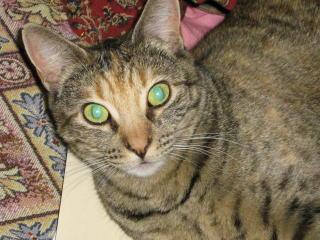
The cat has long been one of humankinds favored animals. It has been worshipped as a god by the Egyptians and feared as a demon by Christians terrified by witchcraft. It is both a beloved family pet and a fierce feral predator. It is a loving companion but never tamed. Like most symbols universally important in societies around the world, the cat has a dual nature of both good and evil aspects.
Cats represent clairvoyance, watchfulness, mystery, female malice and sensual beauty. In India, it was believed that cats could take over the bodies of women at will. (1) On the other hand, the Indian goddess of maternity and protectress of children, Sasti, is a feline goddess that rides on a cat. (2)
Both Chinese and Japanese folklore views the cat as symbolic of transformation. Scandinavian mythology says that the goddess Freyja’s chariot is drawn by cats. In Egyptian mythology the goddess Bast, the moon goddess, is cat-headed and the cat also symbolized the protective aspects of the Mother Goddess, Isis.
In Cambodia, the cat is associated with drought and is carried in cages to rain ravaged areas where it is doused with water. It is believed that the cat’s howls will awaken the rain goddess Indra so that she will stop the downpour. (3)
Big cats have dominated the ancient religious traditions of Mesoamerica. Appearing as a jaguar or puma or as a composite jaguar human figure, the cat gods were associated with caves, the night and the underworld. Much as cats were viewed during the witch-hunting days of Europe.
One of the main deities of the Olmec people was the were-jaguar, half human and half jaguar the were-jaguar was important for its rain making abilities. The Maya had the most jaguar deities than any other Mesoamerican people. They regarded the jaguar as representative of the sun. Miller and Taube noted that the Mayan jaguar was the nighttime sun, and as god of the Underworld it was also the Underworld’s sun. (4) The jaguar image is frequently associated with sacrifice.
Black cats are normally thought to bring bad luck—except in England where they have the opposite effect. Images of black cats in England are made into good luck charms. Symbologist J. C. Cooper, however, noted, “As black it is lunar, evil and death; it is only in modern times that a black cat has been taken to signify good luck.” (5) Ancient Chinese tradition speaks of the black cat as representative of misfortune and, of course, Christian symbolism links the black cat with Satan, lust, laziness and witchcraft.
While cats have caused some fear among humans for their mystical character it is the cat that has paid the price more than their human companions have. According to an entry in the January 11, 1851 Notes and Queries British periodical, “In Wilts, and also in Devon, it is believed that cats born in the Month of May will catch no mice nor rats, but will, contrary to the wont of other cats, bring in snakes and slow worms. Such cats are called ‘May cats,’ and are held in contempt.” (6) “May cats” seem to have been universally disliked in England in the 19th century. Another Notes and Queries entry on February 1, 1851 stated “In Hampshire, to this day, we always kill may cats,” and in June another reader wrote “…may Cats are unlucky, and will suck the breath of children.” (7) This last superstition is still commonly found in the Western world.
Cats are also invariably linked to the weather—and generally not good weather. The approach of wind and rain was said to be foretold by the way a cat washes itself or in what direction it sits while grooming. Greek folklore from the 1890’s said “…if a cat licks herself with her face turned towards the north, the wind will soon blow from that dangerous quarter.” (8)
Witch-lore says that the cat familiar is a rain-maker as well as a companion to the witch. Foretelling the weather by watching a cat may not be foolproof however. Another bit of weather-lore says “Cats with their tails up and hair apparently electrified indicate approaching wind, --or a dog.” (9)
Witches have long been associated with the cat—the cat being either the witches familiar or a form that the witch easily transforms into. This relationship is an ancient one, the Greeks and Romans told of a woman who had been changed into a cat chosen as the priestess of Hecate, goddess of the Underworld, sorcery and magic. In fact, Hecate is often depicted as a cat. It is interesting that the cat is so universally thought of in this manner as, in reality, there are more stories of rabbits being associated with witches than the cat. While there is some court testimony of the 16th century concerning witches shape-shifting into cats, many other animals were also implicated such as dogs, frogs, cocks and hares. In 1587 twenty-four Aberdeen witches were tried and eventually “They accused one another of unnatural practices, from eating mutton on Good Friday to concourse with devils in the shape of black cats and dogs.” (10)
This belief in witches assuming the form of cats was not restricted to Europe by any means. Folklorist Vance Randolph wrote in his 1947 study, Ozark Superstitions that “A witch can assume the form of any bird or animal, but cats and wolves seem to be her favorite disguises. In many a backwoods village you may hear some gossip about a woman who visits her lover in the guise of a house cat. Once inside his cabin, she assumes her natural form and spends the night with him. Shortly before daybreak she becomes a cat again, returns to her home, and is transformed into a woman at her husband’s beside.” (11)
In popular folklore, the witch was said to be able to assume the form of a black cat nine times—to match the nine magical lives that the cat is supposedly blessed with. Across Medieval Europe, black cats were hunted down and killed—usually by burning. This most often occurred on Shrove Tuesday (12) and Easter.
In fact, notes Thompson, “the connection of the cat with witches was no doubt the reason for the persecution and ill-treatment of the animal in the seventeenth century.” (13)
Cats have been fearfully linked to death, probably as a result of their association with the witch trials but also due to their ties to ancient predator animal deities around the world and to ancient gods and goddesses of the Underworld.
In Estonian folklore, the returning souls of dead humans, called “home wanderers,” or “revenants” could appear in human or animal form. According to Estonian folklorist Eha Viluoja, out of 92 reported instances of “home wanderer” observations, cats (black of course) accounted for 17 of them. Dogs were the primary ghostly object seen, accounting for 35 cases. (14)
Any cat that jumped over a body awaiting burial was a sure sign of bad luck and immediately killed. It was believed that should a cat do such a thing the corpse would rise up to become a vampire. (15)
Regardless if the cat is empowered with evil forces; it has been used to affect folk-cures and to provide protection—in rather strange ways. Folklorist Luc Lacourcière noted that in French Canada it was not uncommon to attempt to transfer disease from the human patient to an animal. In the case of shingles, a skinned-cat was applied to the human body so that the disease could be absorbed into the body of the dead cat. (16) Other treatments include making the sign of the cross with a cat’s tail over an eye afflicted with a sty. This reportedly will make the sty disappear. This treatment was used in such diverse areas as Louisiana and England. (17) It was not reported if the cat was living or dead when its tail was used for this purpose. A broth, made from a black cat, was also consumed to cure consumption.
The mystic power of the cat was continuously sought until well into the 19th and 20th century and, most likely, into the 21st century as well. Folk-medicine practices around the world abound in strange rituals to cure certain diseases or to warn individuals away from potentially dangerous events. Many of these today seem naïve and childish—as well as cruel for the poor animals involved. In Oregon in the 1960’s folklore warned, “Never allow a child to play with cats or he will become a simpleton.” A similar prohibition was reported in Ohio in the 1950’s, “If a boy plays with cats, it will make him stupid, for the cat’s brain will go into him.” (18)
Other dangers associated with playing with cats include the very real possibility of women becoming pregnant (recorded in Oslo during the 1930’s). While some folklore warns against being overly friendly with cats the obverse was also true during the 1950’s in the American Mid-West. “If you make enemies of cats during your lifetime,” it was reported, ”you will be accompanied to the grave by storms of wind and rain.”(19)
Other folk-medicine traditions include one from Germany during the early 20th century that said that thieves could become invisible by cutting off the tips of the tongue of black cats and dogs, “wrap them in wax of an Easter candle, and carry them under the left arm.” (20)
A rather grisly tradition in Christian England included sacrificing a cat to ward off evil forces when buildings were constructed. Originally cats, and other animals as well as humans in pre-historic times, were killed and buried in building foundations as sacrifices to the gods and spirits to ensure protection of the structure. Over time, the “sacrificial” aspect was rationalized. Archaeologist Ralph Merrifield wrote, “the cruel practice of killing a cat as a builder’s sacrifice was revived by the notion that the body of a cat set in a lifelike attitude in a hidden place would frighten vermin from the building.” (21) What the actual “vermin” were is questionable however. Were rodents the focus of these efforts or was it more the spiritual “rodent”—demons and witches—that were the objects of such fear? In some instances, a dead cat was found with a single rat in its mouth or near a paw. However since the cat was effectively buried in the structure it is doubtful if any vermin on the earthly plane would have taken notice.
While this use of “charms” was widespread across England from the 15th to 19th centuries, it also occurred in other locations such as Gibraltar and Sweden.
__________________________
Notes
1. Tresidder, Jack. Symbols and Their Meanings. London: Duncan Baird Publishers 2000, 59.
2. Mackenzie, Donald A. Myths and Legends: India. London: Studio Editions 1985, 153.
3. Keister, Douglas. Stories in Stone. New York: MJF Books 2004, 71.
4. Miller, Mary and Karl Taube. The Gods and Symbols of Ancient Mexico and the Maya. London: Thames and Hudson 1993, 104.
5. Cooper, J.C. An Illustrated Encyclopaedia of Traditional Symbols. London: Thames and Hudson 1978. 30
6. Notes and Queries, Vol. 3, Number 63, January 11, 1851, 20.
7. Notes and Queries, Vol. 3, Number 87, June 28, 1851, 516.
8. Inwards, Richard. Weather Lore. London: Elliot Stock 1893, 126.
9. Ibid.
10. Parrinder, Geoffry. “The Witch as Victim” in The Witch in History edited by Venetia Newall. New York: Barnes & Noble 1996, 129.
11. Randolph, Vance. Ozark Magic and Folklore. New York: Dover Publications, Inc. 1964, 268. A reprint of Ozark Superstitions published 1947 by Columbia University Press.
12. Shrove Tuesday is the last day before Lent. It was a day that became popular for divination among many other activities.
13. Thompson, C.J.S. The Hand of Destiny. New York: Bell Publishing Company 1989, 201.
14. Viluoja, Eha. “Manifestations of the Revenant in Estonian Folk Tradition”, in Folklore, Vol. 2. http://www.folklore.ee/folklore/vol2/viluoja.htm 8/14/06
15. Guiley, Rosemary Ellen. The Encyclopedia of Witches & Witchcraft. New York: Checkmark Books/Facts on File 1999, 49
16. Lacourcière, Luc. “A Survey of Folk Medicine in French Canada from Early Times to the Present”, in American Folk Medicine, edited by Wayland D. Hand. Berkeley: University of California Press 1976, 212.
17. Simpson, Jacqueline and Steve Roud. Oxford Dictionary of English Folklore. Oxford: Oxford University Press 2000, 50 and Elizabeth Brandon. “Folk Medicine in French Louisiana” in American Folk Medicine. Edited by Wayland D. Hand. Berkeley: University of California Press 1976, 200.
18. UCLA Folkmedicine Record Numbers 10_4587, 11_4890.
19. Ibid, Record Number 5_5244
20. Hoffman-Krayer, Eduard von and Hanns Bächtold-Stäubli, eds. Handwörterbuch des deutschen Aberglaubens. Berlin & Leipzig 1927-1942, vol. 2, 235.
21. Merrifield, Ralph. The Archaeology of Ritual and Magic. New York: New Amsterdam Books 1987, 186
|


It still amazes me yet that people believe in demons, witchcraft etc.
Elizabeth