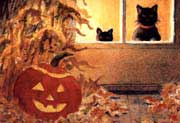
Samhain, today known as "Halloween", is an ancient holy day to remember the dead, to welcome in the new year, and to shrug off unwanted "baggage" from the last year. This article discusses the history and meaning of this misunderstood time.
A time both welcomed and feared...a time to cast off worries and ill-thoughts and to focus on desires for the future...
Samhain, meaning “summer’s end”, (1) is the time of the celebration of the last harvest, a time when the leaves are turning color, when the winds start to turn cool, a time of the closing of the year. Samhain is also a time to celebrate the dead and to look forward to the New Year. Samhain is one of the most holy of times for Pagans; for Wiccans and Druids in particular.
Samhain was a time when the Sun god Lugh died, foretelling the coming of winter, and a time when The Dagda (or “the Good God”) and the Morrigan (a goddess of fertility and destruction) came together to ensure “the continuing prosperity of the tribe and the fertility of the crops and animals in the coming year”. (2) It was customary to extinguish and re-kindle the hearth fires during this time as well.
Because Samhain occurs at the point of transition between the Old and New years, it was also a time when people believed, and still do, the barriers between spirit world and our physical world become so thin that the two merged, allowing the spirits of the dead, as well as the other residents of the Otherworld, to freely roam between both worlds. It was a time both welcomed and feared by the people of old. It was a time of possible communication with the gods and the dead, and as Lewis Spence wrote in his book, The Magic Arts in Celtic Britain:
“The season was associated as a whole with the idea of terror and fear. November was indeed the month of death and sacrifice. The dead and their associates, the fairies, were free to wander the world on that occasion, which was thus one of peril to wayfarers, who might be spirited off by them. It was a night of mischief and confusion.” (3)
Steve Blamires wrote that this “in-between time is clearly a very special state, and it is recognized as being a time when the normal order of things is upset or reversed, and chaos reigns, albeit temporarily.” (4) So strong were the currents of spiritual energy at Samhain, coming across the spiritual boundary, that it was up to the Druids to control and mediate the flow.
Our “trick or treat” tradition originally was an offering of cakes and other sweets left outside to appease wandering spirits. It was felt that if such an offering was not left, the spirits would, indeed, cause some misfortune to befall the household. A Feast of the Dead was also one of the ancient practices. Families would gather at the resting place of the dead and have a feast in their honor, assuming that the spirit of their loved ones would also partake of the food and ale. One custom was to pour libations over the tombs and another to “sacrifice” ale to the sea-god.
Samhain was also a time to cast off worries and ill-thoughts from the prior year and to focus on desires for the future after the re-birth of the New Year. In many ways our contemporary New Year’s celebrations are an extension of this practice.
Our popular costumes, pumpkins and the many games such as bobbing for apples are all ancient in origin. The witch costume is actually a representation of the Goddess in her dark, Crone aspect. And of course the costumes of skeletons and ghosts reflect the thin veil that separates the two realms of the living and the dead. The numerous cats, bats and owls which decorate our homes and businesses at Halloween are soul-symbols” and familiars of witches. The owl has long been associated with Hecate and Lilith, Goddesses of the Underworld.
A more ominous reason for the wearing of masks was to protect the identity of those Pagans worshipping at Samhain from Church authorities during the Inquisition and other times of persecution.
The contemporary usage of pumpkins, carved and decorated, may have origins in the Celtic cult of the head. In Europe turnips were carved in similar fashion. It wasn't until Europeans came to America that pumpkins were substituted. Apples also were sacred to the Goddess. Cut in half, the seeds form a perfect five pointed star, a natural pentagram. Bobbing for apples was a way to obtain the Goddesses favor with good luck for the following year.
Of course something so important and widespread and Pagan could not be ignored by the Christian Church. Samhain was re-named Hallowe’en, or All Souls Day, in an effort to absorb Pagan festivals into mainstream Christianity. Even today many Christian-right groups are attempting to totally eradicate the holiday and to “divert” the young into Christian activities. As one early Christian leader said, “many other superstitious ceremonies, the remains of Druidism, are observed on this holiday, which will never be eradicated while the name of Saman is permitted to remain”. (5) While the name has been changed, the age old practices continue to exist—lets keep it so.
NOTES
1. Various meanings of the word “Samhain” have been suggested over time. John King suggested in his book The Celtic Druids’ Year that it simply meant “November”. This appears to be too simplistic, however. Barbara Walker (The Women’s Encyclopedia of Myths and Secrets) states that Samhain is named after the Aryan Lord of Death, Samana. The most likely explanation is that offered by Miranda J. Green, who noted in The World of the Druids, that Samhain may be a derivative of the Irish “samrad” and Gaulish word “samon” which referred to the seasonal change between warm weather and the beginning of winter. The 1st century C.E. Celtic Coligny calendar referred to Samhain as “Samonios”.
2. Cunliff, Barry. The Ancient Celts. Oxford: Oxford University Press, 1997, 186
3. Spence, Lewis. The Magic Arts of Celtic Britain. Mineola: Dover Books, 1999, 70, a reprint of the Rider & Company 1945 publication
4. Blamires, Steve. Glamoury: Magic of the Celtic Green World. St. Paul: Llewellyn Publications 1997, 217
5. Hazlitt, W. Carew. Faiths and Folklore of the British Isles. New York: Benjamin Blom, Inc. 1965, 340
|



You've set my thoughts a'ramblin down some interesting corridors...
judith