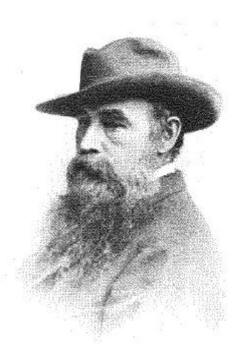
The Folklorist
t was Leland’s early childhood in Philadelphia that spurred on his interests in the mysterious world of Indians, witches, and the ancient cultures that existed before. Folklore and old stories occupied the minds of many people in Philadelphia who were surrounded by an area rich in history and myth.
His niece and biographer wrote, “Not only did statues walk, but there were great marble dogs in Race Street by which the small boy who was wise ran quickly, for they howled when anybody in the neighborhood died; a dreadful sound, surely, even for grown-up people to hear. Then, there were Indians who came from their graves to hold their weekly market in Independence Square and, had he only waked at the midnight hour, he might (who knows?) have seen, from the Fifth Street windows, the statue of Franklin stalking among their shadows. There was the Quaker girl, too, whose ghost on summer nights wandered among the flowers in the garden of the old Pennington House, a ghost no one need have been afraid of. These and other pleasant terrors lurked at every corner, in every open place in town. …And when he invested in the Dime Novels of the day, half the time it was to read some horror of the Salem witches; when he wandered into the kitchen, Irish servants whispered of fairies, or old coloured women muttered ‘Voodoo incantations.’ One there was, a cook, who had gone so far as to put ‘a spell of death’ on all who dared take her place.” (1)
His environment, as well as his ancestry, no doubt contributed to his natural inclination to be fascinated with the unknown. Besides being descended from the first white settler in New England, he was also related to John Leland, an antiquary, and Charles Leland the Secretary of the Society of Antiquarians during Charles I’s time. His mother was a member of the Godfrey family—Rhode Island Puritans. One of her ancestors was a “High German” doctor said to practice sorcery.
According to Elizabeth Pennell, “The unseen, the strange, the extraordinary,--that was what reconciled him to life, from boyhood…to old age…” (2)
Leland’s foray into folklore was, contrary to the experience of most folklorists, one of luxury. His niece would write, “Much as he loved the people of the road, to play tramp would have been no less abhorrent to him than to pose as “Bohemian” in New York. Later, when he went gypsying, it was from his own comfortable quarters. He never lived with the Indians, as Cushing did. He might walk a mile to meet a tinker, but nothing would have induced him to set up a tinker’s forge, like Borrow.” (3)
His research consisted of chance meetings with the Indians and paid accounts from both Indian and Gypsy informants. Rarely did he question the materials that were sent to him but willingly paid for them by the page. Even when he did suspect that his informants were sending materials freely adapted from poems, fiction or the classics he never refused the material but simply adapted them to his needs—and his needs were to create a fantasy of what he believed the ancient cultures, religions and traditions should be.
His most serious example of scholarly fraud was his attempt to place the origin of Algonquin myth in the Norse Eddas. He not only modified Indian art to reflect Old World mythic images, but he falsified Native American mythology to establish a connection between the two cultures. While his work may have been accepted by the public it was immediately challenged by leading scholars of his day as being untenable.
There is disturbing evidence that Leland was, in fact, a racist and his “noble savage” and “noble Gypsy” views were used to enforce his constructed world of fantasy. Thomas Parkhill wrote, “As improbable as it seems to contemporary sensibilities, Leland wanted to show these ‘Indians’ to be in some sense Aryan. According to his story, if the ‘Algonquin’s’ mythology derives from the Norse, then their myths, like the Norse’s, are related to Vedic mythology and are thus ‘Aryan.’ If Leland’s ‘Indians’ are Aryans, or even Aryan-like, they would be seen as strong, aggressive, virile—showing manly virtue.” (4)
Strangely enough, Joseph Campbell, that American icon of folklore and mythology, is the lone scholar who has embraced Leland’s hypothesis of a Norse-Algonquin kinship. Parkhill noted, “Sadly, Campbell depends on Leland to be an authority when scholars unanimously agree he is not; and he relies on a story, the centerpiece of Leland’s work, that Leland had forged to his own specifications.” (5) While we may justify Campbell’s oversight to simply not checking Leland’s sources this does cast a pall over Campbell’s stature among scholars.
Leland pictured himself as an individual totally at ease with all people, although he also implied that he was above them both intellectually and culturally. Pennell noted, “he had always, he said, been able to win the confidence of Indians and Negroes. It was natural then that he and the Gypsies, as soon as they met, should understand each other.” (6) In his own words, Leland wrote of these people, “who have all at least this one point in common with Savages, New Jerseymen, Red Indians, Negroes, Gypsies, and witches, that they by mystic sympathy know those who like them, and take to them accordingly, guided by some altogether inexplicable clue or Hexengarn, even as deep calleth unto deep and star answereth star without a voice. Whence it was soon observed at Heidelberg by an American student that ‘Leland would abuse the Dutch all day long if he saw fit, but never allowed anybody else to do so.’ The which thing, as I think, argues the very ne plus ultra of sympathy.” (7)
One of Leland’s pet projects was his study of “Shelta.” According to Leland, Shelta is an ancient Romany language based in Irish Gaelic. He described it as a “back-slanged and rhyming cant based on old or pre-aspirated Irish Gaelic.” He was certain that it was also identified with Ogham, the ancient writing system of the Irish and the Druids. There is no evidence of this connection, however. In Leland’s opinion, Shelta was a natural origin for the language of the gypsies as the Irish “are given to mysterious languages and secrets.” Leland proclaimed himself to be the “first discoverer of Shelta” although this is unlikely as the first vocabulary of the language was published in 1808. Shelta does in fact exist as a secret language and is used to conceal meaning from outsiders, used primarily in gypsy business negotiations or when speaking around the police. Officially known as Gammon, it may date back to the 13th century. According to linguists, Shelta has a syntax primarily based in English with heavy influence from Irish, English and other non-Gaelic languages. A survival of the language into common usage is the English word “bloke,” meaning “a man”, which may have originated in the mid-19th century. Linguists believe it probably derives from the Shelta word "buachaill", meaning “boy” or "lad". There are approximately 86,000 worldwide speakers today, all of whom are “travelers.” Leland labeled the language the “5th Celtic tongue.”
Although Leland obviously was not the “discoverer” of the language, he was responsible for the first publication of the word “Shelta” in his 1882 book, The Gypsies.
Leland wrote to fellow folklorist David MacRitchie on October 30, 1891 suggesting that papers on Shelta be requested from other researchers for presentation in the Folk-Lore Journal. He wrote:
“The world—even the learned—does not know as yet that a quite new (or ancient) language has been discovered in Great Britain, with tales and songs. If it had been some infinitesimally trifling and worthless Himaritic or Himalayan up-country nigger dialect, every scholar in England would have heard of it long ago. But the old language of the bards—or at worst, an old Celtic tongue—is of no interest to anybody.” (8)
Obviously, Leland’s “love of the Negro” did not extend to language. Leland reportedly “discovered” the language from “an English vagrant in North Wales and an Irish tinker in Philadelphia.”
Leland’s greatest desire was to “discover.” Regardless if he manipulated his informants or modified legends and traditions, regardless if the item of discovery had already been found by another, he lived to be regarded as a revealer of the lost and mysterious. One of his idiosyncrasies was to change the legends, which he received from his informants, from their original into poetic format—he seemed to feel that all ancient tales must have been created in metre for them to be authentic. In a letter addressed to J. Dyneley Prince on February 16, 1902, Leland’s co-author for his book on Algonquin legends, he wrote:
“Just as the learned world is amazed that, with the exception of the Emperor Claudius, no Roman scholar ever tried to collect or preserve any Etruscan record or trace of the language…so will the world in days to come marvel that no scholar (save you and I) ever took pains to preserve the Algonkin poems…” (9)
The next month he wrote to Prince that “…in truth I think it would have been better in a more Edda-like metre. However, it is better that the sing-song, wheel-and-bucket Kalevala-Bulgarian metre of [Longnfellow’s] Hiawatha.” His desire for the Algonquin legends to be more similar to an “Edda-like metre” again shows how he consciously attempted to falsify his information to support his own brand of reality and to fit his own agenda. This will be clearer to the reader in the next chapter.
That same day, he sent another missive to Prince, which alluded to his desire for recognition as a pioneer in folklore:
“…I am proud to be a first pointer-out—just as I am of having been acknowledged to be the first discoverer of Shelta…also of Italian-Latin witch lore and mythology, which latter has not as yet been credited to me, but will be some day.” (10)
And again, on March 22, 1902:
“This [the Algonquin legends] was like my discovery of the Shelta tongue, which also took years, and I am very proud that I have two such discoveries credited to me, for the Shelta also has yielded a large crop of legends and poems, and is rapidly being recognized as the corner-stone of British Celtic literature. …as I had gone through and through the Gyps with success, I was to a degree qualified for Injuns.” (11)
Leland’s desire to prove that an ancient religion religious cult still existed in the contemporary world is illustrated in his 1891 book, Gypsy Sorcery & Fortune Telling:
“…it is certainly interesting to observe that among these people there is still extant, on a very extended scale indeed, a Shamanism which seems to have come from the same Tartar-Altaic source which was found of yore among the Accadian-Babylonians, Etruscan races, and Indian hill-tribes. This, the religion of the drum and the demon as a disease—or devil doctoring…many fragments of this primitive religion, or cult, still exist, under very different names, in the most enlightened centres of civilization.” (12)
He would use his book Aradia as a platform to advance his premise. His earlier view of this Shamanic religion was not as eloquent as he portrayed it in Aradia, however. He wrote, “Not only is Fetish or Shamanism the real religion of criminals, but of vast numbers who are not suspected of it. There is not a town in England or in Europe in which witchcraft…is not extensively practiced, although this is done with a secrecy the success of which is of itself almost a miracle.” (13)
Witchcraft, spell work and other mystical practices certainly are practiced in this very day…they are recreated every few decades to reflect the changing characteristics of a society that wishes to experience mystery and the unknown, and in the hope of influencing others. Witchcraft and shamanism are also practiced in certain indigenous cultures unchanged as they always have been. For the most part, however, people are accused of being witches by others who desire the individual’s possessions or standing in the community or who wish to place blame for failure on someone else. Leland’s statement that shamanism is “the real religion of criminals” is unfounded and irresponsible. It was, at best, sensationalism used to sell books. His statement as well that “there is not a town in England or in Europe in which witchcraft…is not extensively practiced” has no foundation but is used to introduce his theories of an ancient religion surviving into contemporary society.
Even though his niece would write that Leland “loved” the gypsy his attitude towards gypsies, other cultures and races was not a respectful one. He wrote that shamans seem “to have a Tartar-Mongol-mongrel-Turanian origin” (14) and that “the old Shamanism…was deeply based among the inferior races” (15) which are certainly statements of one who believes he is inordinately superior.
His interest in witchcraft was life long. While he denigrated those who practiced sorcery or witchcraft in their indigenous cultures, he was not above professing to practice it himself and keeping amulets and charms in his pockets along with “the Black Stone of the Voodoos.”
Leland’s possession of the Black Stone, according to his memoirs, endowed him with the powers as a “master of Voodoo sorcery.” He often used this title in his books implying that he had received it from practitioners of the Voodoo religion. He would recall a visit to the home of a friend of his mothers, a Mr. Gay who lived in Boston and his discovery of a similar black stone in the man’s garden:
“While there, I found in the earth in the garden an oval, dark-green porphyry pebble, which I, moved by a strange feeling, preserved for many years as an amulet. It is very curious that exactly such pebbles are found as fetishes all over the world, and the famous conjuring stone of the Voodoos, which I possess, is only an ordinary black flint pebble of the same shape. Negroes have travelled a thousand miles to hold it in their hands and make a wish, which, if uttered with faith, is always granted. Its possession alone entitles any one to the first rank as master in the mysteries of Voodoo sorcery. Truly I began early in the business! I may here say that since I owned the Voodoo stone it has been held in several very famous and a few very beautiful hands.” (16)
While Leland believed that he was beloved and accepted by gypsies, Indians and practitioners of Voodoo how much of this belief was true or only in his mind or embellished upon in his books, we may never know. Elizabeth Pennell wrote that Leland “was called Master by witches and gypsies.” (17) After his repeated falsification of myths to create a pseudo-history of religion, it is possible that he also created his relationships with the gypsies and Indians to bolster his reputation in literary circles. Other than his decade long relationship with Maddalena, which was primarily conducted through the mail, he only had chance encounters with Native Americans and those he would claim practiced voodoo. His statement that he was a “master in the mysteries Of voodoo sorcery” simply because he possessed an amulet stone, without any reference to the stone or its background, is indicative of his desire to be in the center of the public’s eye as a discoverer, a leader and a “master”. Unfortunately, his many claims cannot and were not substantiated.
An example of placing himself in a mysterious light based on his writings is the following:
“When all the slaves in Nashville were set free by the entrance of our troops, the poor souls, to manifest their joy, seized a church (nobody opposing), and for three weeks held heavy worship for twenty-four hours per diem. But not a white soul was allowed to enter—the real and deeply-concealed reason being that Voodoo rites (which gained great headway during the war) formed a part of their devotion. However, I was informed that an exception would be made in my case, and that I was free to enter. And why? Had Jim surmised, by that marvellous intuition of character which blacks possess, that I had in me “the mystery”? Now, to-day I hold and possess the black stone of the Voodoo, the possession of which of itself makes me a grand-master and initiate or adept, and such an invitation would seem as natural as one to a five-o’clock tea elsewhere; but I was not known to any one in Nashville as a “cunjerer,” and the incident strikes me as very curious.” (18)
His constant use of derogatory language concerning individuals of other races is not what one would expect of someone loved and respected by whole ethnic groups as he claimed. In his memoirs, he would state, “I have found other blacks who believed that all good darkies when they die go to Guinea…” (19) He would also declare “Compared to the awful massacres and cruelties inflicted by the blacks on one another, the white slave trade seemed to be philanthropic and humane.”(20) This is, of course not substantiated in any account of the slave trade that Leland could have accessed in his day.
As a scholar, Leland excelled. He was a gifted linguist, artist and writer. His ability to formulate ideas into plans and to put the plans into action was clearly one of his talents. As a folklorist, he showed many of the traits of other well-privileged males of the 19th century. He was aristocratic in attitude, had a huge ego, felt himself above the rest of his peers and far above everyone else. While he did some good in his folklore studies, his manufacture of the myths and traditions of those he studied simply to create a fantasy world of his own making so he could be regarded as its “discoverer” reduces his real accomplishments. His behavior also detracted from the true mysteries and wonders of the cultures he studied—the gypsy, the Native American and the Old World witches.
Was Charles Godfrey Leland a self-serving fraud who valued a false reputation more than true scholarship? It is possible that his relationship with his father created the overwhelming need he felt to be #1 in his pursuits. According to a letter he wrote to his wife in 1863 he felt that his father viewed him in an unsavory light:
“My father regarded me as a failure in life, or as a literary ne’er-do-well, destined never to achieve fortune or gain an état, and he was quite right.” (21)
He would take steps to change this perception and they would influence people 150 years later in his writings about the witches of Italy. Writings that many still believe to be authentic evidence of a long hidden cult of witches.
Notes
1. Pennell, Elizabeth Robins. Charles Godfrey Leland a Biography, Vol. I. London: Archibald Constable & Co. Ltd., 1906, 14-16.
2. Ibid., 24.
3. Ibid., 277.
4. Parkhill, Thomas C. Weaving Ourselves into the Land: Charles Godfrey Leland, “Indians,” and the Study of Native American Religions. Albany: State University of New York 1997, 65.
5. Ibid.
6. Pennell, Elizabeth Robins. Charles Godfrey Leland a Biography, Vol. 2. London: Archibald Constable & Co. Ltd., 1906, 129.
7. Leland, Charles G. Memoirs. London: William Heinemann 1894, 142.
8. Ibid., 226-227.
9.Ibid., 246.
10. Ibid., 247.
11. Ibid., 248.
12. Leland, Charles Godfrey. Gypsy Sorcery & Fortune Telling. Edison: Castle Books 1995, xxix.
13. Ibid, xxxi.
14. Ibid., 5. Emphasis added.
15. Ibid., 6.
16. Leland, Charles G. Memoirs. London: William Heinemann 1894, 61.
17. Pennell, Elizabeth Robins. Charles Godfrey Leland a Biography, Vol. 1. London: Archibald Constable & Co. Ltd., 1906, 6.
18. Leland, op cit., 285-286.
19. Ibid., 118.
20. Ibid.
21. Pennell, op cit., 278.