A short excerpt from the book, SACRED WELLS.
First, let us clarify that there was not a "St. Madron". Madron, or Modron, is the goddess also referred to as The Mother of Fates, the Spinner of the Threads of Life, the Provider, the Creatrix. She is part of a triad of the Triple Goddess with sculptures of her in the Triple Goddess form found all over Britain, most always near wells. As in most other sites of Pagan origin, the ancient names have been altered through the assimilation of Pagan dieties to those acceptable to Christianity.
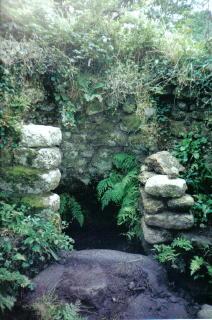
St. Madron’s Well is located just a few miles outside of Penzance (the "Jews Market"—associated with Joseph of Arimathea). A long walk through a heavily ferned and treed wood, the well is located inside the ruins of a small chapel (1) which was built over the well during the early Christian era. St. Madron’s has been called "one of the earliest sites of the Age of the Saints". (2) During the English Civil War the chapel was destroyed by Puritan fanatics, however the well is still well preserved.
St. Madron’s, as well as many of the other sacred wells in the world, has a notoriety for its healing. As part of the healing ritual, pilgrims would leave a strip of cloth or ribbon on a nearby tree or bush so that the spirit of the well would perform a healing act upon it. This practice is still very much alive today and the author saw such offerings at St. Madron, Sancreed and St. Nectan’s Well in September, 2000.
Inside the chapel ruins is a stone seat or, as some have referred to it, an altar. The seat is along one wall to the left of the well opening. Mara Freeman proposed a very interesting theory in her article "Sacred Waters, Holy Wells" (3) that St. Madron’s was not only a healing well but also a "dream-temple". Evidently many sacred wells have a radioactive quality which makes many people drowsy and to actually fall into a sleep while visiting the wells. During this time dreams occur, many of a divinatory form. The altar, or dream-seat, according to Freeman, "was customarily used for dream-incubation purposes"(4)at St. Madron’s. This practice of soliciting sacred dreams appears to have been a replacement for the ageless oracles which were normally consulted at sacred wells prior to the arrival Christianity. Such foretelling appears to be consistent with the characterization of sacred wells as being Wells of Wisdom. Earth scientist Paul Devereux noted that dream-temples occurred in 300 locations in the Mediterranean area in Greco-Roman times and that a dream-temple dedicated to the god Nodens was built at Lydney near Gloucester in England. Devereux wrote:
"all dream temples were located at major water sources. The patient would bathe in and drink the waters, then incubate a dream in special cells known as abatons…Ideally, the dream would reveal instructions from the god how the illness was to be dealt with, or, in some traditions, the ‘Temple Sleep’ was considered healing in its own right".(5)
The size of the "chapel" is such that this site could very well have been a "dream-temple" used for healing and for its oracular powers.
A "faerey glen" exist along the pathway to the well and it is said that the otherworld guardians frequent the glen and can be seen at certain times if one is willing to take the time to wait for their appearance.
NOTES
1. At its best the small chapel could have housed 10-12 people and more than likely was used only by one or two people at a time. The structure today consists of four walls about 4 feet high, 6 feet wide, 9 feet long. The roof is missing, but the baptistry is still intact. The well opening is at one end near the stone seat. When I visited St. Madron’s in September 2000 the well had dried up. This is the first time in recorded history that the well had been dry. No reason as yet has been forthcoming.
2. Michell, John. Sacred England. Glastonbury: Gothic Image Publications, 1996, 192
3. Freeman, Mara. "Sacred Waters, Holy Wells", in Parabola, Spring 1995
4. ibid
5. Devereux, Paul. Earth Memory: Sacred Sites—Doorways into Earth’s Mysteries. St. Paul: Llewellyn Publications, 1992, 255-256
|


