An excerpt from the book, Sacred Wells: A Study in the History, Meaning and Mythology of Holy Wells and Waters.
Photo by Gary R. Varner
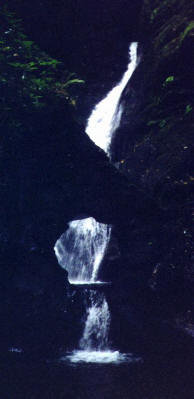
The Waterfall at St. Nectan's Glen
Tintagel itself is a place of mystery. The legendary birthplace of Arthur, the location of Merlin’s Cave and the seat of mystical learning, Tintagel is also home of the Rocky Valley labyrinth carvings dating back to 1400 B.C.E. indicating that this location has been sacred for over three thousand years.
Another sacred spot near Tintagle is St. Nectan’s Glen. The official story of St. Nectan’s is that the saint settled in the area around 500 C.E. and built a small sanctuary beside the Trevillitt River above the beautiful waterfall which still flows today. The good saint also built a bell tower behind the sanctuary and rang a silver bell which was hung there to warn sailors from the treacherous coastal rocks. Having visited St. Nectan’s it is difficult to see how anyone could have seen the coast that well from this location.
As St. Nectan approached death he prophesied the return to "the older, simpler faith"—it is not known if he was referring to the "Old Religion" of the Pagans or simply the original form of Christianity.
St. Nectan’s Glen is situated in a gorgeous forest. I continually expected to see Pan walking through the ferns with the other woodland spirits. The waterfall basin is steeped in the legends of faeries—ancient guardians of sacred wells.
In this instance the term "well" must be clarified—for there is nothing which looks like a "well". However, in the old sense, any natural spring or open pool of water is a "well" by definition.
Like St. Madron—that "unknown" saint named after the goddess, St. Nectan was also a pre-Christian diety. "Nectan" is a derivative spelling of "Nechtan" who was a water god and who was also known as The Daghda—the "good god". The name Nechtan also means to wash, to be clean, pure and white (1). Ellis notes that Nechtan "had a well which was called the Well of Segais" or "Conlai’s Well". This well had nine hazel trees of wisdom which grew over it and which caused the waters of the well to bubble in "mystic inspiration" as the hazel nuts fell into the well (2). Only The Daghda/Nechtan and his attendant cup-bearers were allowed to draw water from the well.
The waterfall at St. Nectan’s is approximately 60 feet in height emptying into a 20 foot deep basin. The rock formation which makes up the fall is spectacular. The force of the falls has broken out one section of rock producing an amazing feature which has been described as "water spring(ing) forth from an opening to the body of the Goddess". (3) Here again the waters are said to be healing and are watched over by a population of faeries. Pieces of cloth and ribbon, as well as food offerings, are left in the trees and on the rock ledges for the water spirits. One visitor stated that the offerings were "ritual garbage" but I believe that she was incorrect in her assessment. Offerings such as these have been part of the heritage of sacred wells since ancient times and the continued practice of leaving offerings continues to links us to that past and the Old Ways.
CHAPTER NOTES
1. Ellis, Peter Berresford. The Druids. Grand Rapids: Wm. B. Eerdmans Publishing Company, 1995, 134
2. ibid
3. Jones, Kathy. The Ancient British Goddess: Her Myths, Legends and Sacred Sites. Glastonbury: Ariadne Publications, 1991, 19
Interesting article, Gary; although I have to disagree about the offerings. The current fashion for sticking post it notes, polythene bags tied up in the semblance of dolls and brighid crosses made from polyester yarn and such onto and around the cliff face are definitely not traditional at this particular site. I think "ritual garbage" is a perfect description of it. The acceptable offering has always been silver [often, but not exclusively, coins] - or a simple prayer. Too many sacred sites are being damaged by people who do not understand that this kind of expression of spirituality is just another form of pollution.
Jude: The Easy Study Bible Commentary
Completely Revised and Greatly Enhanced!
Not for scholars but for anyone who struggles to understand the New Testament!
The Easy Study Bible Commentary takes The Easy Study Bible Diagra
Finally! Understand and learn from the New Testament Books of Matthew, Mark,Luke, and John.
Try James first for free
Now there is a Bible translation that is easy to read, understand, and study.
This translation is uniqu
Finally! Understand and learn from the New Testament Books of Galatians, Ephesians, Philippians, Colossians, 1 Thessalonians, 2 Thessalonians, 1 Timothy, 2 Timothy, Titus, Philemon.
Try James first for free
Now there is a Bible tr