A book review
_________________________________________
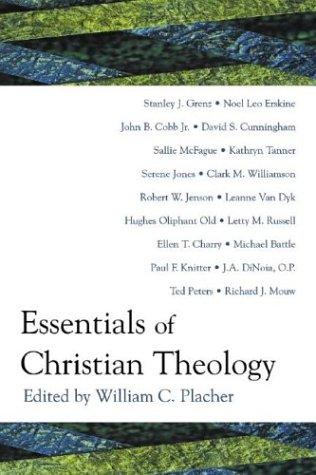
William Placher is a well-known theologian, a good writer and a great teacher, recognised as such by the American Academy of Religion a few years ago. When this book came out last year, I recognised it at once as a very valuable resource, both for classroom use and for congregational study. The book can be used as a good introduction to the key issues in theology, a companion volume for systematic theology classes, a worthwhile text for contemporary issues in theology, and a good pro-and-con collection on significant topics. As such, it should serve as a textbook in many settings.
Many of the names incorporated into this volume are significant figures in theology. I am pleased to have met several of them; I had heard of almost all of them before getting this text, which speaks to the prominence of the contributors.
There are nine primary issues addressed in the text, each with two essays developing the topic from different (although not always directly opposing) viewpoints. Each addresses aspects of what Placher identifies in the first chapter as the five factors in context of theology in North American today -- issues of modernity, post-modernity, ecumenism, pluralism, and the Barthian challenge. Placher describes the Barthian challenge as the idea that 'Christianity should never compromise its principles to fit the culture around it.' Placher defines ecumenism and pluralism for the context of this book, but modernity and post-modernity always present a challenge in definition.
Placher acknowledges that the nine primary topics are fairly standard; not all theological topics are covered here (such is often impossible in one-volume texts). He arranges them in the following manner:
Revelation and authority
Doctrine of God
Creation and providence
Human nature and sin
Christology (person and work of Jesus Christ)
Ecclesiology (church)
Christian life
Pluralism from a Christian perspective
Echatology (end-times; also, intentions and purposes)
Placher provides a brief introduction to each of the nine topics; these are almost always 7-8 pages in length, setting the stage for the subsequent dual presentations.
One of the more interesting exchanges for me was the chapter on 'Human nature and sin', where Placher paired Clark W. Williamson with Serene Jones. Serene Jones' father, Joe Jones, was a colleague of many years of Williamson; knowing Williamson and the elder Jones personally, and having met the younger Jones and having read her work independently, the exchange of views here was intriguing.
Placher's format is interesting -- the text is laid out with pull-quotes and text boxes scattered generously throughout the narrative, highlighting key points. There are suggested readings after each chapter, as well as questions for reflection and discussion. Placher's own introduction has a topically-arranged bibliography of further readings, too. There is a useful glossary of terms and names, as well as a good index.
The readings here are worthwhile without being unnecessarily hard or obtuse -- while this is a grand collection of theological scholars, it is also a good collection of accessible readings presuming no particularly in-depth theological education.
|


Candida
Thanks for sharing!!
Love Tinka