Did you know these interesting facts about the 7th President of the United States Andrew “Old Hickory” Jackson.
DID YOU KNOW?
ANDREW “OLD HICKORY” JACKSON
He is some interesting facts about the 7th President of the United States Andrew “Old Hickory” Jackson.
Andrew Jackson was born of Scotch-Irish descent to Andrew and Elizabeth Hutchinson Jackson, on March 15, 1767.
His father, Andrew Jackson Sr., was Irish and was born in Carrickfergus, CountyAntrim, in Ireland. Andrew Jackson Sr. married Elizabeth Hutchinson and immigrated to America in 1765.
Jackson had two brothers: Hugh (born 1763) and Robert (born 1764).
While lifting a log Andrew Jackson, Sr. was mortally injured and died in February 1767,he was only 29!
Three weeks after Andrew Jackson Sr. died; Andrew Jr. was born and was the youngest of the Jackson’s three sons.
It was during the American Revolutionary War, Jackson, age thirteen, joined a local regiment.
His eldest brother, Hugh, died from heat exhaustion during the Battle of Stono Ferry, June 20, 1779.
Andrew and his brother Robert were captured by the British and held as prisoners; nearly starved to death while in captivity.
Andrew received scars on his left hand and head when a British officer slashed at him with a sword, for refusing to clean the officer’s boots.
While they were imprisoned, both brothers contracted smallpox. Robert on April 17, 1781 just a few days after their mother secured their release died.
Elizabeth Jackson had volunteered to nurse prisoners of war on board two ships in Charleston harbor. There had been an outbreak of cholera in which she died from the disease. For whatever reason, she was buried in an unmarked grave in November 1781.
Andrew Jackson Jr. was orphaned by age 14.Since Jackson's entire family died from hardships of the war Jackson would continue to blame the British for their deaths.
Did you know that Andrew Jackson would be the last U.S. President to have been a veteran of the American Revolution, and the second president to have been a prisoner of war? Washington was captured and held prisoner by the French in the French and Indian War.
Jackson was appointed commander of the Tennessee militia in 1801.
Battle of New Orleans. When British forces threatened New Orleans, Jackson took command of the defenses. This was his chance for revenge against the British for the loss of his family years earlier. Even though he was a strict officer he was extremely popular with his troops. It was at this time he was tagged with the nickname "old hickory". During the Battle of New Orleans on January 8, 1815, his 5,000 soldiers defeated over 7,500 British. In the end the British suffered 2,037 casualties: 291 dead, including senior generals, 1,262 wounded, and 484 captured or missing. Jackson’s forces suffered 71 casualties: 13 dead, 39 wounded, and 19 missing.
This victory made Jackson a national hero.
Jackson became acquainted with, Rachel Donelson Robards. At the time, Rachel Robards was in an unhappy marriage with Captain Lewis Robards. Due to Lewis Robards' temperament, the two separated in 1790. Jackson married Rachel after hearing that Robards had obtained a divorce.
However, the divorce had never been completed, making Rachel's marriage to Jackson technically invalid. After the divorce was officially completed, Rachel and Jackson remarried.
The controversy surrounding their marriage was a sore point for Jackson, who deeply resented attacks on his wife's honor. It was said that Jackson fought 13 duels, many nominally over his wife's honor. Charles Dickinson was the only man Jackson ever killed in a duel. The duel was fought over a horse-racing debt and an insult about Jackson’s wife. Dickinson shot Jackson in the ribs before Jackson returned the fatal shot. The bullet that struck Jackson was so close to his heart that it could never be safely removed.
Since Jackson had been wounded so frequently in duels it was said he "rattled like a bag of marbles."Jackson would be seen at times coughing up blood, and he would continue to experience excruciating pain from his wounds for the remainder of his life.
Rachel Jackson died of a heart attack on December 22, 1828, two months before Jackson took office as President. Jackson would continue to blame John Quincy Adams for Rachel's death because the marital scandal was brought up during the election. He felt that this had hastened her death and never forgave Adams.
Jackson had two adopted sons, Andrew Jackson Jr., the son of Rachel's brother Severn Donelson, and Lyncoya, a Creek Indian orphan adopted by Jackson after the Creek War. Jackson planned to have Lyncoya attend West PointMilitaryAcademy in New York,but he died of tuberculosis in 1828, at the age of sixteen.
The tomb of Andrew and Rachel Donelson Jackson is located at their home, The Hermitage in Nashville, Tennessee.
The widower Jackson invited Rachel's niece Emily Donelson to serve as host at the White House. Emily was married to Andrew Jackson Donelson, who acted as Jackson's private secretary. The relationship between the President and Emily became strained during what was called “The Petticoat affair”. This was a scandal involving members of President Andrew Jackson's Cabinet and their wives. The two became estranged for over a year. They eventually reconciled and she resumed her duties as White House host. Sarah Yorke Jackson, the wife of Andrew Jackson Jr., became co-host of the White House in 1834. This was the only time in history when two women simultaneously acted as unofficial First Lady. Sarah took over all hosting duties after Emily died from tuberculosis in 1836.
Jackson finally retired to The Hermitage in 1837. Even though Jackson was a slave-holder, he was a firm advocate of the federal union of the states, and declined to give any support to talk of secession.
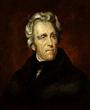
Looking at Jackson he was a lean figure standing approximately 6 feet tall and only weighing between 130 and 140 pounds on a good day. Jackson’s fiery red hair had completely grayed by the time he was elected president at age 61. His deep blue eyes would appear to penetrate right through you.
The nickname “Old Hickory” is kind of deceiving. Jackson was considered one of the more sickly presidents. He would continue to suffer from chronic headaches, abdominal pains, and a hacking cough, caused by a musket ball in his lung that was never removed, that often brought up blood and sometimes made his whole body shake.
Jackson enjoyed eight years of retirement in Nashville and died at The Hermitage on June 8, 1845, at the age of 78, of chronic tuberculosis, dropsy, and heart failure.
In his will, Jackson left his entire estate to his adopted son, Andrew Jackson Jr., except for specifically enumerated items that were left to various other friends and family members. Andrew Jackson was a member of the First Presbyterian Church in Nashville.