a
True Crime novel
The murder of
James Welton Claybrook

Presented by
Gerald W. Darnell
Copyright ã 2024 by Gerald W. Darnell
Published by cr press
ISBN: 9798329663075
All rights reserved. No part of this book may be used or reproduced in any manner whatsoever without written permission, except in the case of brief quotations embodied in critical articles and reviews, without written permission from the publisher.
Gerald W. Darnell
cr Press, LLC
geralddarnell.msn.com

Chapters
FORWARD
IRONY
SHE WALKS IN BEAUTY
BEGINNING
MURDER
AFTERMATH
BACK STORY
REFERENCES
CREDITS
EXHIBITS
ABOUT THE AUTHOR

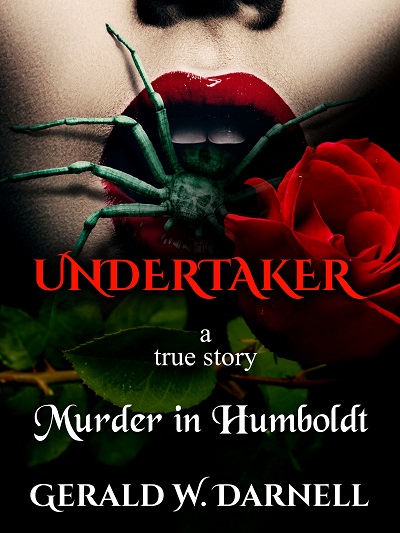
In 1955 a black Funeral Director in a small southern town was brutally murdered – a white policeman is suspected of committing the crime. However, despite a confession and lots of simple clues…nothing happens.
A book was written and a movie made about the murder, using fiction to dress the truth. Now you can finally read the actual story and facts surrounding the murder of an undertaker – a real
Murder in Humboldt.
St. Luke Missionary Baptist Church Cemetery
Haywood County, Tennessee
|
Surname
|
Given name
|
Birth
|
Death
|
|
Claybrook
|
James Welton
|
1905
|
1955
|


“The boundaries which divide Life from Death are at best shadowy and vague. Who shall say where the one ends, and where the other begins?”
Edgar Allan Poe
FORWARD
I write mysteries…usually murder mysteries. Stories that, while fiction, have characters, clues, a crime, a resolution, justice and an ending – usually a happy one. The story that follows has all the above except a resolution, justice and an ending – or at least not one that makes any sense.
~
It all happened almost 70 years ago – in another century. And, as shocking as the crime was, it really didn’t get much attention – or at least the attention it deserved. A man was murdered, a black man and a respected member of the black community. His wife was accused and even confessed to his murder. It should have all been simple…but it wasn’t.
I suspect it would have all been forgotten, just another crime that was never solved because nobody really cared. It was better left alone – sweep it under the rug and move on to something else. Besides, it was possible that a resolution might actually be worse than the crime itself.
So it all went away for a few years – only mentioned by the locals in whispers and rumors. People wanted to forget, and eventually did…for a while anyway.
But, unfortunately the crime had all the juicy makings of a story that Hollywood loved to tell. It had sex, adultery, white/black conflict, murder, ignored clues and obvious attempts by authorities to cover up the facts of the crime.
Then came the book. Then came the movie. And suddenly everybody began to remember. But what they were remembering was far from what actually happened - and more resembled the novel and Hollywood’s version of the murder of a black undertaker in a small southern town.
~
 I was nine in 1955, in the third grade, and had absolutely no knowledge regarding how the events outlined on the following pages unfolded. Like others, my later memories about what happened were formed from a book I read and a movie that Hollywood made about the murder. All very interesting, because they told the story of a racially charged murder that occurred in the town where I grew up. It was fiction, of course. The story didn’t use real names, and even changed the name of the town from Humboldt to Somerton. But, the story that was told in the book and movie soon became fact, and if/when the incidents surrounding the crime were ever discussed, that’s what was heard.
An opportunity was recently presented which allows me to share some research, and to document what really happened in May 1955 and the months/years that followed. I’m glad it came along.
Whether you’re interested in an unsolved murder or not, I think it’s important to make sure that truth and facts are presented. The reader can then compare them to the many stories, books, rumors and movie regarding the murder of James Welton Claybrook – an ‘Undertaker’. The reader can come to their own conclusion…as I did.
~

 I grew up in Humboldt, attended Elementary School, Junior High School (middle school) and High School in this small sleepy little town in West Tennessee. And, except for the fact that my father was in the Navy when I decided to enter this world, I’m sure that I would have been born in Humboldt rather than Miami, Florida. From my first memory to the day I went off to college and moved away I called Humboldt my home – guess I still do.
My mother WAS born in Humboldt and, along with two sisters and a brother, grew up in a small brick house on Central Avenue - a house where I spent a lot of time as a young man, hanging out with my grandparents while mom and dad worked at the Hosiery Mill. That house is still standing, although I’m not sure why. It’s certainly not in the best of condition.
Grandfather was a farmer, and some of my fondest memories are playing with his geese in the strawberry patch or riding a mule around a cotton field behind the house. Frazier G. Reasons farmed most everything, but bees were his passion. He raised the bees, harvested the honey and sold it to the local grocery - or from the back of his truck at the courthouse in Trenton on ‘First Mondays’.
If you were looking for me on a warm summer day, after school or on the weekend, I would most likely be with a couple of friends riding our bikes up and down the streets of Humboldt. We traveled every street almost every day, and if I remember correctly it only took a little over an hour to do it. But, there were a couple of streets we did avoid – streets on the eastern side of the area known as the ‘Crossing’. We didn’t avoid them because of where they were – we avoided them because of the steep roads that went up a hill to one of the highest points in Humboldt. I learned later in life that this hill was called ‘Fort Hill’ – named after an old Civil War Fort that was once located there.
This hill, ‘Fort Hill’, is where in 1955 you would have found the Claybrook Funeral Home. A part of the C.R. Rawls chain, they were the only black funeral home in the area.
~
The ‘Crossing’ is a ‘self-named’ community located in the west and north part of Humboldt. The term ‘Crossing’ denotes the area where the north/south Gulf, Mobile & Ohio (GM&O) and the east/west Louisville and Nashville (L&N) railroads intersect. The ‘Crossing’ has transfer tracks, where north/south or east/west traffic can be turned about and rerouted in other directions, which makes the area perfect for produce and product transfer. Empty boxcars from the north arrive, are quickly loaded with fresh produce and then turned around and routed back to their original destination. Also, loaded boxcars with fresh produce arrived from the south/west and are then rerouted to eastern or northern destinations.
Or so it was until the late 1950’s. The big fire in July 1950 was the beginning of the end for the ‘Crossing’ – destroying the numerous warehouses and packing sheds that surrounded the railroad tracks. It never recovered from the massive destruction.

Map of the eastern area of Humboldt, Tennessee
The ‘Crossing’ is an area known as being ‘on the other side of the tracks’ – separated from Humboldt only by distance and its name. The residents are mostly colored, as well as the churches, schools, and business owners. Up until the 1970’s economy of the ‘Crossing’ was good, and many Humboldt merchants operated successful satellite or second storefronts in the ‘Crossing’ community. Even though segregated and separate, the ‘Crossing’ played an important part in the West Tennessee economy.
But, our story isn’t about the ‘Crossing’ – only about some of the people that once lived there.
~
As I mentioned before, I write mysteries for a hobby - and have for the past fifteen or so years since retiring. However, my fictional stories always have an ending and a solution. What follows in this story has neither – only speculation and rumor. But…what follows DID happen in May 1955.
James Welton Claybrook brought his family from Brownsville to Humboldt in the early 1940’s and settled into the ‘Crossing’ area. Working with C.R. Rawls, he opened the Claybrook Funeral Home and quickly became recognized as one of the prominent and noted leaders in this large black community. For the next decade James served as Funeral Director and Undertaker for the very successful and profitable business – then it all ended suddenly.
On May 31, 1955 the body of James Welton Claybrook was found on a narrow gravel road (Bethal Road), just a few miles outside the Humboldt city limits – he had been dead for several hours. News of his death spread rapidly through the community; murder was suspected and that was definitely not a common occurrence in the Humboldt of 1955. It was front page news for the small local paper until two days later when his wife confessed to the murder – then it became second or third page news. When rumor spread that a white man (a member of law enforcement) might be involved, it ceased to be news at all!
~
After an initial detailed report of the murder was printed in the local newspaper (which included statements from two County Sheriffs and the Chief of Police) we could only find a small mention of the wife admitting to the crime, making bail and being released. Apparently nobody had anything to say after the initial report; because if they did they certainly weren’t saying it – and the newspapers weren’t printing it.
I could find no details of a Grand Jury hearing in Crockett County and no definitive reason for the wife not being charged with the murder – even though she confessed. Oddly, the media was quiet and uninterested – something that simply would not happen today. Perhaps in 1955 a black woman shooting her black husband to death wasn’t real news. Or could there have been some other reason for their silence? Maybe it was just something that nobody wanted to talk about. I’ll let you decide that for yourself.
I will present numerous references throughout this narrative, most of which offer information that is questioned or simply not supported by fact. The book, the movie and the real facts surrounding the murder of James Welton Claybrook get confused in these references - as well meaning reporters mix the glamor of a racially charged incident with the tragedy that actually happened.
However, I encourage you to check my listed references and read what they convey. Each one tells a similar story, but mostly one that resembles fiction rather than fact.
~
What follows is an honest and detailed summation taken from original newspaper reports, court documents, statements from family and additional in-depth investigation conducted sixty years after the fact. Based upon these (and not a book or movie), I will make some assumptions regarding the crime.
Perhaps these same assumptions were made by law enforcement at the time…or perhaps they weren’t. It really doesn’t matter. Read on and you can decide for yourself.