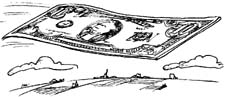
…"American life has become a game of chance—one that has no mercy on Middle America and the working poor."
Elizabeth Warren, a lawyer and Harvard Professor and author of the book, "The Two Income Trap" says household debt has doubled since 1990 and nearly 1-7 American families are filing for bankruptcy. Every 15 seconds an American is filing for bankruptcy and more children will live through their parent’s bankruptcy than their parents’ divorce. The four main expenses are health insurance, mortgage payments, daycare and a second car, as both parents have to work to make ends meet.
Warren points out that the deregulation of the credit industry has been very profitable, as they are able to prey on the financially vulnerable and that they have become the most influential special interest group in Washington.
Earl Williams, 29, a self employed salesman earning $100,000 a year in Macon, GA never thought he was a candidate for bankruptcy until he accumulated a credit card debt of $80,000 from his medical bills after surgery. He was not overly concerned the first 24 months since he paid double the minimum payments on his 10 credit cards with 4-8% interest rates. However he became distressed when his interests rates rose without warning up to 27%. The credit card companies explanations were the same," "We see you as a candidate for bankruptcy." Williams’ financial problems took their toll—he had to close his business and file a Chapter 7 Bankruptcy. Donald Campbell, 47, has a 7-year-old and earned $60,000 a year as computer tech-support representative with Candle Corp., which makes computer system-monitoring software in Los Angeles. Last fall Candle closed the center and transferred the work to India. When Campbell applied for Trade Adjustment Assistance the labor Department rejected his request because only factory workers not service workers are eligible for help.
Jim Webster, a self-employed welder and his wife with a teenage daughter from Los Vegas thought their health insurance policy with a $3,000 deductible covered their newborn son, Hunter. They were wrong. When 9-month old Hunter spent 19 days in Sunrise Hospital for a brain aneurysm Jim got a bill for $180,000. Although he began to make payments Sunrise turned the bill over to a collection agency and then sued. The medical billing company finally negotiated the collection agency down to a single payment of $40,000. The Westerners took out a loan against their house to pay the bill.
Campbell’s and Webster’s stories were in a February 2, 2004 article in Time Magazine titled, "Has Your Life Become Too Much A Game of Chance?" by Donald Barlette and James Steele. They point out that hospitals everywhere are routinely charging the uninsured, the people with no political clout five times more. K.B. Forbes a political rights advocate who spent three years analyzing and securing reductions in hospital bills of uninsured said Medicaid would have paid less than $10,000 for comparable services and private insurance carriers would have paid around $18,000 instead of the $40,000 the couple agreed to pay. Not to mention the $180,000 they were originally charged.
Barlette and Steele like Warren say the wage gap between the rich and the poor is growing and 44 million Americans are without health insurance.
There are a number of self-help books about transforming our relationship with money that can help. They fall into two categories—how to get rich or how to become financially comfortable on less money. All the books provide valuable information. Robert Kiyosaki, the author of "Rich Dad, Poor Dad" says pay yourself first, buy assets and not liabilities and that there is power in using a corporation as a tax shelter. He does not recommend borrowing money (no credit cards) but creating money to get the things we want by letting go of fear and to work more for what you can learn than what we can earn. David Bach the author of the "Automatic Millionaire" adds that we should buy a house and pay it off via a bi-weekly mortgage plan that could save up to 10 years of payments. He recommends paying yourself first via automatic payments and cutting back on the "latté factor" luxuries.
Two authors, Jean Chatzky of "You Don’t Have to Be Rich" and Joe Dominguez of "Your Money or Your Life" say the amount of money we make—whether it’s $20,000 or a $100,000 a year has little bearing on how happy we are. Chatzky says money can make us miserable if we handle it wrong. The late Dominquez lived on around $7,000 a year and donated the money he made from his book, tapes and workshops to a foundation he created to fund non-profit environmental and social justice organizations. Dominguez saw his life work as helping people find peace with their concept of money, to stop people from consuming things they do not need and to start people contributing to goals and ideals they do believe in. His research shows that most of us experience fulfillment only up to a certain point with luxury items. Once our survival and comforts needs are satisfied, if we don’t give back to the world, we experience disillusionment. His ideal was for us to work because we want to, not because we have to.
When we file for bankruptcy we need to be aware if it was due to reasons beyond our control or if we used poor money management skills. Learning money management helps us realize that knowledge is power and that making money is an art that requires knowledge, skill and creativity. But most of all we learn the wise investor knows it is not how much money we make but how much money we keep that is important.
|