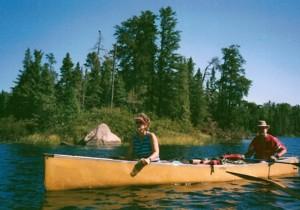
It was August and hot. We planned a leisurely five-day canoe camping trip along 33 miles of Minnesota’s Boundary Water southeast of Ely. On the map Ely appears to be the end of the road. For people like us who love the wilderness, beauty and solitude, it is the center of the world.
Our party of eight consisted of Terry, the trip leader and navigator, Gail, his canoe partner and long time friend, Joe and Virginia who were discovering how quickly you can get to know someone when you share a canoe and tent, and two married couples, Marty and Cathy and Bud and me. Our ages ranged from 42 (Virginia) to 69 (Joe).
The Balsam-scented breeze in our faces felt good as we paddled the canoe across Lake Isabelle, our starting point. The canoe felt like a reed in the wind. The silence was broken only by the breeze in the trees, the birdsong and the sounds of lapping water.
The portages were another story. We quickly discovered that there were no straight, flat, dry, bug free trails. We had to make two trips each. Often trudging through ankle-deep ooze. The men carried the canoes on their shoulders then helped the women haul the gear.
Those without bug repellent or mesh bug suites (with head nets) swatted at the swarms of mosquitoes around their faces, arms and legs.
Minnesota’s hundreds of shining rivers and connected lakes were created during the last glacial period. The Superior National Forest and Canada’s adjacent 1.2 million-acre Quetico Provincial Park are the heart and lungs of the Boundary Waters.
Two bald eagles sat on the upper limb of a dead tree in front of our canoes. Suddenly one spread its huge wings and soured above the tree line. We oohed and aahed with delight.
Planning for our canoe camp experience was made easier with the help of an outfitter. They supplied us with lightweight 40-pound canoes, tents, sleeping bags and freeze-dried food.
We chose a rocky campsite near a rapid on the north bank of the Isabelle River at dusk. The heat, the eight-and-a-half mile paddle and the five portages had left us tired.
To cool off we swam in the tannin-tinted water. Terry reassured us no leeches would bite as they were mostly found in swampy areas. I swam in my mesh bug suite to escape the mosquitoes (a first for me). Joe said the mosquitoes were so big they could mate with a chicken flat-footed.
When Terry and Marty were unable to locate a tree to hang our food to keep bears away they put the bags in an anchored canoe a short distance from the shore.
The sun set red and round in the clear sky. The water became as calm as glass. Beavers circled and dove in the sunset tinted pools.
It got so dark in the woods you could get lost ten feet from your tent. We all fell asleep listening to the mournful call of Minnesota’s state bird—the loon.
The following morning we paddled a forested shoreline to Bald Eagle Lake. A pair of loons with shiny black and white feathers bobbed low in the sparkling waves about 50 yards straight out. We smiled with joy.
Terry used his GPS to navigate when the islands blended with points and bays along the open water. Progress was measured by the bite of our paddle in the black water and the weight of the canoe and packs on our shoulders during the four portages.
The next two nights were spent camping on a rocky point on the north shore of Bald Eagle Lake. Basking on the sun-warmed rocks felt good after our cold swims in the lake.
Joe and Virginia entertained us with accounts of their ups and downs as new canoe partners and tent mates. Joe named Virginia SHE WHO MUST BE OBEYED and himself HE WHO MUST AQUIESSE. He confided with a grin that a female friend once observed that the women in his life all seemed to be bright, bosomy, bull-headed and bossy.
“I don’t fit in the second category,” Virginia said laughing.
The following morning Joe announced with a twinkle in his eye, “I left the tent when the OPM’s started!”
“What are OPM’s? the group asked in unison.
“Orders Per Minute,” Joe chuckled. “I’ve been given an ultimatum. If I leave the tent open again I’ll have to sleep with Terry,” he snickered sipping his coffee. “You should have seen the way she went after the mosquitoes in the tent. It gives new meaning to aggression.” He grinned impishly. “I’m afraid it might spill elsewhere!”
“At least you get to sleep with her,” Bud teased.
Joe laughed. “Yea, I get all of the disadvantages and none of the advantages!”
There was the haunting cry of a loon in the in the early morning mist as we ghosted in the canoes the following morning.
We paddled west from Bald Eagle Lake crossed Lake Gabro around a point to South Kawishiwi River. Portages and rapids punctuated the river course.
The boulders, cliffs and shoreline of the river were stunning. They towered above our canoes. Northeast Minnesota represents the largest expanse of boreal forest in the lower 48 states.
The forest is dominated by a dozen tree species; balsam fir, white and black spruce, quaking aspen, paper birch, three north pines, north white cedar, tamarack and maple.
Designated in 1926, the Boundary Water Canoe area is the United States most heavily used wilderness and its second oldest. No homes, roads or motorized crafts are allowed in the interior lakes. Permits are required to stay at the designated group campsites (complete with outdoor pit toilets) and are limited to nine people. Glass and cans are prohibited. Here you can join others who need silent untrammeled places and return to simple joys not unlike the ancient trails of the Indians.
We sensed a scenic rhythm as we journeyed on—from lakes to rapids—to rivers—to where the five-day trip ended just south of Highway 1.
Back in the “civilized” world we discovered with delight that the Boundary Waters now flow deep within us too.