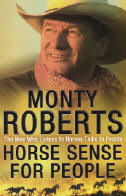
Monty Roberts, the man who inspired the movie "The Horse Whisperer," says people, like horses, perform better in environments that "request" rather than "demand," where they are willing partners.
Monty Roberts turned the horse world on its head and gained international fame when he developed a technique called Join-Up based on communicating with horses using their natural body language. He says communication among humans and horses enables Join-Up and has identified 187 signs with which he can communicate with a horse. He says, "The language of the horse is the language of gestures. It is a gift we all have."
Roberts has trained over 70,000 wild horses and usually gets and out-of-control horse to accept saddle, bridle and rider in 30 minutes. He learned to "listen" to horses by paying attention to the way they communicate with each other with their ears, eyes and body postures. He said, "If you look a horse straight in the eye…that’s a sign that you are in charge, a predator and the horse will back away. If you drop your eyes down, the horse tends to slow and drop its head."
An essential part of Join-Up is the breakthrough moment when a horse bonds and nudges him.
Roberts’ horse training method relies on cooperation, trust and reward rather than submission by force. The old way to master a horse was to break its spirit by inflicting pain. He says people and animals that are treated with respect usually perform beyond your expectations.
Now 70, Roberts rode his first horse at age three, won his first riding trophy at age 4 and spent most of his life working as a competitive rider trainer, winning four world championships and training hundreds of stakes-wining racehorses.
Roberts is the author of three best sellers including the book "The Man Who Listens to Horses" that sold 4.5 million copies. He wrote the book at the urging of Queen Elizabeth II who invited Roberts to train her equestrian staff. His work inspired "The Horse Whisperer" a best selling novel by Nicholas Evans that was made into the movie starring Robert Redford. His latest book "The Horses in My Life" was released in October 2005. Roberts travels the world giving lectures and demonstrating his techniques. Much of the money from his non-profit organization goes to local charities and communities he visits. He also holds dozens of workshops at his "Flag is Up" farm in California for corporate executives (representatives from over 200 corporations attended the past decade), businesses, educators, social workers and other leaders who want to create conditions that foster trust, cooperation and partnership to improve efficiency, motivation and satisfaction.
Join-Up in the workplace involves observing the needs, conditions, rules and framework of the workers and communicating in their language. Roberts says people, like horses, perform better in environments that "request" rather than "demand" where they are willing partners. Feeling like a team player creates an atmosphere that says each position is important to achieve a successful outcome. Horses and people want to please but are often confused by mixed messages or made resentful by harsh treatment. The corporations that implement trust based leadership and no longer pull rank, intimidate or use fear report improved productivity.
Struggling with post September 11, Enron and the war on terror even the U.S. Central Intelligence asked Roberts to help them with trust based training techniques and how to develop a culture of cooperation. Since Roberts cracked the code on the silent language of horses his work is not that different from the world of spies and espionage.
Central to Roberts’ horse training methods is the complete elimination of physical and emotional violence that he believes is the root of most behavior problems. He says, "The more you use pain, force and coercion, the more the horse holds back and tries to fight. I will not use violence with any horse at any time, for any purpose."
Rising above his own abusive childhood where he suffered 71 broken bones by age 12 from his father’s beatings he has shown that his Join-Up method can be used to "tame" unruly children. He and his wife Pat raised 47 foster children plus three of their own. Roberts said about raising children, "I had show there is a better life if you get rid of violence." He emphasizes commitment, trust, and partnership over confrontation, coercion and punishment. He says horses and children are both flight animals in need of communication and support.
For years the educational authorities were skeptical about Roberts’ discipline methods until a failing British School adopted his practices in a last-ditch attempt to evade closure. The results were spectacular. In less than four years the Kingshurst Junior School in Solihule was transformed into a center of excellence. The 290 pupils with 40% special needs children love going to school now.
Roberts, a grandfather with a cowboy hat, is now inundated with requests for help from schools all over the world. For discipline he uses signed contracts titled "A Road Map to Excellence" that outline the effects of children’s positive and negative behavior. For example fights result in three weeks of missed playtime while good behavior earns rewards. Roberts says, "Before they act they must know the consequences of their actions. Contracts allow kids to manage their own lives. It’s about assuming responsibility…You can’t push information in a child’s brain, the brain must pull it in. When children loose trust, they become loose horses. They try to survive any way they can."
Roberts admits that applying pain may result in obedience and compliance but says it is ultimately counterproductive as there is no choice. Teaching through partnership allows the freedom to choose and produces a sense of accomplishment that is more productive than force and intimidation. There is also the potential for abuse when a relationship involves a dominant and weaker partner.
Roberts discovered that many people who cry or faint when the horse nudges him in Join-Up have experienced mental or physical abuse.
Roberts has performed his horse-gentling techniques before hundreds of thousands of people around the world. He says "Remaining cool and getting out of the punishment business is critical to having an effective relationship with horses and children…there is no such thing as teaching—only learning."
|


