I was born in New Orleans, grew up in South Africa and left the country in the early 70s. I returned to visit my parents, my brother and his family and childhood friends in late 2007.
South Africa is five times the size of Britain and has astonishing diversity—craggy mountains, dry desert, grassy plains and forest fringed coastlines.
Bud, my husband, and I spent two weeks visiting with my parents near the sprawling city of Johannesburg. The city which is 6,000 feet above sea level developed around the rich gold mines and is the economic heart of South Africa.
After driving three hours south to the Natal Midlands we had a wonderful reunion with my cousins who I’d not seen in 30 years. Tony and Jenny, his wife, took us through the Drakensburg Mountains where we saw breathtaking views of waterfalls and streams flowing through secluded valleys.
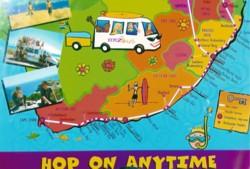
After a few days we headed south to catch a Baz Bus at the Nomad Backpacker Lodge near the Indian Ocean in Durban a leading coastal resort.
The Baz Bus is a unique hop-on hop-off door-to-door backpacker bus service that charged $135 per person for a week. The lodges cost around $30 a night for a room with a double bed.
Once on the bus we passed Durban’s 4-mile promenade lined with sandy white beaches, hotels, amusement parks, and restaurants. Heading southwest we meandered past rivers, lagoons and hills lined with sugar cane.
Our 18-seater semi-luxury bus had a television and trailer to carry the backpacks, surfboards and bicycles.
Two hours later we disembarked at the Mantis and Moon Backpacker Lodge in Umzumbe. The charming wooden cabins, a two-minute walk from the beach, are snuggled among wild broad-leafed banana trees in a subtropical forest. Our one bedroom cabin had a private open-air bathtub and shower surrounded by tropical plants. Vervet monkeys eyed us with interest as they romped through the trees.
After walking the beach and watching the surfers bob among the waves we sampled the lodge’s exotic rock pool and Jacuzzi.
The following morning we boarded the Bus and headed south along the coast to Port St. John.
Most of the high spirited bus passengers were in their 20s and 30s. Since we’re over 55 we called ourselves the "golden oldies."
Five hours later we arrived at Port St. John. Dramatic jungle covered cliffs towered above the bustling coastal village along the Umsimvubu River. Perched on a hill The Jungle Monkey Hostel’s open-air tree-house Deli and pool and our safari tent had a beautiful tree top view of the ocean.
The area formerly known as the Transkei is undeveloped and communally owned by the Xhosa speaking people. Their one-bedroom huts have no electricity or indoor plumbing. However, the homes have enough land to keep livestock and a vegetable garden. Although South Africa generates 60 percent of its own electricity, more than half the nation’s households rely on paraffin, wood and gas for light, cooking and heating. A smoky haze hung among the mountains when we took a shuttle to the top of one of the cliffs to see the sun set.
We boarded the bus to the Buccaneers Lodge at Chintsa the following day. Five dogs with wagging tails greeted us four hours later. Set on a hill in a wild coastal forest our cozy safari tent had a stunning view of the sea, beach and lagoon.
After strolling the beach and dipping our feet in the icy ocean we swam in the lodge pool set in a lush tropical forest.
We boarded the bus at noon the next morning. Our destination was Tanaqua Lodge in Humewood just southwest of Port Elizabeth. We arrived near midnight.
Spectacular views of mountains and bays replaced Port Elizabeth’s ocean lined hotels, restaurants and apartments the next day.
Wild Tongue Lodge in Nature’s Valley, our destination for the night, had a charming lodge and open-air restaurant with a spectacular view of the Tsitsikama Mountains indigenous forest.
Returning from delightful visits to monkey and elephant sanctuaries we were shocked to discover a tub of half-eaten oatmeal cookies on the cottage kitchen floor. Horse hoof prints dotted the area. Jenny, the lodge owner, confirmed the horse has been known to steal food.
The next day we enjoyed a scenic two-hour ride through rugged mountains to Highfield Backpackers Lodge in Knysna.
Barbara, a close childhood friend, drove us to her beautiful home on a hill overlooking an eleven-mile lagoon. We later enjoyed a cruise on the lagoon to see the sandstone cliffs called the Knysna Heads that protect the water from the sea.
After a couple of days visiting with Barbara’s family she drove us back to Johannesburg. The 10-hour trip took us through the Karoo Desert. We spent the night in a tiny village called Nieu-Bathesda. Helen Martin’s Owl House and Camel Yard is the main attraction. Since Martins is my maternal great aunt we were given free admission and a special tour of the Owl House. Martins turned her house into a magical place when she used ground colored glass to decorate images on the walls, windows, ceilings and doors. She also built large concrete camels, owls, mermaids, shepherds and religious figures. Photographs of my grandmother and mother hung on the walls.
Martins’ life and work is immortalized in the award-winning play and movie "The Road to Mecca" starring Kathy Bates.
I wept as I studied her artwork and felt proud that I was related to her.
After another brief visit with my family in Johannesburg Barbara dropped us at the airport.
Back in America I realized with gratitude my absence had not effected my bond with my family, friends and the land of my childhood.