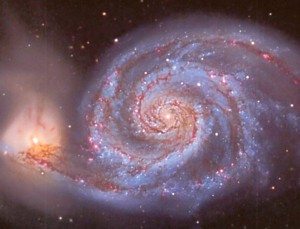
Our 4.5 billion-year-old Sun is only one of 200 billion other suns in The Milky Way, our galaxy. The Milky Way is known as a spiral galaxy and is about 100,000 light-years in diameter and 10,000 years in thickness.
Galaxies are made up of gas and millions of stars held together by gravity. Suns are gigantic balls of gas held together by gravity and kept hot by atomic reactions.
Our sun rotates slowly around the Milky Way’s center along with the other stars.
Eight planets and three dwarf planets and their moons and several thousand asteroids and comets orbit the sun in our solar system.
All galaxies, including ours, have a massive black hole at its core that is so dense that light cannot escape its gravitational field.
An object is considered a planet if it orbits the sun, is massive enough that its self-gravity gives it a nearly spherical shape and it has cleared the neighborhood around its orbit.
Andromeda is a nearby similar size spiral galaxy with two nuclei. Billions of years in the future Andromeda and the Milky Way galaxies will collide. They will pass through each other and merge into one. It will take millions of years to complete.
Astronomers say the 13.7 billion-year-old Universe could contain 40 to 50 billion other galaxies.
Our human genome is full of viruses similar to HIV-1. These have played an important role in human evolution and still play an important role in human embryology and day-to-day chemistry. Just how important are they to our evolution past and future?