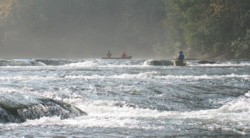
The Riverkeeper operation was so successful it has spawned 70 others nation and worldwide and the movement continues to grow.
Published in the Atlanta Journal-Constitution November 7, 2001
“They call themselves Riverkeepers, and to hearthem, you’d think they were swashbuckling young men patrolling the waterways of America, ridding them of plunderers and polluters.
In many ways, that’s exactly who they are.
Think David and Goliath. Think fighting City Hall and winning,” wrote Craig Wilson on January 8, 1998 in USA TODAY. He was taking about John Cronin and Robert F. Kennedy Jr., who spent years fighting, with repeated success, to rid New York’s Hudson River of pollutants. The Riverkeeper operation was so successful it has spawned 70 others nation and worldwide and the movement continues to grow. Georgia now has four-licensed Keeper organizations with more expected to be added.
The Altamaha Riverkeeper or ARK, founded in 1999, is the Ocmulgee River basin Keeper organization now. It is working to restore and preserve the habitat, water and flow of the mighty Altamaha from its headwaters in North Georgia to its terminus at the Atlantic Coast. A network of volunteers are working to identify and correct sedimentation erosion, chemical and other biological pollution problems throughout the Altamaha River Watershed including the Oconee, the Ocmulgee, the Ohoopee and their many tributaries.
The Ocmulgee is far more that the 242-mile main-channel that flows through middle Georgia to join with the Oconee to form the Altamaha. It is a 6,080-square-mile basin that channels thousands of tiny rivulets and streams to the Atlantic Ocean.
The explosive growth between metro Atlanta and Athens is putting increased pressure on the headwaters of the Ocmulgee and Oconee River basins. Experts fear that without better water resource planning, both the quantity and quality of the river water could suffer. More development upstream means worse floods in times of heavy rain. Roads, parking lots and rooftops prevent water from being absorbed into the ground and instead send it to the rivers. The increased runoff carries pollution in the form of fuel, oil, fertilizers and pesticides.
The dirtier the source of water the better chance for poison at the tap. Bacteria, viruses and other parasites are for the most part removed. But chemical pollutants are removed at a much lower rate, ranging from 0 to 90 percent. The chemicals are also toxic to fish and other aquatic life.
Too much sedimentation suffocates the plant life needed by the fish and damages fish spawning and migration. The muddy brown water also suffocates the plant life needed by the fish.
Studies show that a 50-foot buffer of trees can filter out up to 90 percent of the silt and chemicals washing into the rivers. Despite those findings, DNR and most government agencies still allow developers to clear and build right on the edge of the rivers.
Studies indicate that poorly managed construction sites can release seven to one thousand more tons of sediment per acre during a year, compared to one ton or less from undeveloped land.
The EPD requires developers to file an erosion control plan and install “silt fences” on the edge of the construction sites. But inspectors say they don’t have the staffing to make sure streams stay free of silt.
To protect their cities from municipal and industrial waste many states have
implemented a bill called “The Fisherman’s Right To know” law that gives basic
information about the discharger. Although the Georgia DNR board and the
politicians were in favor of the law the Georgia Chamber of Commerce and other
business industry groups were able to block the bill. However, public outcry about a
series of high volume raw sewerage spills in Macon did result in a new bill requiring
that the sewerage spills be reported and signs posted in the Macon area. In addition
to Macon, James Holland, a dedicated Altamaha Riverkeeper, said he found
violations for high coliform fecal matter, sedimentation and toxic chemicals in
Lumber City, Reidsville, Cochran, Jesup, Baxley and Hawkinsville. Laurens,
Tatnall, Wayne, McIntosh and Glynn counties also had violations.
Because of the Altamaha Riverkeeper’s efforts, the Ocmulgee is flowing a little cleaner. ARK filed three law suites against two cities and a company for chronic violations of their water permits. It is the responsibility of the State to ensure the polluters are complying with their permit limits. However, when the State does not do its job, the Altamaha Riverkeeper steps in to protect our rivers. The ARK attorneys have reached an agreement with one of the cities to stop further permit violations from their wastewater treatment plant and the other city agreed to build a new treatment plant. A federal judge ruled that the tire cord manufacturing company had violated the Clean Water Act in discharging excess amounts of cyanide, copper, zinc and lead. Another court hearing will determine how to address the company’s water quality violations.
Georgia’s Chattahoochee Riverkeeper members said their half-billion-dollar victory in 1998 against the city of Atlanta was inspired by Cronin and Kennedy’s Hudson Riverkeeper Alliance.
Cronin and Kennedy’s book “The Riverkeepers: Two activists Fight to Reclaim Our Environment as a Basic Human Right” by Scibner is also a helpful primer on how to reclaim a river and reads like a detective novel. (For more information on the Waterkeeper Alliance see www.keeper.org)
Cronin and Kennedy say the biggest threat to all environmental groups is how the polluters formulate strategies to avoid environmental responsibility. They hire scientists for the industry who will say what they’re told to say. They call it “tobacco science”.
The fitness and survival of our wetlands and estuaries depends on the health of the river system that surrounds it. The upkeep of the Altamaha River Basin plays a vital role in the health of sea life such as fish, shrimp, crabs, oysters, lobster and plant life. When we flush uncontrolled waste in streams, rivers and the sea, nitrogen, phosphorus, sediment and other pollutants disrupt nature’s balance by supporting algae which depletes the oxygen. Without oxygenated water the marine life cannot survive.
Estuaries are our most vital, productive and important environments: yet, they are among our most threatened habitats. With industrial effluents, radio active wastes and domestic sewerage pouring into the sea scientists fear that it may eventually kill the ocean’s phytoplankton, which produces half the world’s oxygen and provides food for the fish. (Most of the phytoplankton is found around the continents.) Some bays and sounds are already practically dead zones in America and other parts of the world.
Thanks to environmental legislation and the Riverkeeper Alliance, the quality of some of our rivers and bays has begun to recover.
By preventing eroded soil, fecal matter, and toxic chemicals from polluting our rivers and wetlands we can help nature protect human health, provide public recreation and healthy habitats for animals, birds, plants and other aquatic life.
Cronin stated in his book, “When people embrace their waterways, they discover something in themselves, and they’ll fight and win.” His prediction seems to be coming true .
|


