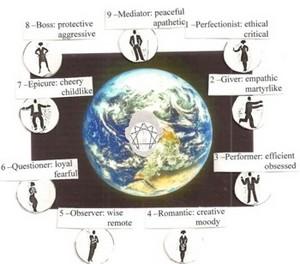
The Enneagram is an ancient Sufi mystic teaching that describes humankind's nine personalities and their interrelationships. It is part of a teaching tradition that suggests awareness of our personalities and learning how to ultimately set them aside is a stepping stone to greater consciousness.
The Enneagram remained an oral spiritual tradition until Bob Ochs, a Jesuit priest, wrote it down in the 70s.
The Enneagram is now not only being used by self-help circles. Stanford University School of Business offered a course called “Personality, Self-Awareness and Leadership” that focused on the Enneagram. Stanford Medical School's Department of Psychiatry cosponsored the first International Enneagram Conference in Palo Alto California in 1994. The CIA uses the Enneagram to help agents understand the behavior of world leaders. The U.S. Postal service has turned to the Enneagram to help employees resolve conflicts. Clergy from the Vatican has also offered Enneagram siminars.
The star-shaped Enneagram (Greek for “nine” and “points”) groups human emotion and behavior both negative and positive into nine personality types. Each of the personality patterns has strengths and weaknesses, fears and desires and room for growth. It's a guide to understanding ourselves and others, our differing mental and emotional makeups and improving coping strategies. Each point on the Enneagram connects to two other points called “arrows.” When relaxed you take on the positive qualities of the number that connects yours. When stressed you reverse directions.
According Enneagram theory our personality types are heavily influences by early childhood experiences. However destructive traits can be modified through exploration and awareness.
Although everyone has all nine personality traits your Enneagram type is based on your most dominant pattern.
Each personality may blend into or be influenced by the types on either side or yours. They are called “wings.”
So what is your Enneagram type?
One –Perfectionists at their best are ethical, reliable, productive, wise, idealistic, fair, honest, orderly and self-disciplined. At their worst they are judgmental, inflexible, dogmatic, obsessive-compulsive, critical of others, overly serious, controlling, anxious and jealous. They are motivated to live life the right way and avoid anger. Their task is to overcome resentment.
Two –Helpers or Givers at their best are loving, caring, adaptable, insightful, generous, enthusiastic, tuned into people's feelings. At their wost they are martyr-like, indirect, manipulative, possessive, hysterical, and over-accommodating. They are motivated by the need to be loved and appreciated. Their task is to overcome pride and not neglect their own needs.
Three –Achievers or Performers at their best are optimistic, confident, industrious, efficient, self-propelled, energetic and practical. At their wost they are deceptive, narcissistic, pretentious, vain, superficial, vindictive, overly competitive and obsessed with image. They are motivated by the need to be productive and successful and avoid failure. Their task is to overcome deceit.
Four –Romantics or Individualists at their best are warm, compassionate, introspective, expressive, creative, intuitive, supportive and refined. At their wost they are depressed, self-conscious, guilt-ridden, moralistic, withdrawn, stubborn, moody, self-absorbed and attracted to the unavailable. They are motivated by the need to understand feelings and avoid being ordinary. Their task is to overcome envy.
Five –Observers or thinkers at their best are analytical, persevering, sensitive, wise, objective, perceptive and self-contained. At their wost they are intellectually arrogant, stingy, stubborn, distant, critical, unassertive, emotionally remote and negative. They are motivated by the need to understand, be self-sufficient and avoid emptiness. Their task is to overcome hoarding.
Six –Questioners at their best are loyal, likable, caring, warm, compassionate, witty, practical, helpful and responsible. At their wost they are hyper-vigilant, controlling, unpredictable, judgmental, paranoid, defensive, rigid, self-defeating and testy. They are motivated by the need to seek approval, be taken care of and avoid doubt. Their task is to overcome fear.
Seven –Adventurers or Epicures at their best are fun-loving, spontaneous, imaginative, productive, enthusiastic, quick, confident, charming and curious. At their wost they are narcissistic, impulsive, unfocused, rebellious, undisciplined, possessive, manic, self-destructive, restless, childlike and reluctant to commit. They are motivated by the need to be happy and have fun and avoid pain. Their task is to overcome gluttony.
Eight –Asserters or Bosses at their best are direct, authoritative, loyal, energetic, earthy, protective and self-confident. At their wost they are controlling, rebellious, insensitive, domineering, self-centered, skeptical, aggressive and love to fight. They are motivated by the need to be self-reliant, strong and avoid weakness. Their task is to overcome lust.
Nine –Mediators or Peacemakers at their best are pleasant, peaceful, generous, patient, receptive, diplomatic, open-minded and empathic. At their wost they are spaced-out, forgetful, stubborn, obsessive, apathetic, passive aggressive, judgmental, unassertive and may tune our reality. They are motivated by the need to avoid conflict and keep peace. Their task is to overcome sloth.
Before deciding your Enneagram type determine your default emotion and coping pattern.
The nine Enneagram types can be divided into three subgroups:
The Heart or Feeling Center (Image), the Head or Thinking Center (Fear) and the Gut or Instinctive Center (Anger).
The dominant emotion of the Giver (2), Performer (3) and Romantic (4) is sadness.
The dominant emotion of the Observer (5), Questioner (6) and Epicure (7) is fear.
The dominant emotion of the Boss (8), Mediator (9) and Perfectionist (1) is anger.
The Giver (2), Performer (3) and Romantic (4) decide via their feelings.
The Observer (5), Questioner (6) and Epicure (7) decide by thinking.
The Boss (8), Mediator (9) and Perfectionist (1) decide via their gut and action.
Another tool to discover your Enneagram type is to pick where you would like to serve in one of nine “committees.”
The Perfectionist (1) will be in charge of rules and protocol.
The Giver (2) will be in charge of the needs of others.
The Performer (3) will be in charge of the goals and getting things done.
The Romantic (4) will be in charge of the atmosphere and artistic appeal of the place.
The Observer (5) will be in charge of the statistics, research and ideas.
The Questioner (6) will be in charge of trouble shooting and helping the leaders.
The Epicure (7) will be in charge of making it entertaining and fun.
The Boss (8) will be in charge of the administration and enforcing the rules.
The Mediator (9) will make sure everyone gets along.
It took me awhile to figure our my personality pattern. Because I used my feelings not my gut or reasoning to make decisions I knew I was in the helper (2), worker (3), individualist (4) Heart or Feeling Center. Having been a therapist for 20 years I thought I might be a helper (2). I dismissed the Romantic as I saw myself as someone who wanted to not stand out. The Achiever or Performer did not seem to fit either. I enjoyed my job but liked a balance of work and play.
It was a surprise when I friend told me, “Niki, you're a classic Romantic!”
The more I thought about it the more I realized she made sense. My life style choices were not the norm. I called my eclectic mismatched furniture in my tiny cottage on a lake “modern salvation army.” My clothes and interests reflected a frugal lifestyle I called “voluntary simplicity.” Most of my vacations and free time were spent canoe camping, backpacking, hiking or sailing. The “Tragic Romantic” title fit too. Trust and abandonment issues kept me single in my early years and on an emotional roller coaster.
Understanding my Enneagram type helped me to accept myself. It was a relief to know I could work through my destructive feelings and issues and live a less dramatic and more normal life. I'm now happily married.
Understanding the Enneagram pattern of my family and friends helped me be less judgmental and more patient and accepting. The revelation that we had different motivations, needs and goals has made it easier to honor and appreciate our different journeys.
To find your Enneagram personality pattern or number you can also go online to www.9types.com/newtest and answer about 40 questions.
To learn more about your personality type there are many books, workshops and courses on the Enneagram in the U.S. and worldwide.