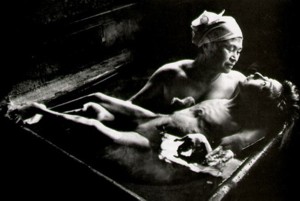
Long before the March 11, 2011 magnitude-nine quake off Japan's northeast coast and the tsunami that crippled the Fukushima Daiichi Nuclear Power Plant there was MINAMATA.
W. Eugene Smith and his wife Alleen did a three-year study and photo documentary showing the effects of mercury poisoning of Kyushu a small fishing and farming town in southern Japan in the 1950s. Minamata's disease is methyl mercury poisoning from industrial waste. The people and domestic animals fell ill when they ate contaminated fish from Minamata Bay and the Shiranui Sea.
One-hundred-and-three people died and 10,000 were seriously damaged. The deaths continued for more than 30 years as the government and Chisso Corporation did little to prevent the pollution. Smith was severely beaten by Chisso union men while following the mercury poisoning damages. Minamata was his last major work as he never fully recovered.
The Japanese are no strangers to hardship. The Minamata pollution happened not long after the U.S. Atomic Bombs killed seventy thousand people in one minute in Hiroshima and Nagasaki (and twice that many slowly from the inside) and 100,000 in Tokyo in the 1945 firebombing. The estimates of those killed and wounded are conservative. Regulations forbade note taking, there were few charts and photographs and official records were scanty.
Smith was a war correspondent in island-to-island fighting in the Pacific. He was involved in 26 carrier combat missions and 13 invasion and was in Okinawa on D-Day. He was known as a photographer who would take almost any chance if it meant getting the picture. While on the east coast of Okinawa he was seriously wounded by a Japanese shell fragment.
On March 2001, 2,265 Minamata victims were officially recognized and Chisso awarded financial compensation to over 10,000. By 2004, Chisso Corporation had paid $86 million in compensation and as of March 29, 2010 a settlement was reached to compensate as-yet uncertified victims.
“MINAMATA” is Smith's powerful photographic essay and text about the pollution of a village and its inhabitants. Many of the victims are severely disabled and continue to pass on genetic mutations to their offspring. The book and his work helped end the pollution and achieve retribution for the victims.
Smith would be heartbroken to learn that the salmon, tuna and king mackerel in our oceans today contain high levels of mercury. The higher up the food chain a fish, the higher the mercury contents.
Smith's courage and work is a gift to humankind. When he died in 1978 he left behind a legacy of some of the most powerful photographs in the history of journalism. His personal approach to integrating his life into the lives of his subjects revolutionized photojournalism and is now known as the photo essay. His body of work remains one of the primary bridges between photojournalism and fine art.