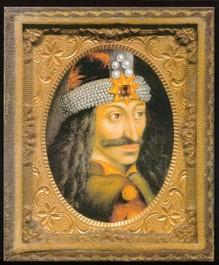
A comic satire on modern sociologists looking back at more punitive criminal justice systems of the past, particularly the system employed by the original Dracula (Vladimer “Vlad” the Impaler), in an attempt to solve problems and weaknesses in modern judicial systems. Published in The Journal of Irreproducible Results, a satire magazine, in January 1996, by the Society for Basic Irreproducible Research.
Average, ordinary, everyday people -- clinically defined as those with mortgages, 2.5 children, and credit card debts -- have traditionally been far too concerned with the rising cost of living to give any thought to the growing threat of crime.
In recent years, however, this has changed dramatically. The rising crime epidemic has spread most alarmingly beyond the inner cities to envelope the surrounding suburbs, throwing law-abiding citizens into a state of panic. Coupled with this is the growing liberalism of modern criminal justice systems, resulting in the recasting of violent criminals as victims of the society on which they prey, the rendering of sentences far less severe than their crimes demand, and even the early release of admittedly unreformed violent criminals. In one recent case, fittingly called "The Trial of the Century" because it lasted nearly that long, a man charged with murdering his wife and her lover was acquitted, to the disgust a vast portion of the population which was convinced he did it.
Thus, we now have a growing anarchy of the criminally insane controlling the general populace through fear. Recent studies (Kennedy and Khrushchev, 1962; Nixon and Haldeman, 1973) indicate a growing tendency toward armed camps: in this case, members of polite society suffering pre- and post-traumatic syndromes, neurotic anxieties, and paranoid personality disorders -- sometimes all at the same time -- which tends to render ordinary citizens capable of violently disassembling the first thing that walks through the door.
Violent criminals are also avoiding the due penalties of their crimes by simply pleading various forms of mental derangement, therapy and recovery, placing the blame elsewhere, and appealing to the sympathies of all-too-sympathetic juries. One man, who murdered both his supervisor and the mayor of his city, contended that the cream filling in the Hostess Twinkies had driven his blood sugar level dangerously high. Time Magazine (June 6, 1994) reported that, by parading life's abnormalities before the viewing public, television talk shows (Oprah, Geraldo, Donahue, Raphael, etc.) have made juries more sympathetic with novel defense strategies, leading to what the attorney general of California called "the Oprahization of the jury pool." A blatant murderer can win his jury's understanding and sympathy with a heart-rending defense plea centered on childhood abuse, irascible laws, or Twinkie cream filling. Thus did Playboy (June 1994) suggest, "If you don't want to do the time, all you need to do is whine."
For these reasons and perhaps more, many sociologists have begun to entertain the notion of reinventing our criminal justice system. This means reversing the liberal judicial climate and returning to more harsh but successful punitive systems of the past. One such system currently under study, and one which has begun to receive more attention among those suffering from violence-induced trauma, is the harshly punitive system employed by the infamous blood-shedding territorial ruler, Dracula.
This Dracula is not Bram Stoker's evil undead predator who feasts on the blood of his victims and destroys them in the process; these qualities get you elected to Congress. The Dracula of this study is Prince Vladimer, the 15th century Transylvanian ruler who inspired Stoker's monster. Vladimer was an unusually cruel man in a cruel age, known for his cunning, trickery and brutality, and feared far and wide for inflicting in a most indiscriminate manner the most tortuous forms of execution imaginable. His fiercest enemies, the Turks, called him Kaziglu Bey (Lord Impaler). He was, according to a contemporary German pamphlet, the "MONSTER and BERSERKER called Dracula who committed such unchristian deeds as killing men by placing them on stakes, hacking them to pieces like cabbage, boiling mothers and children alive and compelling men to acts of cannibalism." History remembers him as Vlad Tepes, Vlad the Impaler, but he was known to his people and to us as Dracula (meaning "son of the devil").
But, however cruel he was, Prince Vladimer implemented and maintained the most crime-free society the western world has ever seen. He ruled his territory with an iron fist. He established a strict code of ethics and enforced it with a reign of terror which hung like a sword of Damocles over the land. He prescribed impalement for any crime, real or imagined; and he even once repulsed the invading Turks when the sight of impaled victims at Giuraia on the Danube frightened the invaders, and the sight of 20,000 impaled prisoners and captives rotting in the sun at Targoviste sickened the usually stout conqueror of Constantinople, Mohammed II.
Vladimer refined his method of impalement by using oiled stakes with rounded ends, which prolonged the victim's torture and delayed his death for several days as he hung suspended above the ground. Victims were mounted on poles in concentric circles around the cities, or around Castle Dracula, in order to afford onlookers a better view. This allowed the people to see what would happen to them if they transgressed either the law or their ruler's mood du jour. Yet, while impalement was Vladimer's favorite form of execution, he was by no means stuck "in a rut." For variety he would drive nails into victims' skulls, cut off limbs, noses and ears, and boil victims alive. He ran over some with carts, roasted others over hot coals, and skinned still others alive down to their entrails. Whenever he felt his subjects needed a good laugh, he would salt the soles of his victims' feet for the animals to lick interminably.
Being politically correct, the Prince was an equal opportunity executioner, torturing and killing all candidates regardless of sex, age, religion or nationality. His atrocities were described -- during his lifetime -- in contemporary Turkish, Slavonic, Byzantine and German writings, as well as folklore and popular horror stories. The result was that crime was nearly nonexistent while he reigned. Here are two documented examples:
1) At a well-known fountain in a deserted square at Targoviste, Dracula placed a golden cup that, anywhere else, would have openly invited theft. The cup, however, was never taken while he lived.
2) A merchant traveling through Dracula's territory with his treasure-laden cart knew of the territory's reputation for honesty. He left his cart outside the inn overnight. The next morning, however, he discovered that 160 gold ducats had been stolen, and he duly reported the theft to Dracula. The Count gave the town two choices: turn in the thief with the gold, or he would destroy the town and kill every man, woman and child therein. Thus he tested the honesty of the town. Meanwhile, to test the honesty of the merchant, he secretly had 161 gold ducats placed in the merchant's cart. The thief and the gold were turned in and the thief was impaled. The merchant, meanwhile, counted his gold, discovered the discrepancy, and reported the extra ducat to Dracula. Having proven his own honesty, the merchant was then allowed to leave with his life as well as his gold.
In an age of rampant barbaric behavior, Vladimer's system of criminal justice reduced crime in his jurisdiction to practically zero. In western cultures, there is good reason to predict that a return to the Draculean formula of criminal justice could have the same effect today that Vladimer's program had 400 years ago. Meanwhile, there would be several side benefits.
For one thing, liberal-minded crusaders who view criminals as victims will find that under a Draculean system criminals, having preyed on helpless citizens, become "victims" of impalement; and humanitarian concerns may be assuaged by the fact that the Lord Impaler always demanded pre-execution confessions to purge the soul; and a slow demise rather than a quick death allowed the condemned time to reflect upon his crimes and to mend his ways.
The necessity to adapt the punishment to fit the crime, so tedious and so inconsistent between jurisdictions, would be negated by inflicting the same punishment for all misdeeds, from the merest misdemeanor to the most hideous atrocity. Indeed, responsibility for such determinations would weary no one save the tyrant in whom it would be vested, and the style of torture itself, as well as its duration, would be completely dependent upon tyrannical whims.
Finally, there is the "laboratory tested" deterrent quality. Impalement proved in Vlad's time to be a most effective deterrent to crime, for which reason his territory had the lowest crime rate of any western society. Today's methods of execution have failed here, partly because they are not visible to the populace at large, and perhaps partly because they are both too quick and not up to historical standards of "cruel and unusual punishment."
Prolonged suffering, lasting for several days and visible to all, has been shown to have a pronounced salutary effect on criminal behavior.
|


