Herodotus was among the first traveler-writers in the history of mankind. He was born and raised in Hellenic Western Anatolia (now Turkey) – a land, where meandering rivers shape the coastlines, and where access to the sea was governed, and often destroyed by sediment deposited during the winter rains.
Herodotus finally settled down in Southern Italy, where he composed his works and died 424 B.C. In Herodotus’ writing we observe a meshwork of archaic theology and syncretic speculations. He takes great care to separate his own observations from what he infers or what he has heard from others.
The latter form the background for amazing snapshots of truly poignant scientific observations, and precise reasoning. These are the focus of this article.
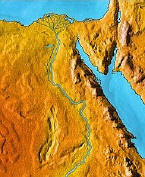
Herodotus travels to Egypt in the fifth century B.C. He portrays the Egypt of the declining Late Kingdom, but well before the reign of the Hellenistic Ptolemids.
Approaching the Nile delta by boat, Herodotus notes that the water far out in the sea is unusually shallow:
“ At least I have the understanding, that the Egypt to which the hellenes come in ships is a land which is ... a gift of the river. First when you are still approaching in a ship and are distant a day’s run from the land, if you let down a sounding-line you will bring up mud and you will find yourself in eleven fathoms. This then so far shows that there is a silting forward of the land.
As he enters the delta, he observes the nature of the deltaic river outlets, the flatness of the land, the softness and colors of its soil:
“ The Delta is parted in three; and one, which is called the Pelusian mouth, turns toward the East; the second of the ways goes toward the West, and is called Canobic mouth; but the one of the ways which is straight runs through... is called the Sebennytic mouth.
"There are also two other mouths which part from the Sebennytic and go to the sea, and these are called, one the Saitic, the other the Mendesian mouth. The Bolbitinic, and Bucolic mouths, on the other hand, are not natural but made by digging.
" From thence and as far as Heliopolis inland Egypt is broad, and the land is all flat and without springs of water and formed of mud…
“As their land advanced forward, many of them were left in their first abodes, and many came down gradually to the lower parts…
“It has soil which is black and easily breaks up, seeing that it is in truth mud and silt brought down from Ethiopia by the river…
“For they (the farmers) have no labor in breaking up furrows with a plough nor in hoeing nor in any other of those labors which other men have about a crop. But when the river has come up of itself and watered their fields and after watering has receded again, then each man sows his own field…
“ But the soil of Libya, we know, is reddish in color and rather sandy, while that of Arabia and Syria is somewhat clayey and rocky.
Herodotus then intelligently speculates about the magnitude of sediment transport, and mud deposition:
“For it was evident to me that the space between the mountain ranges, which lie above the City of Memphis, once was a gulf of the sea, like the regions about…Ephesos and the Plain of the Maiander, if it be permitted to compare small things with great. And small these are in comparison, for the rivers, which heaped up the soil in those regions none is worthy to be compared in volume with a single one of the mouth of the Nile, which has five mouth.”
“ If then the stream of the Nile should turn aside into the Arabian Gulf (=Red Sea) what would hinder that gulf from being filled up with silt as the river continued to flow, at all events within a period of twenty thousand years? Indeed, for my part, I am of the opinion that it would have been filled up even within ten thousand years…
Two problems clearly intrigued our early travel-writer: The origin of the Nile, and the problem of the mid-summer Nile-valley flooding. On the first one, he cites the available sources. None appealed to him, rightfully though. On the summer flooding, he tests several theories (melting snow, wind patterns) but admits, that none of the solutions offered are viable solutions:
“As regards the nature of the river, neither from the priests nor yet from any other man was I able to obtain any knowledge: and I was desirous especially to learn from them about these matters, namely why the Nile comes down increasing in volume from the summer solstice onwards for a hundred days, and then, when it has reached the number of these days, turns and goes back, failing in its stream, so that through the whole winter season it continues to be low, and until the summer solstice returns.”
As he travels further up the river, Herodotus describes the effects of the Nile rapids on his travel itinerary:
“From the City of Elephantine as one goes up the rive there is a country which slopes steeply; so that here one must attach ropes to the vessel on both sides, as one fastens an ox, and so make one’s way onward; and if the rope breaks, the vessel is gone at once, carried away by the violence of the stream. Through this country it is a voyage of about four days in length, and in this part the Nile is winding like the River Maiander.. Then you will come to a level plain, in which the Nile flows round an island named Tachompso.. Adjoining this island there is a great lake, round which dwell Ethiopian nomad tribes; and when you have sailed through this you will come to the Nile Stream again, which flows into the lake. After this you will disembark and make a journey by land for forty days; for in the Nile sharp rocks stand forth out of the water, and there are many reefs..
Among the many wild animals Herodotus cites, he gives a particularly lovely description of the Nile Crocodile:
“Of the crocodile the nature is as follows: During the four most wintry month this creature eats nothing: she has four feet and is an animal belonging to the land and the water both; for she produces and hatches eggs on the land, and the most part of the day she remains upon dry land, but the whole of the night in the river, for the water in truth is warmer than the unclouded open air and the dew. Of all the mortal creatures of which we have knowledge this grows to the greatest bulk from the smallest beginning; for the eggs which she produces are not much larger than those of geese and the newly-hatched young one is in proportion to the egg, but as he grows he becomes as much as seventeen cubits long and sometimes yet larger. He has eyes like those of a pig and teeth large and tusky, in proportion to the size of his body; but unlike all other beasts he grows no tongue, neither does he move his lower jaw, but brings the upper toward the lower, being in this too unlikely of all other beasts…”
Here ends my summary of Herodotus’ observations on the Nile River. His book is full of interesting notes and stories. He writes, among other topics, about the measuring of time, astrology, sacred animals and the way the Egyptians lived.
Map: From the British Museum website.
Source: “An Account of Egypt” by Herodotus. Translated by G.C Macaulay. Published as E-book by Roberts Publishing, 197 Woodlands Pkwy. # 104-529, San Marcos, Ca. 92069
© 2004 by Franz L Kessler





Thanks for posting this.
Gina