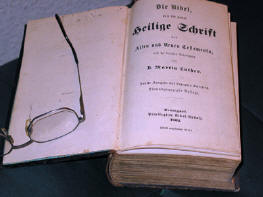
The period around Christmas is often filled with emotion, expectations, wishes and a search for life’s true meaning. It’s a time I like to read in the Bible – not so much guided by faith, but with the curiosity, the critical and humorous eye of a historian and geographer. There are so many interesting stories in this book to ponder. I inherited an old 1862 Bible print from Grandma. It’s a lovely book of original and strong language, based on the original Martin Luther translation from Greek and Hebrew into classic German. I translated a few lines into English, but not without cross-checking with English-worded texts. In the below article, I would like to examine and to interpret references made in respect of the location of paradise.
The Biblic stories are not only interesting from the viewpoint of faith. Arguably, they also contain nuclei of human experiences dating back to the transition period between the Neolithic, and the Copper Age. The word ‘Paradise’ is mostly used in metaphorical connotations: it is perceived as a sacred space that offers bounty and peace. It is a perfect place of innocent happiness, where suffering is unknown.
The word itself seems to have a Persian root describing a garden that is surrounded by a wall. Not surprisingly, the term ‘Paradise’ is used synonymously with ‘Garden of Eden.’ But reading my old Bible I stumbled upon a few geographical landmarks, which seem to indicate the notion of a physical presence on earth. These can help us find the whereabouts of Bible’s ‘Paradise.’
1. Geographical indicators giving clues to the location of the Paradise
In 1 Moses 1.2 we can read how God created the rivers of Eden.
“A stream originated from Eden to water the garden, and divided itself into four main streams: The first water is named Pison, and flows around the entire land of Hevila, where gold is found. The gold of this land is delicious, and one can find Bedellion, and Onyx gemstone."
This description might refer to Egypt – interesting also to see that gold is mentioned explicitly twice. Possibly it refers to gold deposits located between the Nile River and the Red Sea. Onyx was an important gemstone in ancient Egypt. Another important source of Onyx was India, where this precious gemstone was prominently mined in the ancient world. The terms Pison, Bedellion, Hevilla or Havilah remain illusive, as they seemingly don’t match any other source of historical evidence.
‘Havilah’ occurs at several locations of the Bible and seems to point to a geographic location. Most likely it refers to Egypt. According to wikipedia.org its orginal meaning is 'stretch of sand' and might refer to Yemen.
'Bedellion' is interpreted (wikipedia) to refer to a gum-like aromatic substance, similar to myrhh, and possibly harvested from a tree species called today 'guggul.'
“The other water is called Gihon, and flows around the entire land of the Moors.”
The name (Hebrew, Gichôn) may be interpreted as "bursting forth" or "gushing." Could this ‘river’ refer to the Red Sea, the African continent, and its dark-skinned population? First-century Jewish historian Josephus associated the Gihon river with the Nile (Jewish Antiquities, I 39).
However, a quite different Hebrew word is used to designate the Nile elsewhere in the Bible, and even in ancient times it must have been obvious that the Nile could not have a common source with the Tigris and the Euphrates. There are also other interpretations. The researcher David Pohl argues in his book “Legend, the genesis of Civilisation,” that the mentioned Gihon and Pison are synonimous of the present-day Araks and Kisil Usen, both located in the Turkish-Iranian borderlands.
“The third water is called Hidekel (=Tigris, Dicle), which flows before Assyria. The fourth water is the Phrath (Euphrates, Firat)."
The above citations regarding water3 and water4 are very clear. They points to Mesopotamia, the fertile lands of Iraq located between the two rivers, which once harbored one of the oldest (if not the oldest) human civilizations.
2. Anthropologic, Climatic, and Botanic statements that help locate the paradise in time and space.
The first book Moses mentions:
2/9: “Several fertile fruit trees, that are lovely to look at, and nice to eat. In the middle of the garden stand the Tree-of-Life, and the Tree-of-the Recognition of Good and Evil.”
The text clearly reveals a fact I had been previously unaware of: that there were two forbidden trees. The (truthfully speaking) snake advised Eve to pick and taste a fruit from the recognition tree. Indeed, she didn’t die after the fruit consumption, as was the Old-Testament-God’s sinister warning. She only got cursed and became miserable. Did God lie to Adam and Eve? However it appears that God’s original prohibition seemed to have focused on the tree-of-recognition only. After the forced departure from Paradise, so tells the Bible, the Cherubim Angle protected the entry of the garden with his blank sword - to prevent the humans from re-entering and probing the other sacred tree and such obtaining eternal life. This story seems to point at much older cultural heritage – the ‘tree-of-life concept’ appears already in Neolithic paintings, on cave walls in both Europe and Asia. These paintings are at least 40000 years old. It has survived on Turkish carpets, and figures in many Shamanic rituals in Siberia and the Americas.
The story also invokes the picture of a fruit tree grove, which reminds me of fruit tree plantations. Fruit are found in the wild in an association with non-fruit-bearing trees, such as citrus fruit trees that blossom in tropical forests. With a bit of care, a fruit tree forest can be turned into a fruit garden, a paradise. The Bible describes the Paradise as the ‘Garden of Eden’, which infers a horticultural environment rather than a natural forest.
The creation of fruit trees already on the third day of Genesis shows how important fruit trees were for the authors of the Bible. Fruit trees can grow without the constant need of human care. For this reason, perhaps, fruit is seen as a gift of heaven.
However, the Bible puts also a strong emphasis on agriculture, pointing in various chapters to the pain of working the land. This might be related to collective experiences that came along with the traumatic climate changes, occurring at the end of the Neolithic Period: The extended savannas of both Northern Africa and Arabia were rapidly drying out. What used to be lands full of game became wastelands and even desert. Human populations receded to the few remaining permanent rivers (Nile, Euphrates, Tigris), and invented systematic agriculture, Law, fortified cities, and water management. Fertile lands, and water, were in short supply, from which the need of intensive farming may have originated. Whilst harvests in the close proximities of the perennial rivers were (and are also today) bountiful, the arable land was scarce, or even non-existing, a bit farther away. To stay in these few river-oasis meant to be fully aligned with local laws: A breach of these may have led to the expulsion of perpetrators outside of the walls, into the arid lands of sweat and misery. Could the expulsion from paradise be understood as a distant echo of such events?
After having eaten from the tree-of-recognition, Adam and Eve become conscious of their nakedness:
3/7: “Their eyes were opened, and they became aware of the fact they were naked and used ficus leaves to make garments.”
Fig trees, at current climatic conditions, mostly grow in the tropics. Several species are also common in the Mediterranean, and one species is found as far north as Denmark. Figs come in two sexes: hermaphrodite (called caprifigs because only goats eat them) and female. Fig wasps grow in caprifigs; when they mature, they mate, and the females leave in search of immature figs to lay their eggs in. When the wasp finds one, she pollinates the female flowers but will not lay eggs in the edible fig, only in the caprifig. Thus the edible fig ripens without any wasp frass in it. Figs are the only fruit explicitly mentioned in this Bible chapter.
The explicit mentioning of Adam and Eve’s nakedness also represents an interesting subject. During the course of human evolution, humans seem to have gradually lost their body hair cover down to a few remnants. Our distant cave-dwelling ancestors’ bodies were fully covered with hair, and probably suffered a lot from parasites. Even today we seem to be carrying the gene of full body fur in us, but it is turned off. Hence, in a nutshell, the mentioning of nakedness seems to portray a fairly modern stage of human development. This first attempt to protect sensitive body parts also seemed to have been a flawed one:
“7: And God the Lord made hides for them, and put the dresses on them.”
Hides are very primitive clothings, not common in areas of substantial civilisation. Be it as it may, Adam and Eve were now fully dressed-up, and ready to face a world of misery and hardship on the catwalk of life.
The use of hides appears to point toward moderate climate conditions. In the tropics, leather underwear quickly rots in hot & wet conditions, and may represent even hygienic hazards. In the polar and sub-polar regions, however, leather underwear alone would not have provided a garment sufficient of preventing freeze-induced damage to essential reproductive organs. In chapter 4 and 5 Adam and Eve are expelled from paradise. Distressed, they did what most people in survival mode do: circle the wagons, produce kids and form a tribe. Adams sons acquire suitable brides, from the neighborhood. Where these females came from is not explicitly mentioned, but presumably from areas outside of the Paradise - I guess the Cherubim Angel was still there and wouldn’t have let the girls out off Eden without explicit orders.
The list of Adams descendants is long and cryptic, but contains several geographical and historical indicators:
“16: But Cain abandoned the Face of God, and lived beyond Eden, toward the East in the land of Rod.”
“20: And Uba gave birth to Jabal; from him originate those who dwell in huts and raise cattle.”
“21: And his brother was called Jubal; from him descend the violinists and flutists.”
“22: Zilla gave also birth to Thubalkain, a master in melting minerals and ironworks.”
‘East of Eden’ clearly points to a geographic location, the Land of Rod. Building huts and raising cattle might suggest a nomadic life style, pointing to semi-arid climate conditions. Might the Biblic conflict between Cain and Abel depict the very common clash between farmers and herders, as witnessed in nearly every dry country in today’s world?
The mentioning of iron melting is also very interesting. The earliest iron, which was obtained from meteorites, appears already in the Classic Egypt of the Second Empire. The Hittites of Anatolia are seen as the inventors of iron smelting. It involved powerful kiln technology with burning temperatures above 1200 deg Celsius. This temperature is needed to reduce iron oxide, with the help of (char)-coal to yield liquid iron. The new technology gave them a terrific technological edge in warfare, until the others caught up with. Iron smelting might also have been independently invented in Cameroon (West Africa). Be it as it may, the mentioning of iron works places Thubalkain roughly in the second or first millennium B.C.
3. My Conclusions
Both climatic and geographic landmarks mentioned in the Bible seem to locate the paradise in an area otherwise known as the currently rather unhappy and perturbated ‘Middle East,’ and perhaps the eastern part of Northern Africa. India is not explicitly mentioned at this point. Several thousand years ahead of the birth of Jesus, the ‘Middle East’ was probably already a dry place, but still possibly a little wetter and more pleasant, if compared to today’s relentless desert climate. Nevertheless, the frequent allusion to rivers and the little mentioning of seasonal rains may point out that irrigation was already a necessity even in those old days (One particular ruler of Sumerian Mesopotamia had the name Akurgal, which means Water-Is-Power).
A precise location of the ‘Paradise’ in time and space cannot be obtained without farther and deeper studies. If I were to speculate, I would guess for Aden, located in today’s Yemen in Southern Arabia (In Hebrew ‘Eden’ and ‘Aden’ look identical, I was told). Yemen might also be related to ‘Yaminites,’ synonymous for ‘Benjaminites,’ one of the Israelite tribes. In times of a wetter climate Southern Arabia might have felt like paradise.
The portrait of Eden could also be understood as a reflection of pre-iron-age Mesopotamia – an area where fruit orchards thrived, and where horticulture might have been invented. Possibly, the Genesis images a kaleidoscope of historical events and cultural perceptions engrained in the ‘Middle Eastern’ societies from the 4th millennium BC onwards. Wherever the Paradise may have been located, it is gone for good.
Personally I believe these stories are full of insight and mystery– irrespective of their religious weight, they serves as a great Christmas lecture.
References:
Encyclopedia Britannica 2003
Wikipedia – the free encyclopedia on the web -
David Rohl: Legend, the Genesis of Civilisation, Randomhouse.
Der Spiegel.de: "Wegweiser ins Paradis."
Die Bibel oder die ganze heilige Schrift des Alten und Neuen Testaments nach der deutschen Uebersetzung von D. Martin Luther. Einundzwanzigste Auflage. Stuttgart 1862.
updated text: December 2006
© 2004 by Franz L Kessler
|




As for the two trees, Satan had a plan. After he convinced Adam and Eve to eat of the fruit, he intended to take them to the 'tree of life,' and if they ate of that, they would have lived forever. That was the reason the angle acted as a barrier to the tree. (Genesis 3:4) is the first lie on record, where Satan told Eve she wouldn't die, if she ate the fruit. Now if Satan could have gotten the first human pair to the tree of life, he would have made God a liar, but nobody beats God , do they?
Ted