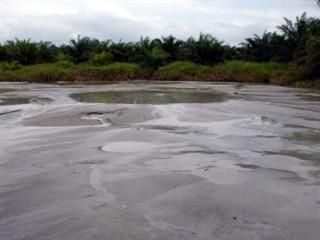
‘What is this,’ you may ask. We all know about volcanoes spewing red-hot-glowing lava, pumice, and hot gases. The latter cause the upward expansion and drive of the magma. Mud volcanoes also have a gas drive. But unlike ‘hot’ volcanoes, the temperature of the fluids and gases (water, methane, ethane etc) are mostly below a 100 F.
Where do mud volcanoes occur? Generally they can be seen in sedimentary basins, where clay and sand are accumulating in a fairly short period of time. Water is mostly retained within the original pore space, and may help carry the weight of an increasing overburden. The cities of Venice, Italy, Bangkok, Thailand, and New Orleans, Louisiana are built on such thick packages of soft rock.
With rising overburden weight, plastic clay in the subsurface becomes unstable and can behave like a highly viscous fluid and potentially reach the surface. The plastic clay produces volcano-shaped cones that can reach a height of a few hundreds of feet. Some of the biggest mud volcanoes occur in the Caspian, but are equally common on the Island of Borneo.
In January I visited mud volcanoes in a location called Ngebol in Sarawak, Borneo. The word is from the Iban language and means ‘bubbling.’ Negotiating slippery mud roads, we arrived on a valley bottom, in the middle of the Bukit Peninjau palm oil plantation. Approaching the site we could see some twelve bubbling craters, and nets put up by local tribes people to catch migrant birds. An individual mud volcano crater in Ngebol ranges in size from three to fifteen feet in diameter. The largest one is continuously bubbling, ejecting a stream of methane? gas. Unfortunately, the clay surrounding the crater is very soft – one might possibly drown in some kind of ‘quick-shale.’ An oil exploration well drilled nearby around 1935 indeed located a source of methane gas – it rises probably from a source deeper than 12000 feet, beyond the total depth of the old well. It also seeps from a crack in the old wellhead, and can be ignited with a lighter.
In a nutshell, mud volcanoes are rare phenomena that occur in young, under-compacted basins only, and are often associated with the occurrence of oil and natural gas.
© 2005 by Franz L Kessler
|



Thank You.
Love Tracey xo