There seems to be an arbitrary line between the rights pets have, and farm animals don't have
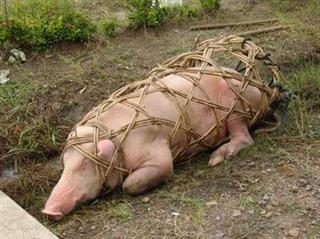
It was a hot day. The wedding ceremony in the jungle village had not started yet. Food needed to be prepared to feed the entire community. Charcoal fires were burning already, old vegetable oil drums being used as cooking pots and hovering suspended above the fires. Inside the pots, and wrapped in banana leafs, rice from the recent harvest was cooking. Soon, however, pork would be on the menu – one big pink over-age swine and a smaller brown pig were lying in a nearby ditch, immobilized in some kind of bamboo cage. Tomorrow the entire village population would gather for a meal, and it wasn’t planned to be a vegetarian event.
At noon, one of the cooks came by and sprinkled a bit of water over the animals that roasted under the sun. I followed their example, and gave them a cool shower with the water hose. At midnight, the pig’s unhappy hour had come. I heard terrible, piercing screams – I almost could feel the cold knife in the pig’s heart. This said, thinking less emotionally, these animals were given a fair, if not humane killing compared to the hundreds of thousands of animals slaughtered by robots etc. in abattoirs every single day.
The difference was that I could feel it happen.
The above experience reminded me about animal rights. Some countries have adopted legislations that grant animals certain rights – though animal rights in most instances mean rights for pets. An arbitrary line is drawn between pets, and farm animals. Let’s look what controls the course of this dividing line.
Commonly, pets or dogs are referred to as either particularly intelligent, emotional or loyal. Furthermore, it is cultural heritage in many countries to have dogs and cats as pets inside the house.
There is little doubt, however, that:
• A pig may have the same level of intelligence compared to a dog, or more;
• Pigs are animals with strong emotions, and very similar to humans;
• Pigs are perfectly clean animals, if efforts for hygiene are made.
I knew people who raised a baby boar. This wild animal proved to be perfectly apt for domestication. It lived, in fact, the rare wild-pig-example of a pet’s life.
A long time ago I had a chance to witness intelligence expressed by cows. These bovines are capable of communication, and can even achieve a group decision. On that day I saw a group of cows that got bored grazing on a mountain meadow. It was surrounded by a barbed wire fence, and the cows wanted to break free. I saw the cows getting together as a group, as if they were discussing something. Suddenly, they turned around, and galloped over the meadow. With a phalanx of heads and horns they gave the fence one big blow, and pulled it down – in an act, which a single cow could never achieve.
In a nutshell, should I come back to this planet as a dog, I might get pampered in the Ritz. As a pig or cow of equal intelligence and emotional capacities, I will get butchered and milled into a burger or hot dog.
Does our attitude toward animals have a touch of racism?
Countries that consider animals at least partly as pets seem to have far better laws for the protection of animals. Personally I have little doubt, that the level of compassion expressed toward animals can be used as a reliable parameter to judge the spiritual or ethic development of a given country, or a civilization. Yet again, farm animals hardly ever seem to benefit from legal protection. The meat on our table has to come from somewhere. As long as humans eat large quantities of meat, farm animals will be killed and butchered. There is also a fair cultural spread of ideas what qualifies as food. In many countries even worms and certain insects end up in the cooking pan.
What can be done to give farm animals a better life? Better legislation and law enforcement could bring ‘acceptable’ living conditions for farm animals (enough space, air, no hormone injections etc). Secondly, modern transport and slaughter policies might help protect farm animals from abuse, cruelty and excessive pain.
I fear, however, that such legislative improvements might not address the real issue: I’m referring to our perceived cultural and historical rights to kill animals for food consumption. There isn’t a silver bullet in sight. We are witnessing an uneasy management of a cultural blind spot, where our collective stomach always has a louder voice than our moral values, and heart.
© 2005 by Franz L Kessler
|



But the pendulum, unfortunately, has been swinging the wrong way these days for dogs and cats and wild animals, too. Millions of them are now rounded up and slaughtered in the US every year, and it seems we humans have less and less compassion for our earthly nonhuman neighbors these days whether they be pets, farm animals, or wild creatures.
We truly have become a gluttonous callous society.