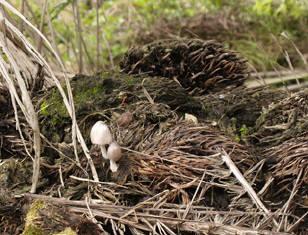
Kulat Saui is a mushroom, that grows on oil palm fruit.
Mushrooms can be a wonderful addition to many home-cooked dishes. Throughout my life, I have collected mushrooms in many countries. Guided at first by Grandma’s knowledge it became a passion difficult to subdue. Collecting mushrooms can be dangerous and one should always rely on the wisdom and experience of local people.
The most appreciated species of mushroom in this part of Sarawak (Borneo, Malaysia) is called Kulat Saui. It is a species associated with palm trees, and grows preferentially on decomposing oil palm fruit. It requires a lot of water, and grows on fresh palm fruit baskets only (black clusters are old and unproductive, light brown ones are productive). Under optimum conditions (water and heat) mushroom grow in this habitat for perhaps three weeks. The mushroom is highly prized (RM2 or 0.5 USD), for a handful only, and is regularly harvested by the local Iban. As many other mushrooms the Kulat Saui grows very fast, reaching full size in less than two days.
The obvious place to look for Kulat Saui is oil palm plantations. When we entered a large oil palm plantation on a weekend in January, it had been raining for several days. Creeks were full with water to the top. Discarded oil palm fruit gaskets lay soaked in the shade of the palm trees. In brief, conditions were ideal, and right from the begin I found a ‘nest’ of mushrooms, exceeding one pound. We continued to scavenge the forest under the rain, and finished with about four pound. It was our lucky day.
Caution
Caution 1: Only collect mushrooms you know
Caution 2: Sometimes the underbrush gets sprayed with toxic chemicals. Watch for signs that mention spraying operations; ask locals or the plantation management.
How to cook Kulat Saui mushrooms
There are many local recipes. I love mushrooms oil-fried.
Wash the mushrooms carefully and thoroughly. For a pound of mushrooms, cut some 100 g of garlic.
Use a large cooking pan, and heat olive oil until it starts boiling. Add the garlic, and fry it until light brown. Add gradually the mushroom. Keep frying until the water from the mushroom has evaporated. Add a little salt, marmite or Rosmarin for seasoning.
My book is a collection of dialogues with award-winning chefs from various backgrounds and cultures, sharing their personal experiences of where and why food culture is where it is today.
Mad Cow’s Disease is a food feeding consumption disease issue. What food is fed cows. Is if remains of cows? Does this feeding pattern create a Disease?
If you’re a brave fire eater, aka a Wailer, you’ll find something in The Little Book of RED HOT Chili Pepper Recipes that will tease, sizzle and excite your taste buds.
Chili, pork chops, chicken, beef, fish, egg and veggie dishes—even dess