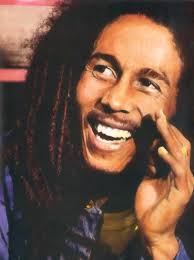
A little info on Bob Marley
Possibly one of the greatest lyricists ever--Bob Marley's talents are highlighted on LEGEND, THE BEST OF BOB MARLEY AND THE WAILERS. He is the undisputed Reggae king and unarguably Jamaica's best known citizen. Robert Nesta Marley was born February 6, 1945 and left this world on May 11, 1981. Having grown up in the shanty-town area called Trenchtown outside of Kingston, it seems inevitable that Bob would eventually base his spirituality in Rastafarian beliefs. The plaited and matted hair that he kept for so long was typical of Rastas, and his music and life is representative of those teachings.
Two decades of his short life were spent making music, beginning in the early 60's as a solo artist, then with a group he put together--The Wailing Wailers. The group, consisting of Peter McIntosh, Bunny Livingston, Junior Braithwaite, and Beverly Kelso, charted locally in 1964. Then Junior and Beverly left the group and Bob went to America for a time. At the end of the 60's he returned to Jamaica, joined up with Pete and Bunny, and became popular throughout the Caribbean. During this time period the three set the direction for Reggae. One of their earliest songs, written by Bob, is "Stir It Up," and is the seventh tune on LEGEND, but it was first made popular in 1972 by Johnny Nash.
The big change came in 1972 when the band signed with Island Records. This began the journey to international fame, beginning with the release of CATCH A FIRE in 1973. It was one of the first reggae albums. Soon to follow was BURNIN'. Two 'biggies' from this disc can be found on LEGEND: "Get Up, Stand Up," an activism song written by Bob and Pete, and "I Shot The Sheriff" written by Bob, and which was later to become a #1 hit for Eric Clapton.
The album NATTY DREAD in 1975 gave the group a world-wide hit with "No Woman, No Cry," penned by Vincent Ford. It was a song of love and memories of Trenchtown and contains the famous chorus "Everything's gonna be all right" along with a great guitar solo. This year saw Pete and Bunny leave to pursue solo careers. One of the new members for background vocals was Rita Marley, and the new group name became Bob Marley and the Wailers.
In 1976 Marley, Rita, their manager, and another friend were shot inside their home by unknown assailants, and after being released from the hospital they hid until the 'Smile Jamaica' festival, where they performed in bandages. Shortly after recovering they left for England. Here they recorded EXODUS and KAYA. EXODUS included five tunes that are on LEGEND: "Exodus," "Waiting In Vain," "Jamming," and "Three Little Birds," all written by Bob, and "One Love," a rendition of "People Get Ready" by Curtis Mayfield. "Jamming" is a religious, but humble, and world-popular song in which he states "No bullet can stop us now." "Three Little Birds" is a light-weight, optimistic, 'don't worry bout' a thing' tune with a great bass guitar attitude. "Waiting In Vain" is a pure love ballad; "One Love" another religious/unification plea. "Exodus," though a repetitive tune with lots of bongo drum, was considered a message of activism.
KAYA gave the world "Is This Love," and "Satisfy My Soul"--more Marley-penned and easy going love songs included on LEGEND. "Is This Love" personifies the group's excellent vocals. Listen to the percussion on the jaunty little "Satisfy."
After these releases, Bob returned to Jamaica for the 'One Love, One Peace' concert, a hugh event. He followed this with his first trip to Africa to visit the home of Rastafaria: Ethiopia. He was inspired to produce two more albums: SURVIVAL, and then UPRISING, which hit all European charts. "Redemption Song" from UPRISING is included on LEGEND, as is "Could You Be Loved," both penned by Bob. "Redemption" is a call for freedom, if only in the mind. "Could You" has a faster beat and was seen less as a message and more as a 'get up and move' song.
After touring Europe, the group went to America and did some touring before Bob collapsed. He was diagnosed with cancer and ultimately died in a Miami hospital while trying to return home. He was 36.
In 1983, posthumously, the album CONFRONTATION was released and contained previously unheard material. On it "Buffalo Soldier," written by Bob and NG Williams, is the fifth song on LEGEND. It told the story of four U.S. Army regiments composed of black men under white leaders who fought against Native Americans. The Indians called the men "Buffalo Soldiers." The song is filled with irony over the history of the black man.
Bob once said, "Music goes on forever." Certainly his will.
|


Ron
Love ya!
Jane