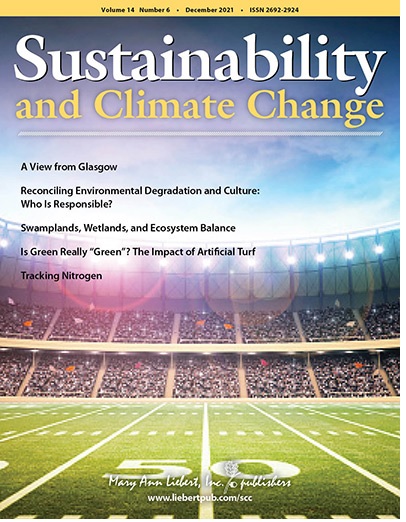
Add another environmental problem to the installation of artificial grass playing fields. Critics of the installation of artificial grass playing fields have long pointed to its many environmental problems. These include carcinogenic compounds in the fill material, foot injuries resulting from the elevated temperatures the grass attains on sunlit days, the migration of fragmented artificial grass blades into the waterways of the world, including the oceans, the concomitant destruction of trees and creatures that live in soil, and the inability to recycle used artificial grass, resulting in large piles of rolled-up toxic artificial grass in woods, by streams, and on private property. The well-known high temperatures that sunlit artificial grass can attain has been suggested as a possible additional source of global warming, but now a study published as the cover article in the December, 2021, issue of Sustainability and Climate Change by Leslie M. Golden of the Center for Computational Astrophysics in Oak Park, Illinois, has shown that those forever-green artificial turf fields do in fact contribute to global warming. Golden has quantified the contribution in a rigorous mathematical treatment.
Ever since AstroTurf was first installed in the 1960s in outdoor playing fields, athletes and coaches have been aware of the heightened temperatures that the material can attain. Routinely, youth football and soccer teams practice early in summer mornings to avoid the heated surfaces. Some colleges and universities spray water on the surfaces to reduce the heating. Studies at the University of Nevada, Las Vegas, Brigham Young University in Provo, Utah, and Penn State University in University Park, Pennsylvania, and have shown that the temperatures attained by artificial grass can exceed that attained by natural grass at the same time by as much as 80 oF, well-known to student-athletes who practice on such fields during the summer. The question that Golden sought to answer involved the magnitude of any resultant deposition of energy into the atmosphere.
Golden examined the radiation emanating from surfaces of different temperatures and whether that radiation was transmitted through the atmosphere or was absorbed by carbon dioxide and water vapor in the atmosphere, capturing it and increasing the temperature of the atmosphere. He found that although the increasing temperatures attained by artificial grass compared to natural grass under the same meteorological conditions led to both an increase in the transmission of radiation through the atmosphere and an increase in the absorption of radiation by the atmosphere, the net effect was an increase in absorption. Taking typical sizes of artificial turf playing fields, and multiplying the effect of each by the approximately 13,000 playing fields that exist in the U.S., Golden found that an energy equivalent to that of about twenty moderately-sized nuclear power plants is deposited into the atmosphere. With artificial turf playing fields in Europe and other areas, and with 1200 to 1500 artificial turf playing fields being installed annually in the U.S. alone, the effect is only increasing.
The major cause of global warming remains an indirect one, the deposition of greenhouse gases into the atmosphere. The direct deposition of energy into the atmosphere by urban heat islands is a much smaller effect, and the contribution of artificial turf playing fields to urban heat islands is a small part of that. Yet, as Golden points out, the contribution of artificial turf playing fields to global warming is yet another such contribution, and is another environmental problem with the artificial material.
Artificial turf has become popular in water-parched regions of the U.S. to replace natural grass. Yet, the greatest amount of acreage is installed by governments, namely park districts and school districts. Golden does not hesitate to fault government. “While governments decry the social and economic effects of global warming, they are exacerbating the effect by their rush to install artificial turf playing fields. Only government can battle global warming, but by their actual actions they show that they are in effect no less than hell-bent in making it worse,” he said. He calls for elected park district and school boards to become environmentally progressive, and not approve administrators wish list plans to replace natural grass with artificial grass for their playing fields. As an alternative to artificial grass for landscaping in drought-stricken areas, Golden suggests traditional rock gardens, natural low-water use flora such as cactuses and succulents, and drought-resistant grasses, the most drought-resistant being buffalo grass.
Those concerned with climate change routinely ignore the result of replacing natural grass with artificial turf as part of the urban heat island. Although this is understandable, its contribution being much smaller than the contribution of greenhouse gases created by fossil fuels, Golden points out that those plastic grass blades and infill and matting material must also be considered in the context of its life cycle. This includes not only the immediate effects of installation but also the complete life cycle effects, from its manufacture to its disposal.
Golden’s paper concludes with a plea to mankind and governments at all levels. “We have only one Earth. It is our responsibility, for ourselves, our future generations, and indeed for all the fauna and flora that inhabit the Earth that we attain a state of sustainability.”