AuthorsDen.com   Join | Login    
Where Authors and Readers come together!

SIGNED BOOKS    AUTHORS    BOOKS    SAMPLE CHAPTERS    AUDIOBOOKS    eBOOKS    STORIES    ARTICLES    POETRY    BLOGS    NEWS    VIDEOS    SUCCESS    TESTIMONIALS

Featured Authors:  Judy Joy Jones, iMORGAN ST. JAMES, iCheri Clifton, iFrank Ryan, iAnita Shaw, iGlen Schulz, iJeff Ovall, iCynth'ya Reed, iEmmanuel Laroche, iJeff Mason, i

  Home > Essays > Articles Popular: Books, Stories, Articles, Poetry      Authors: A B C D E F G H I J K L M N O P Q R S T U V W X Y Z     

Eddie Thompson

 Follow Me  

· Contact Me
· Books
· Articles
· Poetry
· News
· Stories
· Blog
· Messages
· 128 Titles
· 720 Reviews
· Save to My Library
· Share with Friends!
·
Member Since: Oct, 2003

Eddie Thompson, click here to update your pages on AuthorsDen.


Harry Potter: The Sorcerer Scorned
by Eddie Thompson   
Not "rated" by the Author.
     
Recent articles by
Eddie Thompson

• The Argument Against Gay Marriages
• Hurricane Gustav
• Does Evolution Explain Origins?
• Lifestyles of the Spiritually Myopic
• Praying For America
           >> View all

Should content be a factor in what Christian parents allow their children to read? Or does the fact they are reading trump all other considerations? This article addresses the claim that our children are intelligent enough to separate the harmful influences of what they read.

The intelligence of our parents, not our children, is at issue.  Children, by nature, are lumps of clay that are molded though the years of their lives by parents, teachers, events, experiences, and, believe it or not, instruction.  I won=t take the time to offer my debate concerning the causes of the downward spiraling of morality and religious conviction among children being raised in "Christian" homes.  We keep trying to convince ourselves that we as a Christian people are unharmed by the acceptance of books, toys, and ideals that contradict the guidelines given to us in the pages of the Bible.  Anyone who doesn=t believe that images placed within a young child=s mind can move that child in a certain direction does not understand why multi-national corporations pour millions of dollars into advertising.  Neither will they understand the argument that exposure to images of witchcraft, like those found in the Harry Potter books, is detrimental to the battle Christian parents face to instill Christian values in their children.


The suggestion is that parents need to read Harry Potter for themselves to see if it is harmful or not.  That argument is flawed.  It assumes that the lessons of the Bible can=t be trusted at face value.  From experience, Christians have learned through the ages that it is not necessary to try every sin before we can take for granted that the wages of sin is death.  If the Bible tells me that something is not good for me, I do not feel the need to participate in that thing to prove to myself that the Bible is right.


The Bible says that God is provoked to anger by a people who use enchantments, witchcraft, and familiar spirits.  (2 Chronicles 33:8)  Just because witchcraft is gift-wrapped in a presentable package that seems harmless enough to the casual reader doesn=t mean children should open the package and experience the taste for abomination that is sprinkled either subtly or not-so-subtly throughout the book.  Poison, hidden in a tasty meal has been the death of many a pesky rat.  Christian parents should not be fooled by the hue and cry of Harry Potter=s apologists to allow their children to partake of poison no matter how scrumptious the feast appears.  The Bible tells us witchcraft is an abomination.  That may not settle it for many, but Christian parents need nothing more to formulate an opinion on anything that promotes witchcraft.  The Harry Potter books present witchcraft in a favorable, harmless light that legitimizes such activity in the minds of children.


We are not compelled to continue the downward spiral into moral oblivion simply because we always have.   Compromise has corrupted what is acceptable now to many families who are unaware of spiritual deception.  Who can really gauge the damage done to the faith of Christians in each generation that was exposed to ungodly influences?  My contention is that we are not alright for all of our "experiences".  The very simple lesson we learned in Sunday School demonstrates perfectly the way we should respond to our generation=s influences--whether they be toys, books, television programs, or experiences.  Be careful little eyes what you see.  Be careful little ears what you hear.  Be careful little feet where you go.  And yes, I believe it is good advice for us all:  be careful, little children, what you read.


Want to review or comment on this article?


Need a FREE Reader Membership?
Reviewed by Gordon McCann (Reader)
Reviewed on February 21, 2007
I stumbled upon your article about our lack of visionary leadership ("Gallup Generation"... well written!) and read on to this piece on Harry Potter. You articulate your position well but I'm wondering (without trying to bate you) how you reconcile this with your appreciation for C.S. Lewis? The Chronicles of Narnia (particularly 'The Magicians Nephew') have a similar measure/type of magic woven throughout the story line. While I'm not attmepting to be prophetic, there was once a day when Mr. Lewis was consistently maligned by conservative Christianity... only later emerging as something of an evangelical patron saint.

Reviewed by Eddie Thompson
Reviewed on February 7, 2004
My response to aneeta sundararaj:

In response to your comments about the article, I guess I would ask this question: Are parents responsible for the environment in which they raise their children? If so, there are going to be limits. Regardless of the parent's views, there will be limits to what is deemed acceptable to that parent. It would be abusive to subject a child to pornography, literature from race-hating organizations, and various other available literature. I only say that to establish that there are limits.

I do not question the critical acclaim of Potter. It is a well-written, enormously successful piece of work. But if a Christian parent comes to the conclusion that it is inappropriate to his belief system, that parent should not allow for its reading anyway simply because it is an exceptionally crafted work.

Of course, I do not advocate banning Potter or any other book. And I do not spend much energy explaining to children what parents need to hear. Simply put, I am bound by my belief system. Although it's an excellent novel full of fun and adventure, Potter also contains subject matter offensive to that belief system. Why in the world would I subject my children's malleable faith to something I consider offensive to my own? Fun and adventure can be found in many books, and they run a distant second to faith in my book.

I certainly appreciate your comments. They are well thought-out and very well presented. I even agree with much of it. Thank you, once again.

Reviewed by aneeta sundararaj
Reviewed on February 7, 2004
I remember a time when I was a child and was told not to read a book by Bhagwan Shri Rajnish's former bodyguard. It was supposed to contain explicit information. If people had said nothing and left it to me, I don't think I would have bothered to read it. However, because 'adults' said 'Don't read this, it's not for children!', I wanted to read it more. When I did read the book, there was nothing in it that was really so bad after all. I was old enough (about ten) to assess whether it was good or bad. After reading it, I was amazed at how much energy was spent preventing me from reading the book. Surely if a child is taught to see the beauty in the manner in which J K Rowling writes, would that not be better than concentrating only on the witchcraft aspect of the book - there is the scenary, the game of Quidditch, Hogwarts and even the game of chess, the history of Paddington station and so on!! There's more to Harry Potter than just witchcraft.

Reviewed by Ian Thorpe
Reviewed on January 18, 2004
The Holocaust, The Spanish Inquisition, The Persecution of the Hugenots, The slaughter of the Cathar's, The Seventeenths Century Witch hunts. All inspired by The Bible. Seems to me Harry Potter has a long way to go. I have no argument with freedom of religion, but in a non fiction article a little respect for facts would be very helpful to many readers. And if you want dangerous fiction, forget JK Rowling and listen to the likes of Falwell, Robertson, Buchanan and Graham.
From an untenable position you present your case well but your argument will only reach the audience who are already convinced.

Reviewed on January 16, 2004
Me too! There's just too much junk that kids read nowadays, stuff I wouldn't have read when I was little! I am glad I was little back then and NOT now! Good write, Eddie!

Reviewed by Elaine Carey
Reviewed on January 16, 2004
I agree completely!

Popular Essays Articles
  1.  Where Have All the Authors Gone?
  2.  The Advent of ALICE 1.0 Advanced Logis
  3.  War and the Earth we need to live on.
  4.  An Era of Stupidity and the Challenge
  5.  Down with Group Chat
  6.  Critical Race Theory & the 1619 Projec
  7.  Needed: A Progressive Grand Strategy t
  8.  Less Words, More Results
  9.  Takeaways from Adam Smith's The Wealth
  10.  Mr. Trump, have you no sense of decenc
  11.  The Crisis of Opioid, Fentanyl, Cocain
  12.  Verifying Ones Self
  13.  Where, oh where, has my Porsche dream
  14.  Critical Race Theory
  15.  Just a Kid
  16.  Super Spreaders Disguised as Congressm
  17.  Daylight Saving: Stop Legislating the
  18.  Are You Writing for Me?
  19.  The Compassion of Christ
  20.  Why Excessive Inequality Matters
  21.  Bone-headed Supreme Court Decisions
  22.  Rhode Read: RI’s Tobacco-Based Wealth
  23.  Genghis Khan Rides Again!
  24.  The Cozy Mystery: Death by a Thousand
  25.  American Fascism and the Bush Administ

Free Book Review Program
Select a book to read and review today!

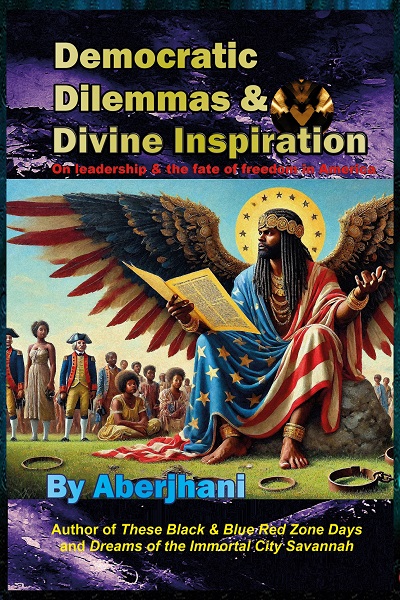
Democratic Dilemmas and Divine Inspiration (A Kindle Short) by Aberjhani

Democratic Dilemmas and Divine Inspiration examines the significance or relevance of the idea that the U.S. Constitution was, as many believe, divinely inspired. How much did that belief matter to founders of the nation and how much does it matter no  
Member BookAds

RAM: Random Articles and Manuscripts by Jay Dubya

RAM: Random Articles and Manuscripts, a non-fiction collection of 38 stories and essays, is author Jay Dubya's 32nd book.  
Member BookAds

Democratic Dilemmas and Divine Inspiration (A Kindle Short) by Aberjhani

Democratic Dilemmas and Divine Inspiration examines the significance or relevance of the idea that the U.S. Constitution was, as many believe, divinely inspired. How much did that belief matter to founders of the nation and how much does it matter no  
Member BookAds